4.06 The MD&A does not say how much of the revenue increase came from price and how much from volume
Company H · a US-listed aerospace services company · SEC-style question
In brief
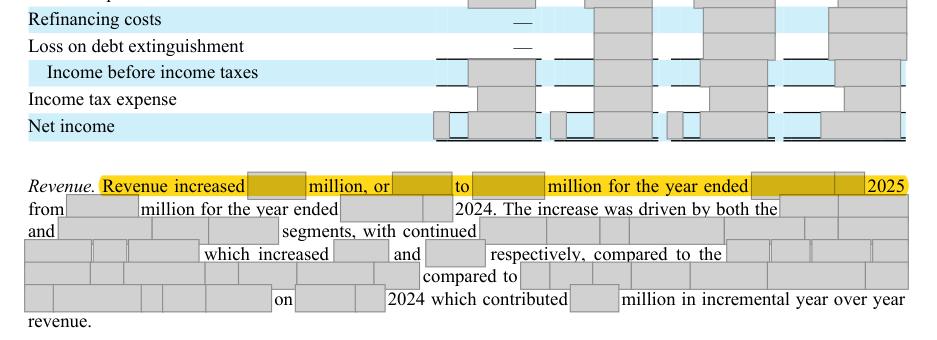
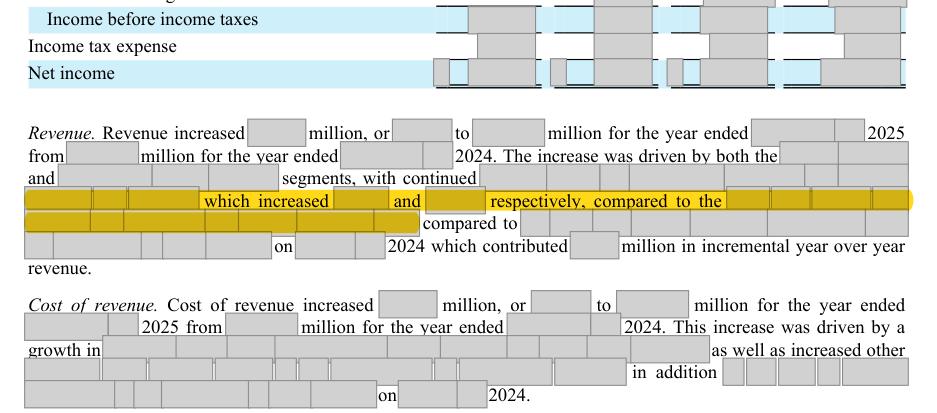
Revenue rose [amount], or [n]%, in fiscal 2025. The MD&A explains the rise by end market (commercial aerospace up [n]%, business aviation up [n]%, military and helicopter up [n]%) and by ramping volumes on new engine programs, and quantifies only the acquisition's [amount]. [segment] margins are said to reflect 'volume and price growth', but no part of the revenue increase is attributed to price. Item 303(b)(2)(iii) asks for the extent to which a material revenue increase comes from price, volume or new services.
The evidence, as filed
What the filing shows, and what the rule requires
| What the filing shows | What the rule requires |
|---|---|
Revenue increase of [amount] ([n]%) explained by end-market growth percentages, program volume ramp-ups and an acquisition contribution of [amount]; price is mentioned only as a margin driver in [segment], with no amount. | A statement of the extent to which the increase reflects price changes, volume (including the new [engine program], [engine program] and [engine program] programs) and the acquisition, quantified where reasonably measurable, or a statement that the price effect was not significant. |
The rule
Regulation S-K Item 303(b)(2)(iii)
If the statement of comprehensive income presents material changes from period to period in net sales or revenue, if applicable, describe the extent to which such changes are attributable to changes in prices or to changes in the volume or amount of goods or services being sold or to the introduction of new products or services.
Version: Text in force at the date of this review · Source: 17 CFR 229.303(b)(2)(iii) (Regulation S-K Item 303), as amended by Release 33-10890
Why it applies here. the narrative implies both volume and price contributed, and the business has pass-through pricing and inflation recovery, so the price element is likely measurable at least in part; Item 303(b)(2)(iii) asks for the extent of each, and the staff routinely asks for quantification when several drivers are named. Because the rule asks the registrant to 'describe the extent', a qualitative explanation may satisfy it where the split cannot be measured, so this is put as a question.
Why it matters
Investors cannot tell whether growth is driven by throughput on new programs or by pricing, which matters for its durability; this is among the most frequent MD&A comment themes.
How often the SEC staff raises this. In 1,100 SEC staff comment letters on fiscal 2023 and 2024 Forms 10-K, released January 2025 to October 2026, MD&A results of operations drew 239 of the 1,774 numbered comments (13.5%): the third most frequent topic.
Exposure
None while the point is a question; the usual outcome of a staff comment on this theme is a future-filings undertaking.
Our workings
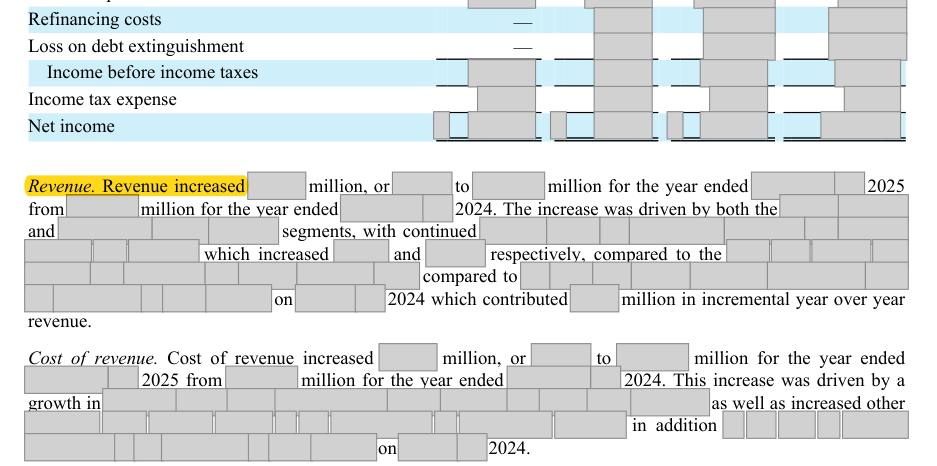
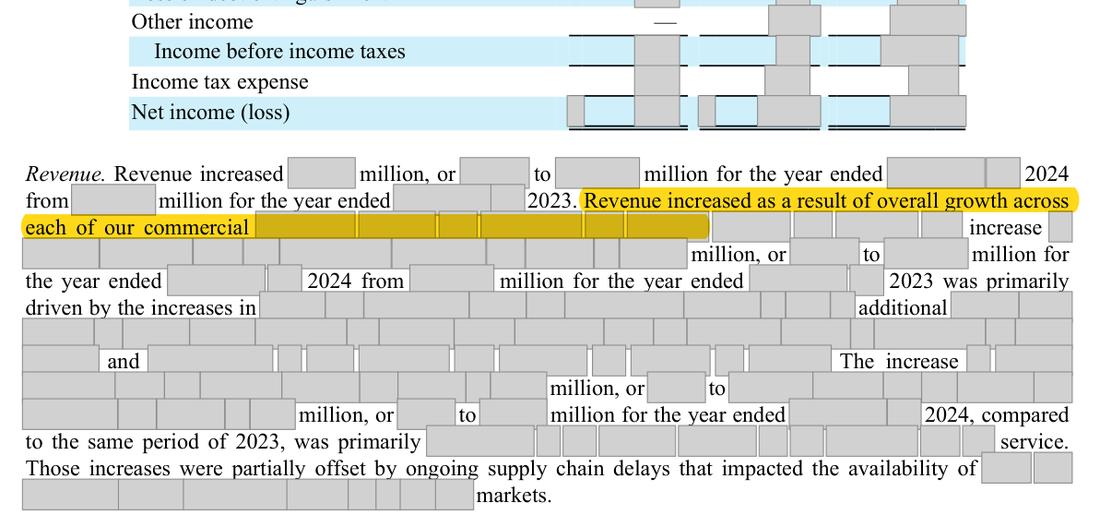
the consolidated revenue paragraph gives the [amount] increase, end-market growth rates and the [amount] acquisition contribution; the [segment] paragraph attributes that segment's increase to commercial aerospace [wording masked]'; the [segment] paragraph says the margin rise was 'driven by volume and price growth'; the trends section says tariff-related cost increases are expected to be passed through to customers where possible. No passage states how much of revenue growth came from price.
none; the test is whether a required attribution is given.
Management’s best defense, and our reply
Management may say that repair and overhaul work is priced job by job, with work scope varying by engine, so a clean price and volume split is not reasonably measurable, and that the narrative of program ramp-ups and end-market growth already tells investors the increase is predominantly volume-driven. It may add that Item 303(b)(2)(iii) asks the registrant only to describe the extent, which the report does qualitatively. That reading is tenable, hence a question; however, the same MD&A cites 'price growth' as a margin driver and refers to passing cost increases through to customers, which suggests the price element is tracked, and the staff commonly asks for the split when several drivers are named.
The fix
- Add to the revenue paragraph, for example: 'Of the [amount] increase, approximately $[x] million reflected higher volumes, including the ramp-up of the [engine program], [engine program] and [engine program] programs, $[y] million reflected pricing, and [amount] the acquisition of [acquired business].'
Question for the company
Can management say how much of the fiscal 2025 revenue increase of [amount] came from price (including contractual escalation and cost pass-through), how much from volume on existing and newly ramped programs, and how much from the acquisition, or explain why the price effect cannot be measured?
Evidence relied on
| # | What it shows | Type | Where |
|---|---|---|---|
| 1 | the revenue increase is material | Document | Form 10-K 2025, page 59 |
| 2 | drivers given as end-market growth rates, not as price and volume | Document | Form 10-K 2025, page 59 |
| 3 | the acquisition is the only driver quantified in dollars | Document | Form 10-K 2025, page 59 |
| 4 | [segment] growth attributed to volume ramp-ups, no amount | Document | Form 10-K 2025, page 61 |
| 5 | price growth is acknowledged, but only as a margin driver and without an amount | Document | Form 10-K 2025, page 61 |
Absence check
- Document
- Form 10-K 2025
- Where it would appear
- Revenue. Revenue increased
- What is missing
- the extent to which the revenue increase is attributable to price changes as against volume or new services
- Pages looked at
- p.53-63 (MD&A overview, trends, results and segment results)
- Result
- 'pricing' hits Item 1 and risk factors (p.7, 14-16, [n]), the MD&A trends paragraph on tariff pricing actions (p.54, no amount), the revenue-recognition estimate, Item 7A inflation and share-award valuation notes - none attributes revenue growth to price; 'price increase' hits risk factors and Item 7A, general statements only; 'volume and price' and 'price growth' hit only p.61, the unquantified [segment] margin driver.
Prepared by Pramanex from the company’s public SEC filings, without the company’s involvement, to show how a 10-K Pre-filing Check reads. The company is not named, and nothing on this page is a statement about any identifiable company. Observations are not an audit, review or other attestation or assurance engagement, and not legal advice. An SEC-style question is a question, not a conclusion.
Want this on your own 10-K, before you file?
Start with three free findings on your latest 10-K, or book a fixed-price 10-K Pre-filing Check.
Your next 10-K will be in draft before the audit is done.
Have it read before you file.
Start with three free findings on your latest 10-K, or book a fixed-price 10-K check. Drafts only under NDA, inside your insider trading policy.