3.01 Related parties: amounts expensed and paid to [related-party adviser] in 2025 do not reconcile to the balance due on the balance sheet
Company H · a US-listed aerospace services company · SEC-style question
In brief
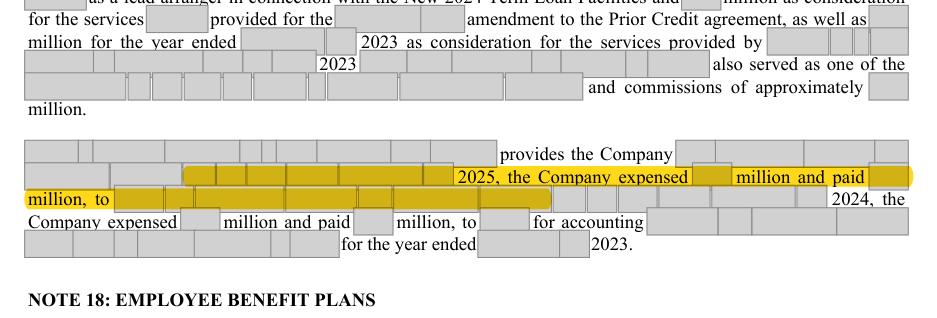
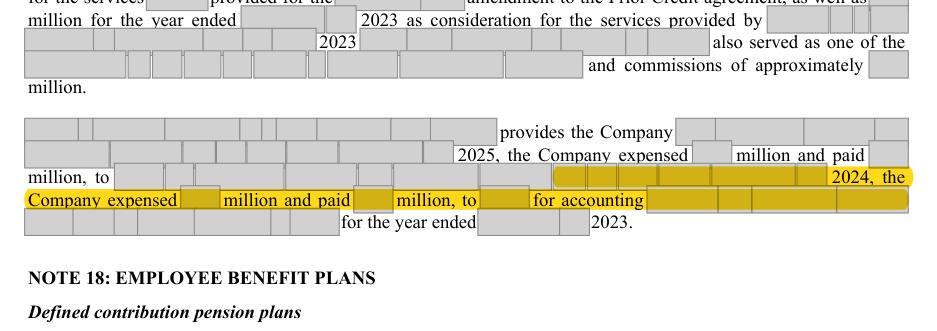
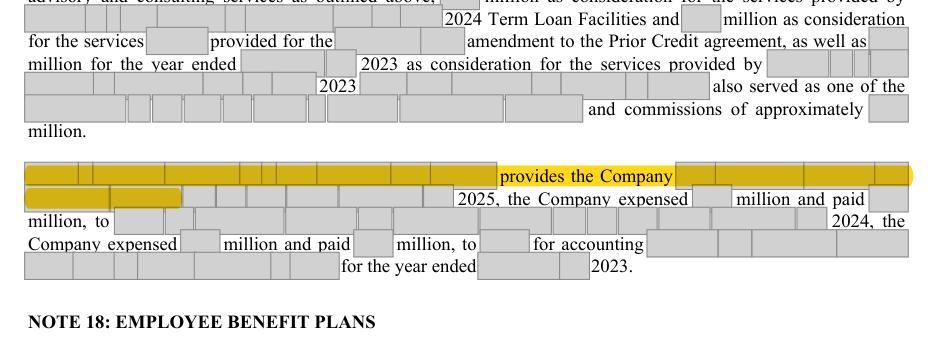
Note 17 says the company expensed [amount] and paid [amount] to [related-party adviser], a [sponsor]-affiliated adviser, in 2024, and expensed [amount] and paid [amount] in 2025. The 2024 figures come close to the [n] due to related parties at [date]. Carried forward, the 2025 figures give a balance of about [n], but the balance sheet shows [n]. Either more was paid in 2025 than the note says or the balance includes other items.
The evidence, as filed
What the filing shows, and what the rule requires
| What the filing shows | What the rule requires |
|---|---|
[related-party adviser] 2025: expensed [amount], paid [amount] (same paid figure as 2024). Due to related parties: [n] (2024) to [n] (2025); cash flow movement ([n]). | Amounts paid to [related-party adviser] in 2025 that agree with the movement in the balance due (on the balance sheet figures about [amount]), or an explanation of what else the balance contains. |
| What we checked. Note 17 ([sponsor], [related party] and [related-party adviser] arrangements), balance sheet, cash flow statement, segment-note reconciling items; the prior-year Form 10-K. | |
The rule
Regulation S-X Rule 4-08(k)(1)
Related party transactions that affect the financial statements. (1) Amounts of related party transactions should be stated on the face of the balance sheet, statement of comprehensive income, or statement of cash flows.
Version: Text in force at the date of this review · Source: 17 CFR 210.4-08(k) (Regulation S-X Rule 4-08), eCFR text as at the law pack date
Why it applies here. the repeated 'paid [amount]' in 2025 may be a copy of the 2024 figure; the related-party note must give amounts due at each balance sheet date and the transactions that produced them.
Why it matters
A related-party note whose payments do not agree with the balance due undermines the reliability of a disclosure that investors read closely while the sponsor still controls a large stake.
How often the SEC staff raises this. In 1,100 SEC staff comment letters on fiscal 2023 and 2024 Forms 10-K, released January 2025 to October 2026, related parties drew 7 of the 1,774 numbered comments (0.4%): topic 20 of 25 by frequency.
Exposure
A question for management; if the paid figure is a carry-over, the correction is a future-filings matter.
Our workings
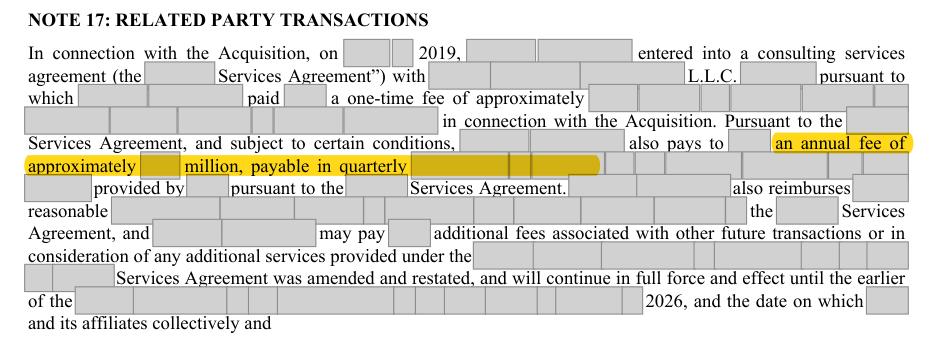
Note 17 states that [related-party adviser], a portfolio company of a [sponsor]-affiliated fund, was expensed [amount] and paid [amount] in 2024, and expensed [amount] and paid [amount] in 2025. The fees to [sponsor] and [related party] are payable quarterly in advance, so they sit in prepayments, not in the balance due. The balance sheet shows due to related parties of [n] at [date] and [n] at [date], and the cash flow statement a movement of ([n]).
2024 expense less payment is [n], close to the [n] balance (which also absorbed a small related-party advance held at the end of 2023); carrying it forward, [n] + [n] - [n] = [n], against [n] reported, a gap of [n]. The payment that would reconcile is [n].
| Step | Arithmetic | Result |
|---|---|---|
| 2024: [related-party adviser] expense less payment | [n] - [n] = [n] | [n] (balance sheet [n]) |
| 2025: expected balance due | [n] + [n] - [n] = [n] | [n] |
| Gap to balance sheet | [n] - [n] = [n] | [n] |
| Difference: reported less expected | [n] - [n] = -[n] | -[n] |
| Payment that would reconcile | [n] + [n] - [n] = [n] | [n] |
| Cash flow movement check | [n] - [n] = ([n]) | ([n]) as reported |
| Gap as share of pre-tax income | [n] / [n] = 0.37% | 0.37% |
| Gap as share of the line | [n] / [n] = 321.2% | 321.2% |
Management’s best defense, and our reply
The company may say that the expense figure includes accruals and invoices of the prior year, that 'paid' means paid for 2025 services only, and that the [n] dollar gap is immaterial against [n] dollars of pre-tax income. It may add that 'Due to related parties' is a single caption covering several arrangements. The answer: on any of these readings the note should let a reader reconcile the balance, because related-party amounts are judged by their nature, not their size; the identical 'paid [amount]' in both years and a balance that falls while expense exceeds payments are what a review would ask about.
The fix
- Correct the 2025 amount paid to [related-party adviser] in Note 17 (or state what else 'Due to related parties' contains) and add the balance due to each related party at each year end.
Question for the company
How much was paid to [related-party adviser] in 2025, and what makes up the [n] due to related parties at [date] given [amount] expensed and [amount] paid?
Evidence relied on
| # | What it shows | Type | Where |
|---|---|---|---|
| 1 | 2025 [related-party adviser] expense and payment | Document | Form 10-K 2025, page 109 |
| 2 | 2024 figures; the paid amount is the same in both years | Document | Form 10-K 2025, page 109 |
| 3 | [related-party adviser] is a related party | Document | Form 10-K 2025, page 109 |
| 4 | The [sponsor] fee is paid in advance, so it does not create a balance due | Document | Form 10-K 2025, page 108 |
| 5 | Balance due at each year end | Document | Form 10-K 2025, page 75 |
| 6 | Cash flow movement agrees with the balance sheet | Document | Form 10-K 2025, page 79 |
| 7 | Pre-tax income for scale | Document | Form 10-K 2025, page 76 |
Prepared by Pramanex from the company’s public SEC filings, without the company’s involvement, to show how a 10-K Pre-filing Check reads. The company is not named, and nothing on this page is a statement about any identifiable company. Observations are not an audit, review or other attestation or assurance engagement, and not legal advice. An SEC-style question is a question, not a conclusion.
Want this on your own 10-K, before you file?
Start with three free findings on your latest 10-K, or book a fixed-price 10-K Pre-filing Check.
Your next 10-K will be in draft before the audit is done.
Have it read before you file.
Start with three free findings on your latest 10-K, or book a fixed-price 10-K check. Drafts only under NDA, inside your insider trading policy.