4.01 Item 7A gives the interest-rate sensitivity for [date] only, with no preceding-year figure or comparison
Company H · a US-listed aerospace services company · Compliance or disclosure gap
In brief
Item 7A says a one percentage point rise in rates would add about [amount] to annual interest cost, measured on borrowings at [date]. It gives no figure for [date] and no discussion of how the exposure moved, although the [amount] swap and the [n]% cap both ended during 2025. Regulation S-K Item 305(a)(3) requires the preceding year's summarized market risk information.
The evidence, as filed
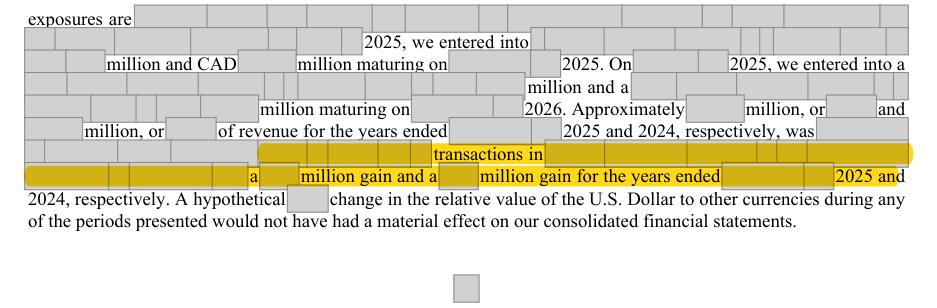
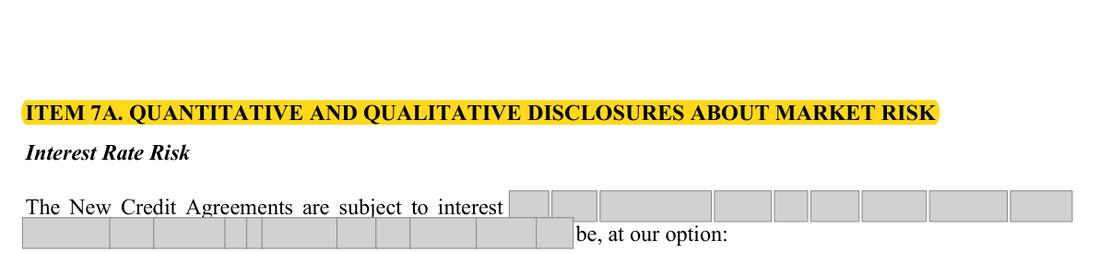
7 further page extracts: screenshot withheld to protect the company’s identity. The rows below say what each shows.
What the filing shows, and what the rule requires
| What the filing shows | What the rule requires |
|---|---|
Interest-rate sensitivity of approximately [amount] at [date] only; no [date] figure and no explanation of the change in hedge cover (swap fixed at [n]% matured [date]; cap at [n]% matured [date]) | The [date] sensitivity shown beside the [date] sensitivity, with a sentence on why the exposure changed (maturity of the swap and the [n]% cap; only the 5.00% cap on [amount] remains) |
| What we checked. Item 7A (interest, inflation and currency risk), the interest-rate risk factor, and the prior-year Item 7A and risk factor | |
The rule
Regulation S-K Item 305(a)(3)
Registrants shall present summarized market risk information for the preceding fiscal year. In addition, registrants shall discuss the reasons for material quantitative changes in market risk exposures between the current and preceding fiscal years.
Version: Text in force at the date of this review · Source: Regulation S-K, 17 CFR 229.305 (Quantitative and qualitative disclosures about market risk), as in the electronic Code of Federal Regulations
Why it applies here. The first duty is unconditional and is not met; the second is engaged because hedge cover changed during the year. The comparative exists: the fiscal 2024 risk factors gave approximately [amount] at [date], so it costs one clause to add.
Why it matters
- Readers cannot see from Item 7A whether the company's rate exposure rose or fell in 2025, the year its swap and first cap ran off.
- Market risk is a routine staff review area; a comment and an undertaking for future filings is the realistic outcome. No fine applies.
Exposure
A staff comment asking for the preceding-year information and an undertaking to add it in future filings; no amendment would be expected for this alone.
Our workings
Item 7A gives one quantitative interest-rate measure, a sensitivity 'based on the amount of outstanding borrowings at [date]' of approximately [amount]. The only other sensitivity in the 10-K, in the risk factors, is again 'As of [date]'. The same Item 7A says the [amount] swap fixed at [n]% matured on [date] and the [n]% cap matured on [date], leaving a cap at 5.00% on [amount] to [date]. The currency-risk paragraph, by contrast, gives both years. Law: Item 305(a)(1) requires quantitative information as of the end of the latest fiscal year in one of three forms (tabular, sensitivity or value at risk); the company uses the sensitivity alternative. Item 305(a)(3) then adds two separate duties: present summarized market risk information for the preceding fiscal year, and discuss the reasons for material quantitative changes between the two years. The first duty is unconditional once (a)(1) applies; the second turns on materiality. The paragraph's relief for the first fiscal year in which Item 305 applies covered the fiscal 2024 report, the company's first Form 10-K, and does not reach fiscal 2025.
the first duty is not met, and the second is engaged because the hedge cover changed during the year. The prior-year 10-K gave no interest-rate sensitivity in Item 7A at all; its risk factor gave approximately [amount] at [date], so the comparative already exists and costs one clause to add.
| Element | [date] (this Form 10-K) | [date] |
|---|---|---|
| One-point interest-rate sensitivity in Item 7A | approximately [amount] | not given |
| Same measure elsewhere in this Form 10-K | risk factor: approximately [amount] | not given |
| Swap, [amount], fixed SOFR [n]% | matured [date] | in place (matures [date]) |
| Cap, SOFR [n]%, [amount] | matured [date] | in place (matures [date]) |
Management’s best defense, and our reply
Management would argue that the exposure did not change in substance: the [date] sensitivity, disclosed in last year's risk factors, was the same approximately [amount], the term loans barely moved, and the swap and cap terms of both years are described in the same paragraph. On that view there is no material quantitative change to discuss and a repeated figure adds nothing. The answer: the first sentence of Item 305(a)(3) is unconditional - only the discussion of changes turns on materiality - and a figure in last year's filing is not presented in this one. Nor is it true that nothing changed: the [amount] swap and the [n]% cap ended during 2025, so the hedge cover at the two year-ends differs, which is exactly the change the second sentence asks to be explained.
The fix
- Add after the sensitivity sentence: 'At [date], the equivalent effect was approximately [amount]. The change in our exposure during 2025 reflects the maturity of our [amount] interest rate swap and our [n]% interest rate cap; at [date] a 5.00% cap on [amount] remains in place.'
Item 7A, interest rate risk, page 68: after the sensitivity sentence
Evidence relied on
| # | What it shows | Type | Where |
|---|---|---|---|
| 1 | The only Item 7A interest-rate sensitivity is measured at [date] | Document | Form 10-K 2025, page 68 |
| 2 | The [amount] swap ended at the year-end | Document | Form 10-K 2025, page 68 |
| 3 | The [n]% cap ended during the year | Document | Form 10-K 2025, page 68 |
| 4 | Only the 5.00% cap remains after the year-end | Document | Form 10-K 2025, page 68 |
| 5 | The risk factor repeats the [date] figure only; no prior-year figure anywhere in the 10-K | Document | Form 10-K 2025, page 39 |
| 6 | The currency-risk paragraph does give both years, showing the comparison is practicable | Document | Form 10-K 2025, page 69 |
| 7 | The [date] figure exists, in the prior-year risk factor | Document | Form 10-K 2024 (prior year), page 38 |
| 8 | At [date] the [n]% cap was still in place | Document | Form 10-K 2024 (prior year), page 67 |
| 9 | the sensitivity is stated on a fully drawn basis | Document | Form 10-K 2025, page 68 |
| 10 | the same sentence says it is based on outstanding borrowings | Document | Form 10-K 2025, page 68 |
| 11 | term loans outstanding at year end | Document | Form 10-K 2025, page 62 |
| 12 | the revolver was undrawn | Document | Form 10-K 2025, page 62 |
Absence check
- Document
- Form 10-K 2025
- Where it would appear
- Interest Rate Risk
- What is missing
- the preceding-year ([date]) interest-rate sensitivity and the reasons for the change in exposure
- Pages looked at
- p.68-69 (Item 7A) and p.39 (interest-rate risk factor)
- Result
- 'hypothetical' hits p.68 (the [date] interest-rate sensitivity) and p.69 (the 10% currency sensitivity); 'percentage point' hits p.39 (risk factor, [date] only), p.45 (the [n] percentage point ownership-change test for tax attributes) and p.68; none gives a [date] interest-rate figure. 'preceding fiscal year' and 'interest rate sensitivity' have no hits.
Prepared by Pramanex from the company’s public SEC filings, without the company’s involvement, to show how a 10-K Pre-filing Check reads. The company is not named, and nothing on this page is a statement about any identifiable company. Observations are not an audit, review or other attestation or assurance engagement, and not legal advice. An SEC-style question is a question, not a conclusion.
Want this on your own 10-K, before you file?
Start with three free findings on your latest 10-K, or book a fixed-price 10-K Pre-filing Check.
Your next 10-K will be in draft before the audit is done.
Have it read before you file.
Start with three free findings on your latest 10-K, or book a fixed-price 10-K check. Drafts only under NDA, inside your insider trading policy.