2.02 Item 9A presents four unremediated material weaknesses as if new, though the prior-year Form 10-K reported all four
Company H · a US-listed aerospace services company · Presentation point
In brief
The fiscal 2025 Form 10-K lists four material weaknesses in internal control over financial reporting (ICFR) at [date]: control environment, monitoring controls, period-end financial reporting and information technology general controls. Under the heading on previously reported material weaknesses it names only the three that were remediated (risk assessment, information and communication, policies and procedures), and Item 1A says the weaknesses were identified in preparing the 2025 statements. The prior-year Form 10-K reported all four of the remaining weaknesses, so they are in at least their second year unremediated, which the report never says.
The evidence, as filed
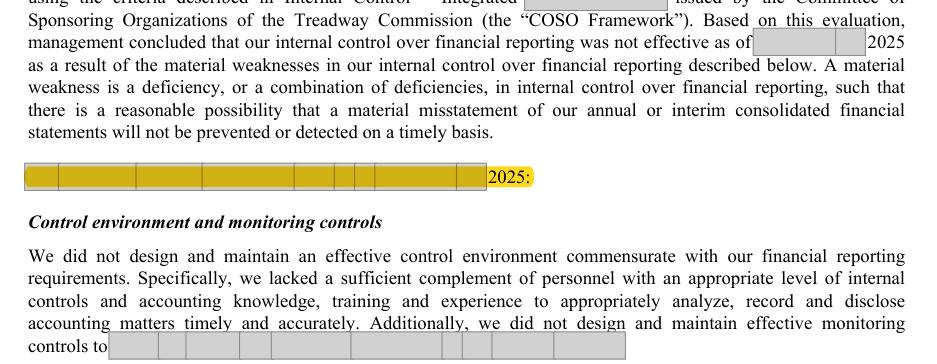
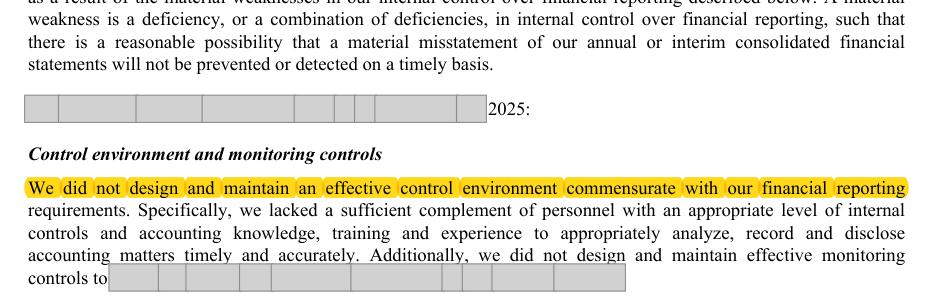
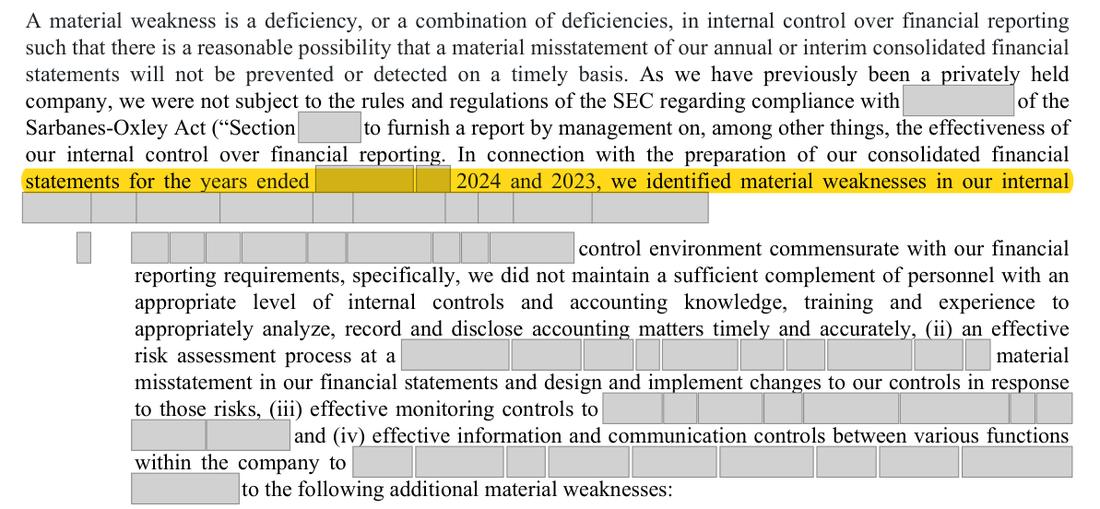
1 further page extract: screenshot withheld to protect the company’s identity. The rows below say what each shows.
What the filing shows, and what the rule requires
| What the filing shows | What the rule requires |
|---|---|
Item 9A: 'As previously disclosed in Item 9A of our Annual Report on Form 10-K for the year ended [date] ... we identified material weaknesses ... related to the risk assessment, information and communication components of the COSO Framework and related to establishing policies and procedures'; then 'The following material weaknesses exist as of [date]': control environment and monitoring, period-end financial reporting, IT general controls. Item 1A: 'In connection with the preparation of our consolidated financial statements for the year ended [date], we identified material weaknesses'. | Item 9A states that the control environment, monitoring, period-end financial reporting and IT general control material weaknesses were first reported in the fiscal 2024 Form 10-K (identified in connection with the 2024 and 2023 statements), remain unremediated a year later, and what remediation has been completed and remains, with the expected timing; Item 1A uses the same history. |
The rule
Regulation S-K Item 308(a)(3)
This discussion must include disclosure of any material weakness in the registrant's internal control over financial reporting identified by management.
Version: Text in force at the date of this review · Source: 17 CFR 229.308 (Regulation S-K Item 308), as amended
Exchange Act Rule 12b-20
there shall be added such further material information, if any, as may be necessary to make the required statements, in the light of the circumstances under which they are made not misleading.
Version: Text in force at the date of this review · Source: 17 CFR 240.12b-20 (Exchange Act Rule 12b-20)
Why it applies here. Of the seven weaknesses reported for 2024 and 2023, three are remediated and four are carried forward unchanged. Read together, Items 9A and 1A tell investors the old weaknesses are fixed and the current ones are new findings of the first ICFR audit. Each 2025 Form 10-Q listed all four as previously reported.
Why it matters
- Investors and the staff cannot see that four material weaknesses have survived a full annual cycle of remediation.
- The staff commonly asks registrants with recurring material weaknesses why remediation has taken more than a year, what is complete and when it will finish; that question is the realistic outcome. No amount changes.
How often the SEC staff raises this. In 1,100 SEC staff comment letters on fiscal 2023 and 2024 Forms 10-K, released January 2025 to October 2026, internal control and disclosure controls drew 55 of the 1,774 numbered comments (3.1%): topic 10 of 25 by frequency.
Exposure
A staff comment asking for the history and timing of remediation of the recurring weaknesses, and a future-filings undertaking; no monetary penalty.
Our workings
the prior-year Form 10-K (Item 9A, Form 10-K 2024 (prior year) p.126) reported material weaknesses identified in connection with the 2024 and 2023 statements: (i) control environment (insufficient complement of personnel), (ii) risk assessment, (iii) monitoring controls, (iv) information and communication, and, as consequences, written policies and procedures, period-end financial reporting and significant account balances, and IT general controls (program change, user access, computer operations).
the fiscal 2025 Item 9A lists as existing at [date] the control environment and monitoring controls weakness, the period-end financial reporting and significant account balances weakness, and the IT general controls weakness, in words that repeat the prior year's.
the paragraph 'Remediation of Previously Reported Material Weaknesses' describes the previously disclosed weaknesses as those related to risk assessment, information and communication and policies and procedures, and reports them remediated.
Item 1A says the weaknesses were identified in connection with the preparation of the 2025 statements.
a matrix of the prior year's seven elements against this year's status (workings): three remediated, four carried forward unchanged.
read together, the two sections tell an investor that the old weaknesses are fixed and the current ones are new findings of the first ICFR audit. In fact four of the seven were already reported and remain open for a second annual cycle; persistence of a material weakness is information the staff routinely asks about (why remediation has taken more than a year and when it will be complete). No requirement is breached outright, because Item 308(a)(3) asks only that each existing material weakness be disclosed, which it is; the defect is the history given around them, so the point is a presentation inconsistency.
| Material weakness reported in the fiscal 2024 Form 10-K (Form 10-K 2024 (prior year) p.126) | Fiscal 2025 Form 10-K position | Described in fiscal 2025 as previously reported? |
|---|---|---|
| Control environment: insufficient complement of personnel | Exists at [date] | No |
| Risk assessment process | Remediated | Yes |
| Monitoring controls | Exists at [date] | No |
| Information and communication controls | Remediated | Yes |
| Written policies and procedures | Remediated | Yes |
| Period-end financial reporting and significant account balances | Exists at [date] | No |
| IT general controls: program change, user access, computer operations | Exists at [date] | No |
Management’s best defense, and our reply
Management would say Item 308(a)(3) requires disclosure of each material weakness existing at year end, and all four are described in full; the history paragraph deliberately covers only the weaknesses that were remediated, and the fiscal 2025 assessment is the first one management and the auditor performed, so the weaknesses were in that sense identified for 2025. The answer: the history paragraph opens with 'As previously disclosed in Item 9A' of the 2024 report and then describes the previously disclosed weaknesses as only the three remediated ones, which is not what that report said; with Item 1A saying the weaknesses were identified for the 2025 statements, the natural reading is that the open weaknesses are new. Rule 12b-20 requires the information needed to keep the required statements from misleading, and the one-sentence history fixes it.
The fix
- In Item 9A add: 'The control environment, monitoring, period-end financial reporting and IT general control material weaknesses described above were first reported in our Form 10-K for 2024 and have not yet been remediated; we expect to complete remediation by [period]', and align Item 1A.
Evidence relied on
| # | What it shows | Type | Where |
|---|---|---|---|
| 1 | Item 9A lists the material weaknesses open at year end | Document | Form 10-K 2025, page 130 |
| 2 | the control environment weakness open at year end, in the prior year's words | Document | Form 10-K 2025, page 130 |
| 3 | the IT general controls weakness open at year end | Document | Form 10-K 2025, page 130 |
| 4 | the history paragraph refers back to the prior-year Item 9A | Document | Form 10-K 2025, page 131 |
| 5 | only the three remediated weaknesses are described as previously reported | Document | Form 10-K 2025, page 131 |
| 6 | Item 1A presents the weaknesses as identified for the 2025 statements | Document | Form 10-K 2025, page 20 |
| 7 | the prior-year Form 10-K reported the weaknesses for 2024 and 2023 | Document | Form 10-K 2024 (prior year), page 126 |
| 8 | control environment weakness already reported in the prior year | Document | Form 10-K 2024 (prior year), page 126 |
| 9 | monitoring controls weakness already reported in the prior year | Document | Form 10-K 2024 (prior year), page 126 |
| 10 | period-end financial reporting weakness already reported in the prior year | Document | Form 10-K 2024 (prior year), page 126 |
| 11 | IT general controls weakness already reported in the prior year | Document | Form 10-K 2024 (prior year), page 126 |
Prepared by Pramanex from the company’s public SEC filings, without the company’s involvement, to show how a 10-K Pre-filing Check reads. The company is not named, and nothing on this page is a statement about any identifiable company. Observations are not an audit, review or other attestation or assurance engagement, and not legal advice. An SEC-style question is a question, not a conclusion.
Want this on your own 10-K, before you file?
Start with three free findings on your latest 10-K, or book a fixed-price 10-K Pre-filing Check.
Your next 10-K will be in draft before the audit is done.
Have it read before you file.
Start with three free findings on your latest 10-K, or book a fixed-price 10-K check. Drafts only under NDA, inside your insider trading policy.