1.14 Revenue: catch-up adjustments on contracts in progress are described but never quantified, and the policy calls them 'prospective'
Company H · a US-listed aerospace services company · SEC-style question
In brief
Revenue on fixed price, time and material and engine utilization contracts is recognized over time on estimated margins and variable consideration that are updated every quarter. US GAAP requires the revenue recognized in the year from performance obligations satisfied (or partly satisfied) in earlier periods to be disclosed. The notes give no such amount in either year, and describe changes in estimates as 'recognized prospectively', while the critical accounting estimates speak of '[wording masked]'. The prior-year Form 10-K used the same policy wording: changes in estimates 'are recognized prospectively' (page 80) and revenue in future periods 'is recognized using the adjusted estimate'.
The evidence, as filed
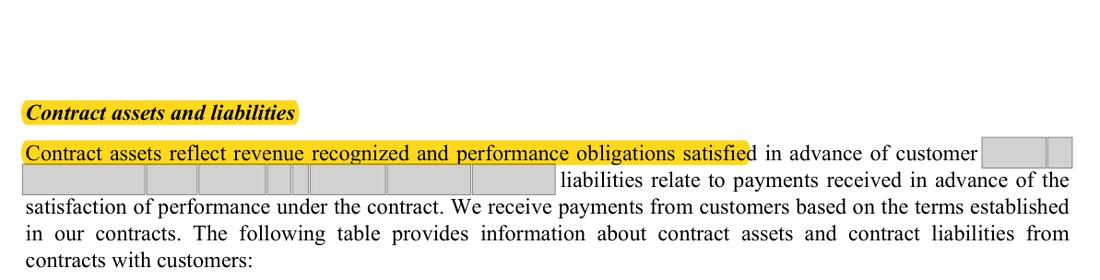
3 further page extracts: screenshot withheld to protect the company’s identity. The rows below say what each shows.
What the filing shows, and what the rule requires
| What the filing shows | What the rule requires |
|---|---|
Note 2: changes in estimates of revenue and cost 'are recognized prospectively'; Item 7: changes '[wording masked]'; Note 3: no amount of revenue from performance obligations satisfied in previous periods, 2025 or 2024. | The revenue recognized in 2025 and 2024 from performance obligations satisfied or partly satisfied in previous periods (net cumulative catch-up), or a statement that it was not material, and one consistent description of how changes in estimates are booked. |
| What we checked. Note 2 revenue policy, Note 3 contract balances and remaining performance obligations, Item 7 critical accounting estimates, auditor's critical audit matter on in-progress contracts; the prior-year Form 10-K. | |
The rule
FASB ASC 606-10-50-8 to 50-10 (contract balances), paraphrase
Summary; FASB/IFRS text is copyrighted Disclose opening and closing receivables, contract assets and contract liabilities, revenue recognized from opening contract liabilities, and explain significant changes in contract balances.
Version: Text in force at the date of this review · Source: FASB Accounting Standards Codification, ASC 606-10-50-8 to 50-12A (ASU 2014-09 as amended), paraphrase
Why it applies here. under a cost-to-cost method a revised margin or transaction price is applied to cumulative progress, so part of the effect falls in the current period for work already done; that part is the amount the contract-balance disclosures ask for. The two descriptions of the method do not read the same, and the auditor names in-progress contract estimates a critical audit matter, so the size of the catch-up is relevant. The requirement to disclose revenue recognized from performance obligations satisfied (or partly satisfied) in previous periods is in ASC 606-10-50-12A, cited here rather than quoted because FASB text is copyrighted. Whether the amount is material is known only to the company.
Why it matters
Investors cannot tell how much of each year's revenue and margin came from re-estimating work done in earlier periods, which matters for a business whose growth rests on long-term engine programs.
How often the SEC staff raises this. In 1,100 SEC staff comment letters on fiscal 2023 and 2024 Forms 10-K, released January 2025 to October 2026, revenue recognition and disclosure drew 68 of the 1,774 numbered comments (3.8%): topic 7 of 25 by frequency.
Exposure
A question for management; if the amount is material, the realistic consequence is a staff comment asking for the amount and a future-filings undertaking.
Our workings
Note 2 says revenue is recognized over time with an input method, using a portfolio estimated margin by engine platform for fixed price and time and material contracts and expected-value estimates of variable consideration for engine utilization contracts, reviewed quarterly, and that changes in estimates 'are recognized prospectively'. Item 7 says material changes [wording masked] adjustments related to revenue previously recognized'. Note 3 gives contract balances and the revenue recognized from opening contract liabilities (approximately [amount]) but no amount for performance obligations satisfied in earlier periods.
| Item | Where | Position |
|---|---|---|
| Policy for changes in estimates | Note 2 | 'recognized prospectively' |
| Description in critical accounting estimates | Item 7 | 'cumulative catch-up adjustments' |
| Revenue from obligations satisfied in previous periods | Note 3 | not given, 2025 or 2024 |
| Revenue from opening contract liabilities | Note 3 | approximately [amount] (given) |
Management’s best defense, and our reply
The company may say that its portfolio margin approach changes the estimated margin only for future cost incurred, so that no adjustment is booked for work done in earlier periods, which is what 'prospectively' means. It may add that any catch-up is immaterial and that materiality applies to every disclosure. The answer: Item 7 itself says changes may produce cumulative catch-up adjustments on revenue previously recognized, and engine utilization contracts re-estimate total variable consideration quarterly; if the amount is immaterial a one-line statement would say so, and the two descriptions of the method should agree.
The fix
- Add to Note 3: 'Revenue recognized during 2025 from performance obligations satisfied (or partially satisfied) in previous periods, primarily from changes in estimated margin and variable consideration, was $X million (2024: $Y million)'; align the Note 2 wording with the cumulative catch-up method.
Question for the company
What revenue was recognized in 2025 and 2024 from performance obligations satisfied or partly satisfied in previous periods (net cumulative catch-up from changes in estimated margin and variable consideration), and which description of the method, 'prospective' or 'cumulative catch-up', is correct?
Evidence relied on
| # | What it shows | Type | Where |
|---|---|---|---|
| 1 | The notes describe changes in estimates as prospective | Document | Form 10-K 2025, page 83 |
| 2 | Estimates change every quarter | Document | Form 10-K 2025, page 84 |
| 3 | Item 7 describes cumulative catch-up adjustments | Document | Form 10-K 2025, page 65 |
| 4 | The contract-balance disclosures are given in part | Document | Form 10-K 2025, page 91 |
| 5 | The auditor treats in-progress contract estimates as a critical audit matter | Document | Form 10-K 2025, page 72 |
| 6 | Prior-year revenue policy uses the same 'recognized prospectively' wording for changes in estimates | Document | Form 10-K 2024 (prior year), page 80 |
| 7 | Prior-year engine utilization policy likewise applies revised estimates only to future periods, with no amount of catch-up adjustments given | Document | Form 10-K 2024 (prior year), unnumbered page |
Absence check
- Document
- Form 10-K 2025
- Where it would appear
- Contract assets and liabilities
- What is missing
- the revenue recognized in the year from performance obligations satisfied or partly satisfied in previous periods
- Pages looked at
- p.64-66, 83-84, 91-92
- Result
- 'catch-up' hits p.65 only (Item 7 says adjustments may arise, with no amount); 'previous periods', 'prior periods', 'satisfied in prior' and 'previous period' have no hits.
Prepared by Pramanex from the company’s public SEC filings, without the company’s involvement, to show how a 10-K Pre-filing Check reads. The company is not named, and nothing on this page is a statement about any identifiable company. Observations are not an audit, review or other attestation or assurance engagement, and not legal advice. An SEC-style question is a question, not a conclusion.
Want this on your own 10-K, before you file?
Start with three free findings on your latest 10-K, or book a fixed-price 10-K Pre-filing Check.
Your next 10-K will be in draft before the audit is done.
Have it read before you file.
Start with three free findings on your latest 10-K, or book a fixed-price 10-K check. Drafts only under NDA, inside your insider trading policy.