1.13 Cash flow hedges: the estimated AOCI amount to be reclassified into earnings within the next 12 months is not given (both years)
Company H · a US-listed aerospace services company · SEC-style question
In brief
At [date] accumulated other comprehensive income (AOCI) holds a hedging loss of [n] on the interest-rate caps and a gain of [n] on the currency forwards, a net loss of [n]. US GAAP hedge disclosures call for the estimated net amount of these balances expected to be reclassified into earnings within the next 12 months. Neither the 2025 nor the 2024 Form 10-K gives that estimate, although both hedge programs mature in [date]. The question is what the estimate is and why it is not stated.
The evidence, as filed
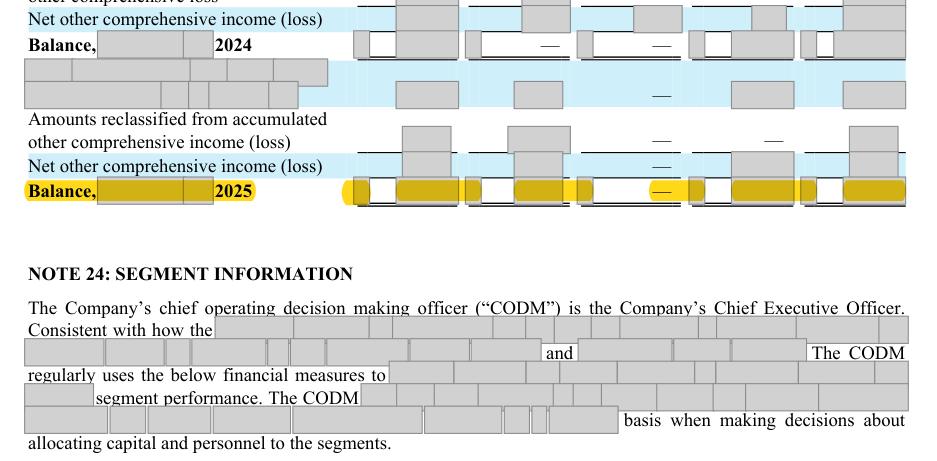
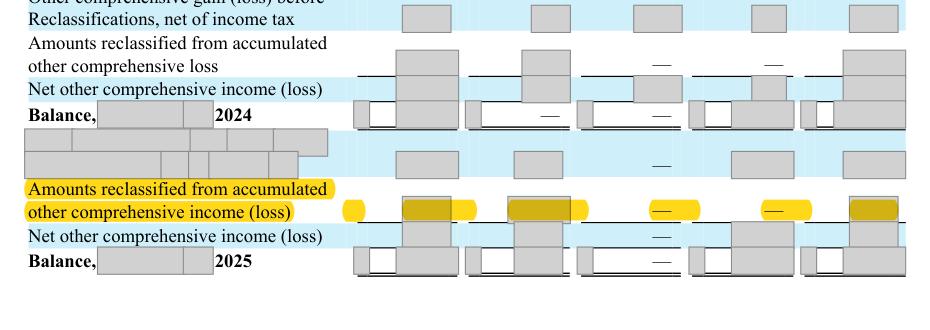
2 further page extracts: screenshot withheld to protect the company’s identity. The rows below say what each shows.
What the filing shows, and what the rule requires
| What the filing shows | What the rule requires |
|---|---|
Note 23 shows the hedge balances in AOCI (interest-rate hedges ([n]); foreign exchange hedge [n]) and Note 21 the instrument terms; no estimate of the amount to be reclassified within 12 months is given in either year. | A sentence giving the estimated net amount of existing hedge gains and losses in AOCI expected to be reclassified into earnings within the next 12 months (on the instrument terms, substantially all of the net loss of [n]), or the reason the company considers it not required. |
| What we checked. Notes 2, 20, 21 and 23, the statement of comprehensive income and Item 7A text on hedges; the whole Form 10-K for the terms searched; the prior-year Form 10-K derivatives note. | |
The rule
FASB ASC 815-10-50-1 and 50-4A (derivative disclosure objectives and tabular gains and losses); the 12-month reclassification estimate for cash flow hedges is at 815-30-50-1
Summary; FASB/IFRS text is copyrighted Disclose why derivatives are used, how they and hedged items are accounted for, and tabular fair values and gains or losses by statement location.
Version: Text in force at the date of this review · Source: FASB Accounting Standards Codification, ASC 815-10-50 and 815-30-50 (as amended by ASU 2017-12), paraphrase
Regulation S-X Rule 4-01(a)(1)
Financial statements filed with the Commission which are not prepared in accordance with generally accepted accounting principles will be presumed to be misleading or inaccurate, despite footnote or other disclosures
Version: Text in force at the date of this review · Source: 17 CFR 210.4-01 (Regulation S-X Rule 4-01), eCFR text as at the law pack date
Why it applies here. on the stated maturities substantially all of this balance will pass through earnings in 2026, which is the figure the cash flow hedge disclosure guidance in the Codification asks the company to estimate; the 2025 reclassification of [n] shows the size of the annual flow. The words 'next 12 months' appear nowhere in the hedging notes in either year. Because the requirement rests on the FASB Codification, whose text is licensed and is only paraphrased here, the point is put as a question rather than as a settled omission.
Why it matters
Readers cannot see how much of the 2026 interest expense and operating costs will carry hedge losses already sitting in equity.
How often the SEC staff raises this. In 1,100 SEC staff comment letters on fiscal 2023 and 2024 Forms 10-K, released January 2025 to October 2026, debt, equity and financial instruments drew 80 of the 1,774 numbered comments (4.5%): topic 6 of 25 by frequency.
Exposure
A question for management; if the estimate is required and material, the realistic consequence is a staff comment and a future-filings undertaking.
Our workings
Note 23 shows interest-rate hedge AOCI of ([n]) and foreign exchange hedge AOCI of [n] at [date]. Note 21 shows the [n] interest-rate cap running to [date] and the 2025 currency forwards maturing on [date]; the policy note says cap amounts are reclassified to interest expense as interest is paid.
the net hedge balance is a loss of [n], 1.07% of pre-tax income.
| Item | Arithmetic | Result |
|---|---|---|
| Net hedge balance in AOCI at [date] | ([n]) + [n] = ([n]) | ([n]) |
| Share of pre-tax income | [n] / [n] = 1.07% | 1.07% |
| Reclassified in 2025 (for scale) | [n] + ([n]) = [n] | [n] |
Management’s best defense, and our reply
The company may say that the maturity dates in Note 21 already tell the reader that the whole balance will be reclassified during 2026. It may add that a net [n] dollar balance is immaterial against [n] dollars of pre-tax income. The answer: the maturity tables do not give the amount, and the interest-rate cap balance reclassifies as premiums and interest settle, not on a single date; the standard asks for the estimate itself, and at 1.07% of pre-tax income the balance is above the level at which an omission can be dismissed as trivial.
The fix
- Add to Note 21: 'As of [date], the Company expects to reclassify approximately $X million of net losses on cash flow hedges from accumulated other comprehensive loss into earnings during the next 12 months.'
Question for the company
What is the estimated net amount of the hedge balances in accumulated other comprehensive income at [date] (a net loss of [n]) expected to be reclassified into earnings within the next 12 months, and why is that estimate not stated in the hedging note in either year?
Evidence relied on
| # | What it shows | Type | Where |
|---|---|---|---|
| 1 | Hedge balances in AOCI at the year end | Document | Form 10-K 2025, page 122 |
| 2 | Size of the 2025 reclassification | Document | Form 10-K 2025, page 122 |
| 3 | The interest-rate cap runs to [date] | Document | Form 10-K 2025, page 120 |
| 4 | The currency hedges mature in [date] | Document | Form 10-K 2025, page 121 |
| 5 | Reclassification pattern described, without the 12-month amount | Document | Form 10-K 2025, page 89 |
| 6 | Pre-tax income for scale | Document | Form 10-K 2025, page 76 |
Absence check
- Document
- Form 10-K 2025
- Where it would appear
- NOTE [n]: DERIVATIVES AND HEDGING
- What is missing
- the estimated net amount of hedge gains and losses in AOCI expected to be reclassified into earnings within the next 12 months
- Pages looked at
- p.77, 86-89, 117-122
- Result
- 'reclassif' hits p.58 (MD&A interest expense description), [n] (statement of comprehensive income line), [n] (policy: reclassified as interest is paid) and [n] (AOCI table of past reclassifications), none an estimate for the next 12 months; 'twelve months' hits p.62-63 (liquidity and covenant text), 86-87 (leases) and [n] (lease maturities); '12 months' hits unnumbered page (cover) and [n] (contract assets); 'expected to be' hits p.66, [n], none on hedges.
Prepared by Pramanex from the company’s public SEC filings, without the company’s involvement, to show how a 10-K Pre-filing Check reads. The company is not named, and nothing on this page is a statement about any identifiable company. Observations are not an audit, review or other attestation or assurance engagement, and not legal advice. An SEC-style question is a question, not a conclusion.
Want this on your own 10-K, before you file?
Start with three free findings on your latest 10-K, or book a fixed-price 10-K Pre-filing Check.
Your next 10-K will be in draft before the audit is done.
Have it read before you file.
Start with three free findings on your latest 10-K, or book a fixed-price 10-K check. Drafts only under NDA, inside your insider trading policy.