1.08 Diluted EPS counts legacy restricted shares whose liquidity-event condition had not been met (both years; [n] shares in 2025)
Company H · a US-listed aerospace services company · SEC-style question
In brief
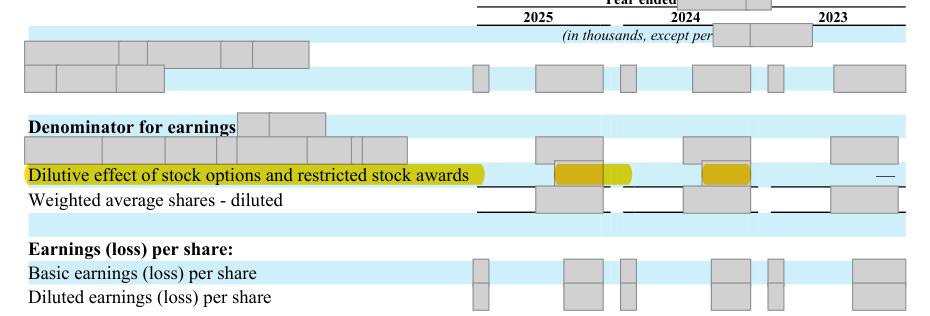
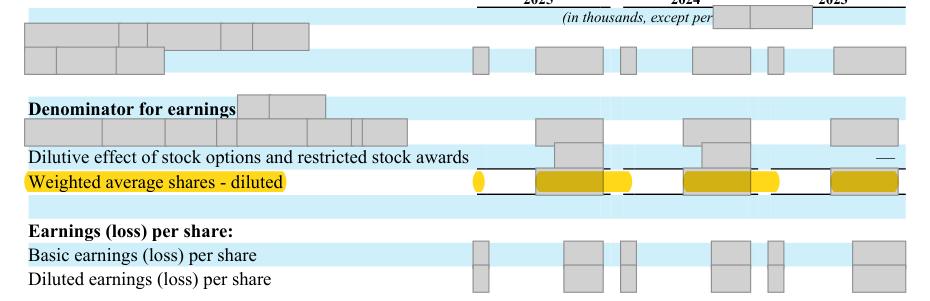
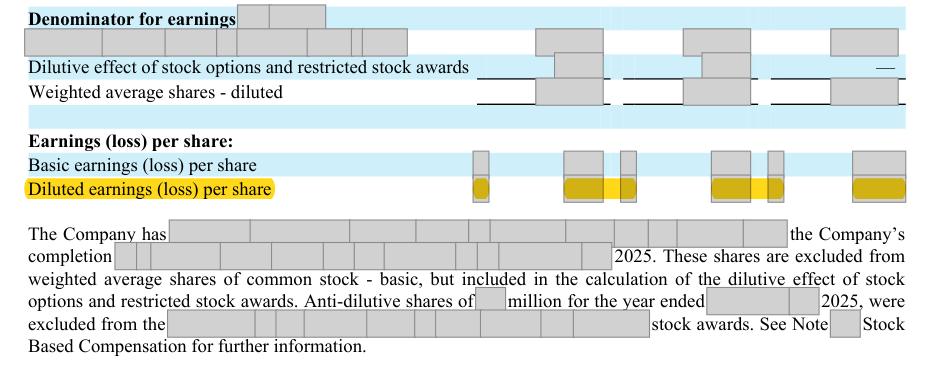
Note 4 says [n] restricted shares are contingently issuable on a liquidity event that had not occurred at [date], yet they are counted in the dilutive effect of [n] shares; the fiscal 2024 Form 10-K said the same of [n] shares at [date] (its own award table shows [n]). US GAAP counts contingently issuable shares in diluted earnings per share (EPS) only if the condition would be met were the period end the end of the contingency period. Without these shares 2025 diluted EPS works out at [n] dollars, which prints as [amount] (equal to basic), not the [amount] reported; in 2024 diluted and basic EPS were both [amount], so the printed figure did not move. The question is what the liquidity event is and why it is treated as met.
The evidence, as filed
1 further page extract: screenshot withheld to protect the company’s identity. The rows below say what each shows.
What the filing shows, and what the rule requires
| What the filing shows | What the rule requires |
|---|---|
2025: diluted EPS [amount] on [n] diluted shares, including the [n] contingently issuable restricted shares whose liquidity event had not occurred at the year end. 2024: the [n] shares described the same way were also included in the dilutive effect (diluted EPS [amount], equal to basic). | Either diluted EPS computed without the contingently issuable shares until the liquidity event occurs (about [amount] for 2025), or a statement of the liquidity-event condition and why it is treated as satisfied at each period end. |
| What we checked. Note 4 computation in both years; face of the statement of operations; Note 19 vesting terms and RSA, option and RSU roll-forwards; the prior-year Form 10-K; both 2026 Forms 10-Q. | |
The rule
FASB ASC 260-10-45-2 and 260-10-50-1 (basic and diluted EPS on the face; reconciliation); contingently issuable shares at 260-10-45-48
Summary; FASB/IFRS text is copyrighted Present basic and diluted EPS on the income statement, apply the two-class method to participating securities, and reconcile numerators and denominators including antidilutive securities.
Version: Text in force at the date of this review · Source: FASB Accounting Standards Codification, ASC 260-10-45 (as amended by ASU 2020-06), paraphrase
Regulation S-X Rule 4-01(a)(1)
Financial statements filed with the Commission which are not prepared in accordance with generally accepted accounting principles will be presumed to be misleading or inaccurate, despite footnote or other disclosures
Version: Text in force at the date of this review · Source: 17 CFR 210.4-01 (Regulation S-X Rule 4-01), eCFR text as at the law pack date
Why it applies here. Removing the shares gives [n] diluted shares and EPS of [amount]. Even if every option and unit outstanding at any time in 2025 were dilutive all year, EPS without the shares would be [amount]; printing [amount] needs more than [n] shares. The one-cent difference rests wholly on these shares, but only management can say whether the liquidity event is a condition that would be met at the period end.
Why it matters
- Diluted EPS is a headline per-share figure, and the same treatment runs through each 2026 quarterly report.
- A staff question asking for the condition and the supporting analysis is the realistic outcome; only if the shares should be excluded would 2025 diluted EPS move, by a single cent.
How often the SEC staff raises this. In 1,100 SEC staff comment letters on fiscal 2023 and 2024 Forms 10-K, released January 2025 to October 2026, debt, equity and financial instruments drew 80 of the 1,774 numbered comments (4.5%): topic 6 of 25 by frequency.
Exposure
A question for management; if the shares should not be counted, the realistic consequence is a staff comment and a future-filings correction of diluted EPS.
Our workings
Note 4 states that [n] shares are issuable on completion of a liquidity event which has not occurred as of [date], and that they are excluded from basic but included in the dilutive effect. Note 19 says the time-based and performance-based restricted stock awards (RSAs) vest only immediately before a liquidity event, that compensation cost began when the [wording masked], and the RSA roll-forward shows [n] nonvested at the year end. The fiscal 2024 Form 10-K made the same statement for [n] shares at [date], again included in the dilutive effect; there basic and diluted EPS were both [amount], so the treatment did not change a printed figure. The prior-year count itself does not agree with the prior-year award records: the EPS note printed [n] shares, while the RSA table of the same Form 10-K, and this year's RSA table, show [n] at [date], so the prior-year note also carried a transposed share count.
removing the RSAs from the [n] diluted shares gives [n] and diluted EPS of [n]. Even if every option and restricted stock unit (RSU) outstanding at any time in 2025 ([n] + [n] options; [n] + [n] RSUs) were fully dilutive for the whole year, diluted shares without the RSAs could not exceed [n], giving [n]; a printed [amount] needs more than [n] shares.
the gap between [amounts] rests wholly on the RSAs. Under the US GAAP guidance on contingently issuable shares, which applies to share awards that vest on a condition, an award that vests on an event is counted only if the event would be met at the period end; the company's own words say it was not. Probability of the event is the test for recognizing compensation cost, not for diluted EPS. The same practice appears in the 2026 quarterly reports, so it recurs each period.
| Step | Arithmetic | Result |
|---|---|---|
| Contingently issuable RSAs in thousands | [n] / [n] = [n] | [n] |
| Diluted shares without the RSAs | [n] - [n] = [n] | [n] |
| Diluted EPS without the RSAs | [n] / [n] = [n] | [n] (prints [amount]) |
| Most options and RSUs outstanding at any time in 2025 | [n] + [n] + [n] + [n] = [n] | [n] |
| Upper-bound diluted shares without RSAs | [n] + [n] = [n] | [n] |
| Upper-bound diluted EPS | [n] / [n] = [n] | [n] (prints [amount]) |
| Shares needed to print [amount] | [n] / [n] = [n] | [n] |
Management’s best defense, and our reply
The company may say the liquidity event became probable at the IPO, that compensation cost has been recognized on that basis since [date], and that counting the shares gives the more conservative (lower) diluted figure. It may also argue that the condition is tied to the share price or to sponsor returns, so that measured at the year-end price it would be met. The answer: probability and conservatism are not the test for contingently issuable shares, and the company itself writes that the event had not occurred; only if the condition is in substance a market-price condition met at the year-end price would inclusion be right, and the Form 10-K does not say so.
The fix
- Define the liquidity event in Note 4 and either exclude the [n] shares from diluted EPS until it occurs, or explain why the condition is treated as met at the period end (for example: 'The liquidity event is ...; because the condition would/would not be satisfied if the reporting date were the end of the contingency period, these shares are included/excluded').
Question for the company
What is the 'liquidity event' on which the [n] restricted shares vest, and on what basis are those shares counted in diluted EPS while the event had not occurred at [date]?
Evidence relied on
| # | What it shows | Type | Where |
|---|---|---|---|
| 1 | Dilutive effect counted in 2025 and 2024 | Document | Form 10-K 2025, page 92 |
| 2 | Diluted share denominator | Document | Form 10-K 2025, page 92 |
| 3 | Diluted EPS reported | Document | Form 10-K 2025, page 92 |
| 4 | Basic EPS: [amount] in 2025 and [amount] in 2024 | Document | Form 10-K 2025, page 92 |
| 5 | The company's own statement that the condition was not met at the year end | Document | Form 10-K 2025, page 92 |
| 6 | The shares are nevertheless in diluted EPS | Document | Form 10-K 2025, page 92 |
| 7 | Basic denominator on the face of the statement of operations | Document | Form 10-K 2025, page 76 |
| 8 | EPS numerator | Document | Form 10-K 2025, page 76 |
| 9 | Vesting depends on the liquidity event | Document | Form 10-K 2025, page 114 |
| 10 | The RSAs were all nonvested at the year end | Document | Form 10-K 2025, page 117 |
| 11 | Same treatment in the prior-year Form 10-K | Document | Form 10-K 2024 (prior year), page 90 |
| 12 | Options outstanding at the start of 2025 (upper bound input) | Document | Form 10-K 2025, page 116 |
| 13 | Options granted in 2025 (upper bound input) | Document | Form 10-K 2025, page 116 |
| 14 | RSUs outstanding at the start of 2025 (upper bound input) | Document | Form 10-K 2025, page 116 |
| 15 | RSUs granted in 2025 (upper bound input) | Document | Form 10-K 2025, page 116 |
| 16 | Probability of the event is the compensation-cost test, not the EPS test | Document | Form 10-K 2025, page 114 |
| 17 | Fiscal 2024: the shares were also in the dilutive effect | Document | Form 10-K 2024 (prior year), page 90 |
| 18 | Number of contingently issuable shares | Document | Form 10-K 2025, page 92 |
| 19 | The event has not occurred, yet the shares are in the dilutive effect | Document | Form 10-K 2025, page 92 |
| 20 | The 2025 dilutive effect of [n] shares is almost entirely these shares | Document | Form 10-K 2025, page 92 |
| 21 | Diluted earnings per share as reported | Document | Form 10-K 2025, page 92 |
| 22 | Probability of the event is the compensation-cost test, not the earnings-per-share test | Document | Form 10-K 2025, page 114 |
| 23 | Same treatment in the prior-year Form 10-K | Document | Form 10-K 2024 (prior year), page 90 |
| 24 | Prior-year EPS note count of the liquidity-event shares | Document | Form 10-K 2024 (prior year), page 90 |
| 25 | Prior-year RSA table count of the same shares | Document | Form 10-K 2024 (prior year), page 113 |
| 26 | This year's RSA table confirms [n] at the prior year end | Document | Form 10-K 2025, page 117 |
Prepared by Pramanex from the company’s public SEC filings, without the company’s involvement, to show how a 10-K Pre-filing Check reads. The company is not named, and nothing on this page is a statement about any identifiable company. Observations are not an audit, review or other attestation or assurance engagement, and not legal advice. An SEC-style question is a question, not a conclusion.
Want this on your own 10-K, before you file?
Start with three free findings on your latest 10-K, or book a fixed-price 10-K Pre-filing Check.
Your next 10-K will be in draft before the audit is done.
Have it read before you file.
Start with three free findings on your latest 10-K, or book a fixed-price 10-K check. Drafts only under NDA, inside your insider trading policy.