1.07 Remaining performance obligations fell from [amount] to [amount] in one year with no explanation
Company H · a US-listed aerospace services company · SEC-style question
In brief
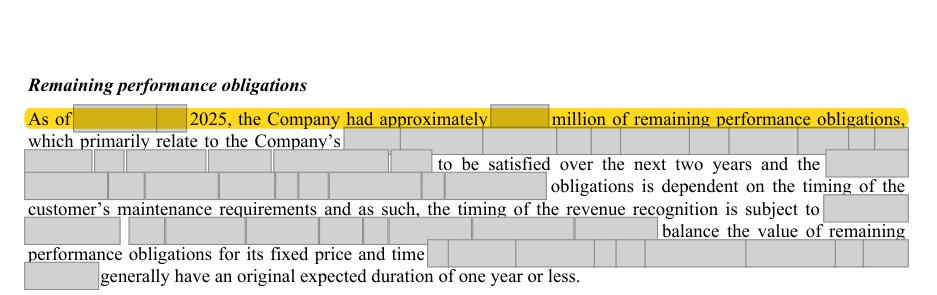
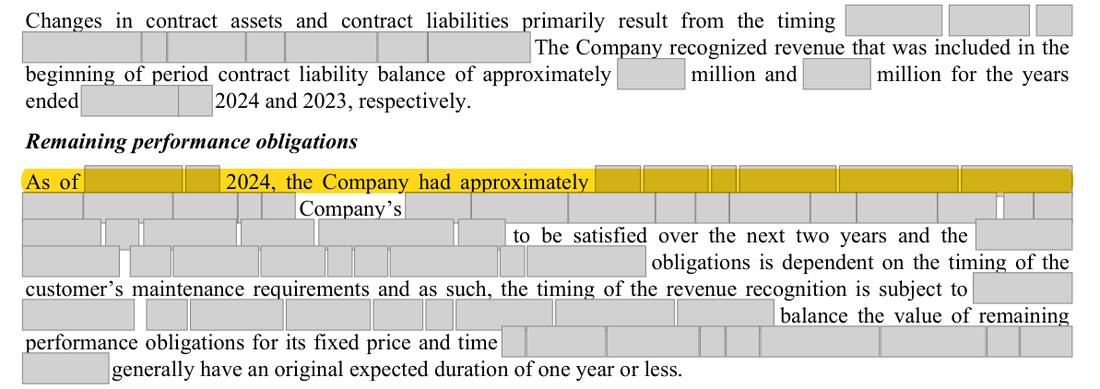
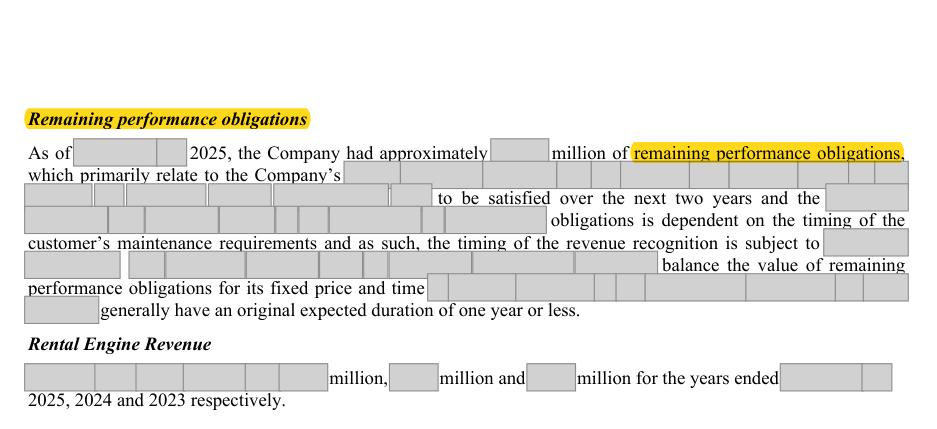
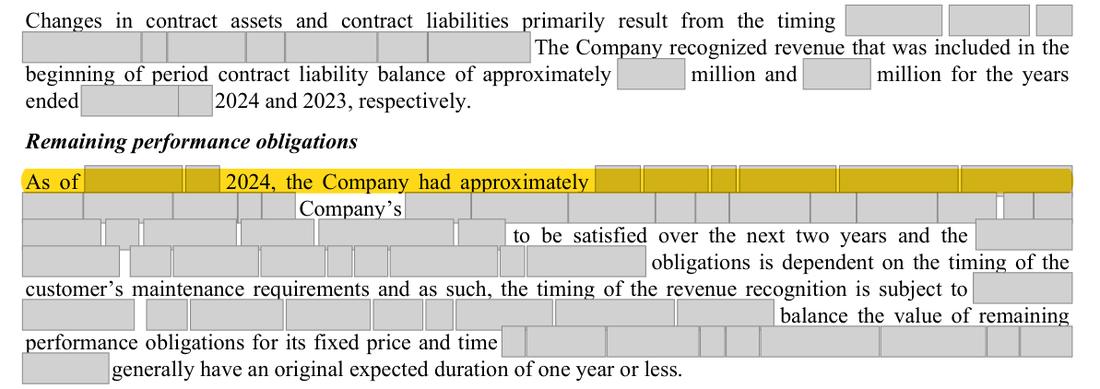
The prior-year Form 10-K reported about [amount] of remaining performance obligations, mostly multi-year engine utilization contracts. This Form 10-K reports [amount], a fall of about 75.5%, and the share expected within two years moved from 30% to [n]%. The quarterly reports show the fall happened in one quarter: [amount] at [date] and [amount] at [date]. Nothing in this Form 10-K says whether contracts ended or were modified, or whether the measurement basis changed.
The evidence, as filed
What the filing shows, and what the rule requires
| What the filing shows | What the rule requires |
|---|---|
Remaining performance obligations: [amount] ([date], prior-year Form 10-K) and [amount] ([date]); no reason for the change given in the note, the MD&A or elsewhere. | A short explanation of the change: contracts terminated, modified or re-scoped (for example with the largest customer), or a change in what is measured (such as variable consideration now excluded under a practical expedient), with the prior-year figure on a comparable basis if the method changed. |
The rule
ASC 606-10-50-13; Regulation S-K Item 303(b)(2)(ii)
ASC 606-10-50-13
Summary; FASB/IFRS text is copyrighted ASC 606-10-50-13 requires the amount allocated to remaining performance obligations and when it is expected to be recognized; it does not itself require the change to be explained. Regulation S-K Item 303(b)(2)(ii) asks MD&A for known trends or events reasonably likely to have a material effect on revenue.
Paragraphs: ASC 606-10-50-13, as codified for the fiscal year under review.
Why it applies here. The fall came in the second quarter of 2025 ([amount]), over the same period in which Customer A's share of revenue fell from [n]% to [n]%. Only management knows whether a contract ended or was re-scoped, or whether variable consideration is now measured differently; if the basis changed, the prior-year figure is not comparable.
Why it matters
- Readers comparing the two [n]-Ks see three quarters of the contracted multi-year book disappear with no reason given.
- If a contract event caused it, it belongs in the known-trends discussion; if the method changed, the prior-year figure was not comparable. A staff question asking which is the realistic outcome.
How often the SEC staff raises this. In 1,100 SEC staff comment letters on fiscal 2023 and 2024 Forms 10-K, released January 2025 to October 2026, revenue recognition and disclosure drew 68 of the 1,774 numbered comments (3.8%): topic 7 of 25 by frequency.
Exposure
A question for management; no penalty is engaged. A staff comment asking for the reason is the realistic outcome if it is left unexplained.
Our workings
the note reports remaining performance obligations of approximately [amount] at [date], primarily engine utilization contracts, with about [n]% expected within two years; the prior-year Form 10-K reported approximately [amount] with about 30% within two years. The Form 10-Q for [date] still reported [amount]; the Form 10-Q for [date] reported [amount], again with no explanation. Over the same period the share of revenue from Customer A fell from [n]% to [n]%.
see workings; the amount expected within two years fell from about [amount] to about [amount], so the fall is not explained by the passage of time alone.
a change of this size in a quarter points to a contract event (termination, modification or renewal on different terms) or to a change in the measurement of variable consideration in the engine utilization contracts. If the prior-year figure was measured on a basis since abandoned, the prior-year disclosure was overstated; if a contract ended, the event is relevant to the known-trends discussion in MD&A. The codification requires the amount and timing of remaining performance obligations but does not itself require an explanation of the change, so this is a question rather than a compliance gap.
| Measure | Computation | Result |
|---|---|---|
| Prior-year amount in USD million | [n] = [n] | [n] |
| Fall in the year (USD million) | [n] - [n] = [n] | [n] |
| Fall as a share of the prior-year amount | [n] / [n] = 75.5% | 75.5% |
| Within two years, prior year (USD million) | [n] x 30% = [n] | [n] |
| Within two years, this year (USD million) | [n] x [n]% = [n] | [n] |
| Fall in the quarter to [date] (USD million) | [n] - [n] = [n] | [n] |
Management’s best defense, and our reply
Management would say that the codification requires only the amount and expected timing of remaining performance obligations, both of which are given, and that the figure is an estimate that depends on customers' flight hours and maintenance timing. They may add that the change reflects ordinary contract renewals or re-estimation of variable consideration, which is commercially sensitive. That defense is reasonable as to compliance, which is why this is put as a question; but a fall of this size in a single quarter, in the only forward-looking contract measure in the notes, is information a reader needs to compare the two years, and the company is best placed to say what caused it.
The fix
- Add one or two sentences to the note, e.g. 'The decrease from [date] reflects [the amendment / expiry of the engine utilization agreement with a significant customer in the second quarter of 2025 / a change to exclude variable consideration ...]', and give the prior-year amount on the current basis if the method changed.
Question for the company
What caused remaining performance obligations to fall from about [amount] at [date] to [amount] at [date] and [amount] at [date]: the end, modification or renewal of one or more engine utilization contracts (and with which customer group), or a change in how remaining performance obligations are measured (for example, excluding variable consideration)? If the measurement basis changed, what would the [date] figure be on the current basis?
Evidence relied on
| # | What it shows | Type | Where |
|---|---|---|---|
| 1 | Remaining performance obligations at [date] | Document | Form 10-K 2025, page 92 |
| 2 | Timing this year: [n]% within two years | Document | Form 10-K 2025, page 92 |
| 3 | Prior-year Form 10-K: [amount] at [date] | Document | Form 10-K 2024 (prior year), page 89 |
| 4 | Timing prior year: 30% within two years | Document | Form 10-K 2024 (prior year), page 89 |
| 5 | Form 10-Q for [date] (EDGAR): still [amount] | Document | |
| 6 | Form 10-Q for [date] (EDGAR): [amount], the fall occurred in that quarter | Document | |
| 7 | Largest customer's share of revenue fell over the same period | Document | Form 10-K 2025, page 91 |
Absence check
- Document
- Form 10-K 2025
- Where it would appear
- Remaining performance obligations
- What is missing
- any reason for the fall in remaining performance obligations from the prior-year figure
- Pages looked at
- p.91-92 (Note 3, page images); the whole report searched, including MD&A and the critical accounting estimates
- Result
- 'remaining performance' hits only p.92, the note itself. 'backlog' and 'contract modification' have no hits. 'utilization contract' hits p.65 (the critical accounting estimate on cost estimates for these contracts), p.83-84 (revenue policy) and p.92 (the note), none of which mentions a change in the contract book. 'terminat' hits p.6, [n], all general risk-factor or business statements that customers or the government may terminate contracts, none describing an actual termination in 2025; the later hits are legal-risk statements, debt facilities ended in 2024, the word 'determination', award terms and trading-plan disclosures, none about a customer contract.
Prepared by Pramanex from the company’s public SEC filings, without the company’s involvement, to show how a 10-K Pre-filing Check reads. The company is not named, and nothing on this page is a statement about any identifiable company. Observations are not an audit, review or other attestation or assurance engagement, and not legal advice. An SEC-style question is a question, not a conclusion.
Want this on your own 10-K, before you file?
Start with three free findings on your latest 10-K, or book a fixed-price 10-K Pre-filing Check.
Your next 10-K will be in draft before the audit is done.
Have it read before you file.
Start with three free findings on your latest 10-K, or book a fixed-price 10-K check. Drafts only under NDA, inside your insider trading policy.