1.03 The amount of subsidiaries' restricted net assets behind the parent-only schedule is not stated
Company H · a US-listed aerospace services company · Compliance or disclosure gap
In brief
The company files parent-only condensed statements, which Regulation S-X requires only when the restricted net assets of consolidated subsidiaries exceed 25% of consolidated net assets. Rule 4-08(e) then requires, when material, the amount of those restricted net assets, and the amount of earnings restricted or free where the registrant's own dividends are restricted. Note 25 says only that the credit agreement restricts subsidiary dividends, and Note 12 that dividends are allowed 'subject to select amounts'; no amount is given in either year.
The evidence, as filed
1 further page extract: screenshot withheld to protect the company’s identity. The rows below say what each shows.
What the filing shows, and what the rule requires
| What the filing shows | What the rule requires |
|---|---|
Note 25: subsidiaries' dividends are restricted by the Credit Agreement 'and indenture'; Note 12: dividends limited '[wording masked]'. No restricted net assets amount and no restricted or free earnings amount in 2025 or 2024. | The amount of restricted net assets of consolidated subsidiaries at [date], and the amount of retained earnings or net income restricted or free of restriction, with the pertinent credit-agreement provisions; the reference to an indenture removed if none is outstanding. |
| What we checked. Note 25 and its policy paragraph, Note 12 covenants, liquidity and risk-factor text on dividends, the whole Form 10-K for the terms searched; the prior-year Form 10-K. | |
The rule
Regulation S-X Rule 4-08(e)(3)(ii)
Disclose separately the amounts of such restricted net assets for unconsolidated subsidiaries and consolidated subsidiaries as of the end of the most recently completed fiscal year.
Version: Text in force at the date of this review · Source: 17 CFR 210.4-08(e) (Regulation S-X Rule 4-08), eCFR text as at the law pack date
Regulation S-X Rule 4-08(e)(1)
Describe the most significant restrictions on the payment of dividends by the registrant, indicating their sources, their pertinent provisions, and the amount of retained earnings or net income restricted or free of restrictions.
Version: Text in force at the date of this review · Source: 17 CFR 210.4-08(e) (Regulation S-X Rule 4-08), eCFR text as at the law pack date
Regulation S-X Rule 5-04(c), Schedule I
The schedule prescribed by § [n]-04 shall be filed when the restricted net assets (§ 210.1.02(dd)) of consolidated subsidiaries exceed 25 percent of consolidated net assets as of the end of the most recently completed fiscal year.
Version: Text in force at the date of this review · Source: 17 CFR 210.5-04 (Regulation S-X Rule 5-04), eCFR text as at the law pack date
Why it applies here. Filing the parent-only schedule signals restricted net assets above 25% of consolidated net assets, more than [amount] at [date], so the amount is material by the company's own test. Note 12 shows some dividend capacity exists, so the restricted amount cannot be read from the balance sheet. The fiscal 2024 note had the same gap.
Why it matters
- Investors cannot see how much of the group's [amount] of net assets is locked in the subsidiaries, which matters now that the board has authorized a [amount] share repurchase program that a parent holding only its investment in subsidiaries can fund only with their cash.
- A staff comment asking for the amounts in future filings is the realistic outcome; the holding-company dividend restrictions and parent-only statements were raised in the staff's 2024 review of the IPO registration statement. No fine applies.
How often the SEC staff raises this. In 1,100 SEC staff comment letters on fiscal 2023 and 2024 Forms 10-K, released January 2025 to October 2026, financial statement presentation drew 254 of the 1,774 numbered comments (14.3%): the second most frequent topic.
Exposure
No fixed penalty; the realistic consequence is a staff comment letter and a future-filings undertaking.
Our workings
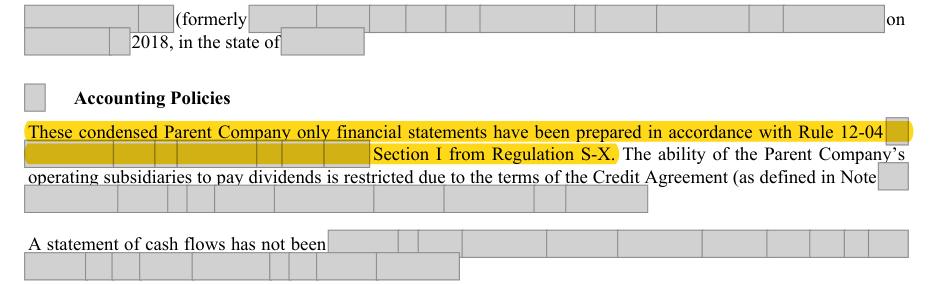
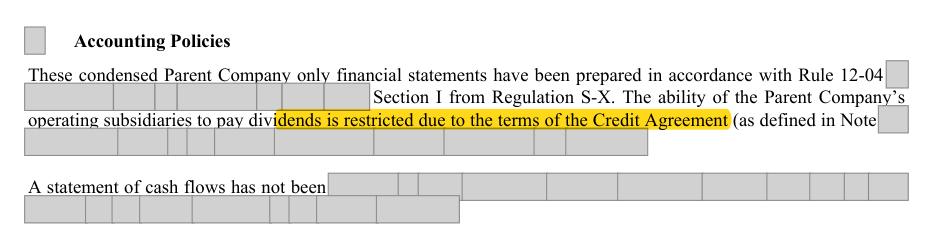
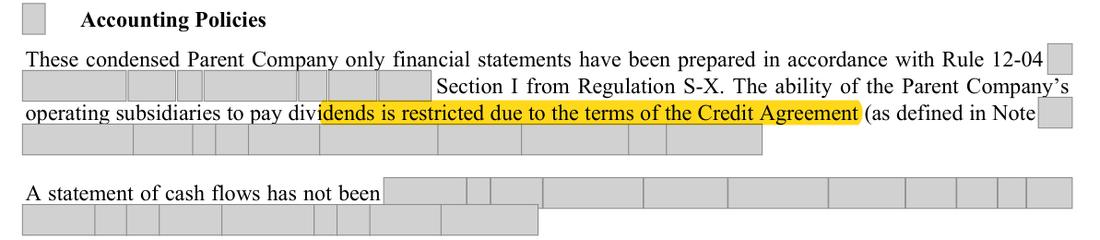
Note 25 presents parent-only condensed statements under Rule 12-04 and states that the operating subsidiaries' ability to pay dividends is restricted by the Credit Agreement and indenture. The parent's only asset is its investment in subsidiaries of [n], equal to consolidated equity. Note 12 says the agreements limit [wording masked]'. The term 'restricted net assets' does not appear anywhere in the Form 10-K.
Schedule I is required when restricted net assets exceed 25% of consolidated net assets, that is more than [n] at [date], so by filing it the company signals that the amount is above that level.
once the schedule is triggered, the restricted net assets amount is material by the company's own test, and Rule 4-08(e)(3)(ii) requires it stated; Rule 4-08(e)(1) separately requires the amount of earnings restricted or free. The reference to an 'indenture' is also out of date: the only indenture, for the Prior Senior Notes, was repaid in [date] according to Note 12.
| Test | Arithmetic | Result |
|---|---|---|
| Consolidated net assets at [date] | total stockholders' equity | [n] |
| Schedule I threshold (25% of consolidated net assets) | [n] x 25% = [n] | [n] |
| Parent's investment in subsidiaries | Note 25 balance sheet | [n] |
| Restricted net assets stated | searched the whole Form 10-K | not stated in 2025 or 2024 |
Management’s best defense, and our reply
The company may say that the parent holds nothing but its investment in subsidiaries, so the reader can see that substantially all consolidated net assets are restricted, and that the risk factors explain the holding-company structure. It may add that the credit agreement baskets are complex and change with leverage. The answer: the rule asks for the amount, and Note 12 itself says dividends are permitted up to 'select amounts', so not all net assets are restricted and the figure cannot be read off the schedule; complexity of the baskets is a reason to state them, not to omit them.
The fix
- Add to Note 25: 'At [date], the restricted net assets of the Company's consolidated subsidiaries were $X million; under the New Credit Agreement the subsidiaries may pay dividends to the parent of up to $Y million plus ...'; delete 'and indenture'.
Evidence relied on
| # | What it shows | Type | Where |
|---|---|---|---|
| 1 | The company files Schedule I, which applies only above the 25% restricted net assets level | Document | Form 10-K 2025, page 129 |
| 2 | Nature of the restriction given; no amount | Document | Form 10-K 2025, page 129 |
| 3 | The parent's only asset is its investment in subsidiaries | Document | Form 10-K 2025, page 127 |
| 4 | Consolidated net assets for the 25% test | Document | Form 10-K 2025, page 75 |
| 5 | Some dividend capacity exists, so the restricted amount is not self-evident | Document | Form 10-K 2025, page 102 |
| 6 | The notes issued under the indenture were repaid in 2024 | Document | Form 10-K 2025, page 102 |
Absence check
- Document
- Form 10-K 2025
- Where it would appear
- 2. Accounting Policies
- What is missing
- the amount of restricted net assets of consolidated subsidiaries at the year end and the amount of earnings restricted or free for dividends
- Pages looked at
- p.38, [n], 62-64, 97-102, 127-129
- Result
- 'restricted payment' hits p.38 (risk factor: the New Credit Agreement permits certain dividends subject to limitations, no amount); 'ability to pay dividends' hits p.42, [n] and [n] (risk factors and Item 5 on holding-company structure, no amount) and p.102 (Note 12 covenant sentence quoted above, no amount); 'restricted net assets', 'free of restriction' and 'Rule 4-08' have no hits.
Prepared by Pramanex from the company’s public SEC filings, without the company’s involvement, to show how a 10-K Pre-filing Check reads. The company is not named, and nothing on this page is a statement about any identifiable company. Observations are not an audit, review or other attestation or assurance engagement, and not legal advice. An SEC-style question is a question, not a conclusion.
Want this on your own 10-K, before you file?
Start with three free findings on your latest 10-K, or book a fixed-price 10-K Pre-filing Check.
Your next 10-K will be in draft before the audit is done.
Have it read before you file.
Start with three free findings on your latest 10-K, or book a fixed-price 10-K check. Drafts only under NDA, inside your insider trading policy.