1.02 Stock compensation note omits the recognition period for [amount] of unrecognized cost, the fair value of the 2025 option grants and the tax benefit recognized
Company H · a US-listed aerospace services company · Compliance or disclosure gap
In brief
Note 19 says [amount] of compensation cost on nonvested awards was unrecognized at [date] but not the weighted-average period over which it will be recognized. It gives the Black-Scholes assumptions for the [n] options granted in 2025 but not the grant-date fair value they produced. It reports stock compensation expense of [amounts] but not the income tax benefit recognized on it. US generally accepted accounting principles (GAAP) require all three, and the prior 10-K also omitted the period and the tax benefit.
The evidence, as filed
2 further page extracts: screenshot withheld to protect the company’s identity. The rows below say what each shows.
What the filing shows, and what the rule requires
| What the filing shows | What the rule requires |
|---|---|
[amount] of unrecognized compensation cost with no recognition period; [n] options granted with assumptions of [n] years, 4.07% and 40.0% but no grant-date fair value; expense of [amounts] with no recognized tax benefit. | The weighted-average period over which the [amount] is expected to be recognized; the weighted-average grant-date fair value of options granted in each year presented; and the total income tax benefit recognized in income on stock compensation for each year presented. |
The rule
Regulation S-X Rule 4-01(a)(1)
Financial statements filed with the Commission which are not prepared in accordance with generally accepted accounting principles will be presumed to be misleading or inaccurate, despite footnote or other disclosures, unless the Commission has otherwise provided.
Version: Text in force at the date of this review · Source: Regulation S-X, 17 CFR 210.4-01(a)(1), as published in the eCFR
FASB ASC 718-10-50-2(d)(1) grant-date fair value of options granted, (h)(1)(i) recognized tax benefit and (i) weighted-average recognition period of unrecognized cost (paraphrase; the Codification text is copyrighted)
Summary; FASB/IFRS text is copyrighted Disclose share-based arrangement terms, fair-value methods and assumptions, award activity, compensation cost and tax effects, and unrecognised cost with weighted-average recognition period.
Version: Text in force at the date of this review · Source: FASB Accounting Standards Codification, ASC 718-10-50-2 (as amended by ASU 2018-07), paraphrase
Why it applies here. The [amount] is 7.32% of 2025 pre-tax income of [amount]. Part of it is recognized over a service period that runs to an estimated liquidity event for Prior Plan awards, which the note does not date, so the recognition period is the reader's only way to schedule it. The note prints the option model's inputs but not the value they produced.
Why it matters
- Readers cannot tell when the [amount] will reach the income statement, what the 2025 option grants cost, or the after-tax cost of stock compensation.
- A staff comment asking for the three items in future filings is the realistic outcome; no fine applies and no recognized amount changes.
Exposure
A staff comment on the stock compensation note and an undertaking to add the items in future filings; no recognized amount is affected, so no amendment is expected.
Our workings
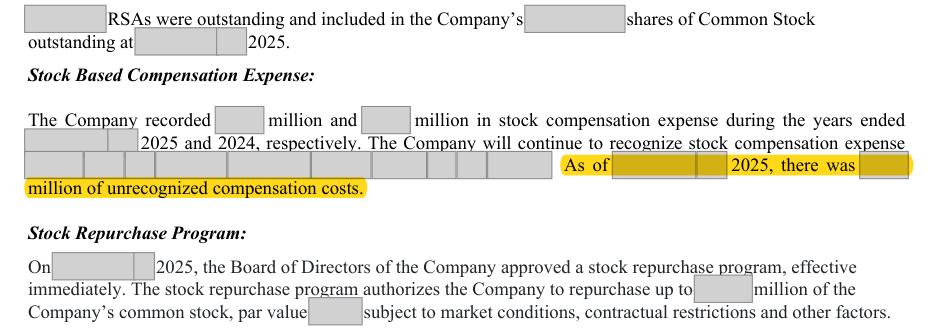
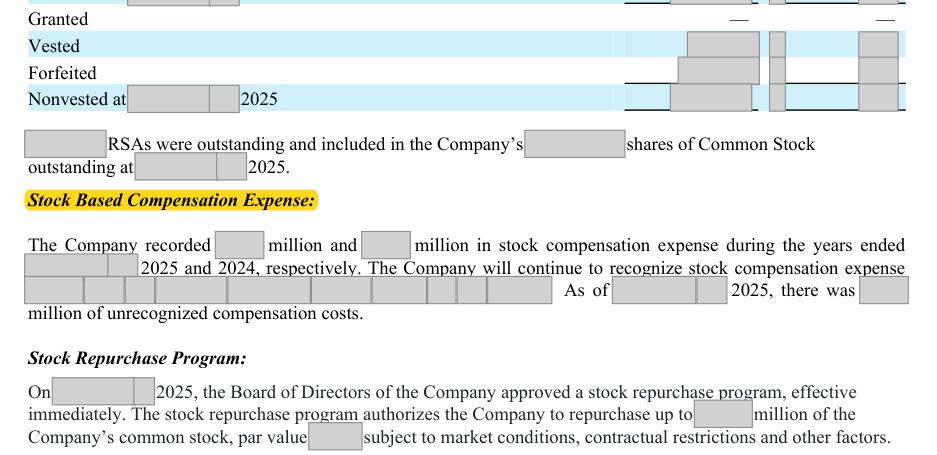
Note 19 states the unrecognized cost at [date] ([amount]) and says expense will continue ratably over the requisite remaining service period, without stating that period. For the Prior Plan restricted stock awards ([wording masked] note says expense is recognized over an estimated service period that runs to the estimated liquidity event, so the period is a management estimate rather than a fixed vesting term. The option table shows [n] options granted in 2025 at a [amount] weighted-average exercise price, and the text gives the expected term, risk-free rate, volatility and dividend yield, but no per-option fair value. Expense of [amount] (2025) and [amount] (2024) is stated with no recognized tax benefit; the income tax note carries a stock-based compensation line only as a rate-reconciliation item.
The unrecognized cost is [n], 7.32% of consolidated pre-tax income (workings).
The share-based payment disclosure section of the Codification sets four objectives (nature and terms, the effect of compensation cost on the income statement, the method of estimating fair value, and cash-flow effects) and then lists the minimum disclosures that meet them, including the three omitted here. The grey area is materiality (the Codification need not be applied to immaterial items), but the recognition period is the only way a reader can schedule the [amount] into future periods when part of it depends on an undated liquidity-event estimate, and the grant-date fair value is the output of the very model whose inputs the note prints.
| Item | Computation | Result |
|---|---|---|
| Unrecognized cost in thousands | [n] x [n] | [n] |
| Share of pre-tax income | [n] / [n] | 7.32% |
Management’s best defense, and our reply
Management would argue the omitted items are immaterial: stock compensation of [amount] is modest against pre-tax income, the Codification need not be applied to immaterial items, and the auditor accepted the note as presented. It could add that a reader can approximate the period from the three-year vesting of 2024 Plan awards and the tax effect from the income tax rate reconciliation. However, the unrecognized cost equals 7.32% of pre-tax income and part of it runs to an undated liquidity-event estimate, so the vesting terms do not give the period; the rate-reconciliation line is a reconciling item, not the benefit recognized; and the note treats the option valuation as relevant by printing its inputs while leaving out its output.
The fix
- Add to Note 19: 'Unrecognized compensation cost of [amount] is expected to be recognized over a weighted-average period of [x] years'; 'The weighted-average grant-date fair value of options granted in 2025 was $[x] per option'; and 'The income tax benefit recognized for stock-based compensation was $[x] million and $[x] million for 2025 and 2024.'
Evidence relied on
| # | What it shows | Type | Where |
|---|---|---|---|
| 1 | Unrecognized cost given as an amount only, with no recognition period | Document | Form 10-K 2025, page 117 |
| 2 | Prior Plan expense runs to an estimated liquidity event, so the recognition period is a management estimate | Document | Form 10-K 2025, page 114 |
| 3 | Options granted in 2025 and their weighted-average exercise price; no grant-date fair value column or line | Document | Form 10-K 2025, page 116 |
| 4 | Expected-term input to the option model | Document | Form 10-K 2025, page 115 |
| 5 | Risk-free rate input to the option model | Document | Form 10-K 2025, page 115 |
| 6 | Volatility input; the text ends here without the fair value the inputs produced | Document | Form 10-K 2025, page 115 |
| 7 | Expense for each year given with no recognized tax benefit | Document | Form 10-K 2025, page 117 |
Absence check
- Document
- Form 10-K 2025
- Where it would appear
- Stock Based Compensation Expense:
- What is missing
- the weighted-average period over which the [amount] of unrecognized cost is expected to be recognized
- Pages looked at
- p.113-117 (Note 19) page images
- Result
- 'recognized over' hits p.72, [n] and [n] (revenue and government-grant policies) and p.114 (the Prior Plan service-period sentence, which names no period); 'remaining service period' and 'unrecognized compensation' hit only the p.117 sentence that gives the amount without a period; the other terms have no hits.
Absence check
- Document
- Form 10-K 2025
- Where it would appear
- Term. The Company began
- What is missing
- the weighted-average grant-date fair value of the options granted in 2025
- Pages looked at
- p.113-117 (Note 19) page images
- Result
- 'weighted-average grant' hits p.116 and [n] (the RSU and RSA tables, not options); 'grant-date fair value of' hits p.115 (the sentence naming the Black-Scholes model, with no amount); the other terms have no hits.
Absence check
- Document
- Form 10-K 2025
- Where it would appear
- The Company recorded [amount]
- What is missing
- the income tax benefit recognized in income on stock compensation for each year presented
- Pages looked at
- p.113-117 (Note 19) page images
- Result
- 'tax benefit' hits p.77 (tax on pension other comprehensive income) and p.107 (unrecognized tax benefits on uncertain positions); 'stock based compensation' hits p.105 (a rate-reconciliation item, which is the rate effect, not the benefit recognized) and policy or narrative text on p.82, [n]; 'stock compensation expense' hits MD&A, cash-flow and segment pages (p.57, [n]) that give the expense only; 'excess tax' has no hits.
Prepared by Pramanex from the company’s public SEC filings, without the company’s involvement, to show how a 10-K Pre-filing Check reads. The company is not named, and nothing on this page is a statement about any identifiable company. Observations are not an audit, review or other attestation or assurance engagement, and not legal advice. An SEC-style question is a question, not a conclusion.
Want this on your own 10-K, before you file?
Start with three free findings on your latest 10-K, or book a fixed-price 10-K Pre-filing Check.
Your next 10-K will be in draft before the audit is done.
Have it read before you file.
Start with three free findings on your latest 10-K, or book a fixed-price 10-K check. Drafts only under NDA, inside your insider trading policy.