1.01 The major-customer disclosure gives a percentage only: no revenue amount and no segment reporting it
Company H · a US-listed aerospace services company · Compliance or disclosure gap
In brief
One customer, labelled Customer A, supplied [n]%, [n]% and [n]% of revenue in 2025, 2024 and 2023. US GAAP segment reporting requires, for each customer at or above 10% of revenue, the amount of revenue and the segment or segments that report it. The note gives a percentage only, and neither the revenue note nor the segment note says whether Customer A is served by [segment], [segment] or both.
The evidence, as filed
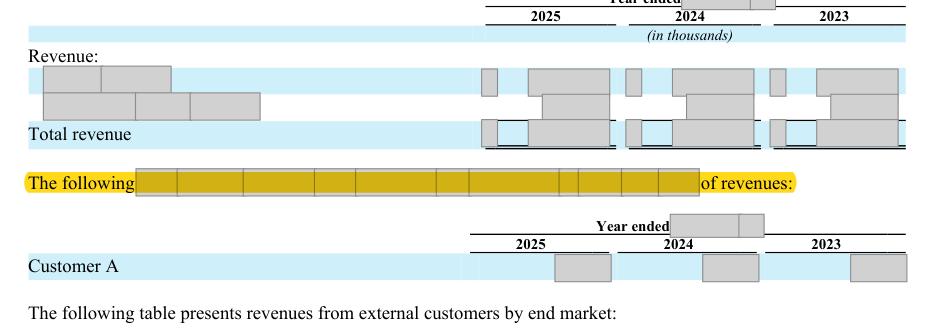
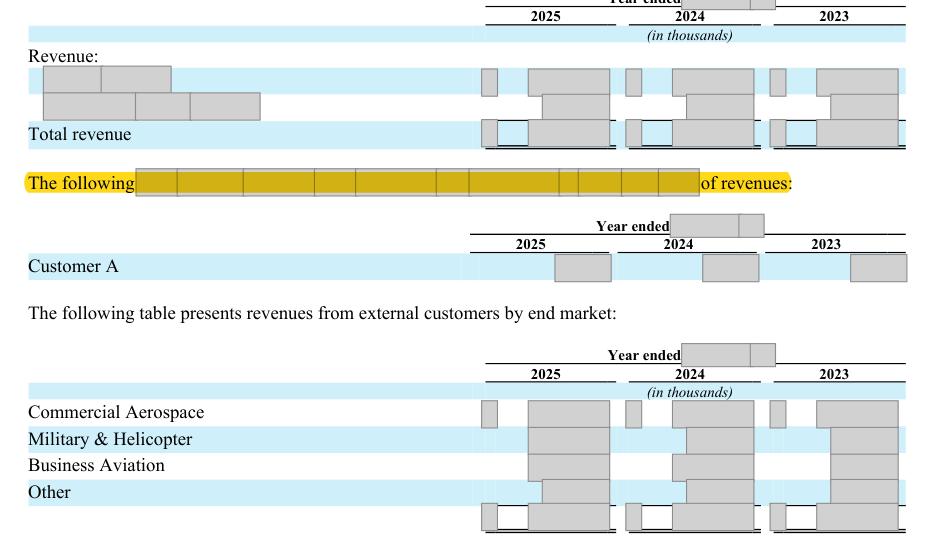
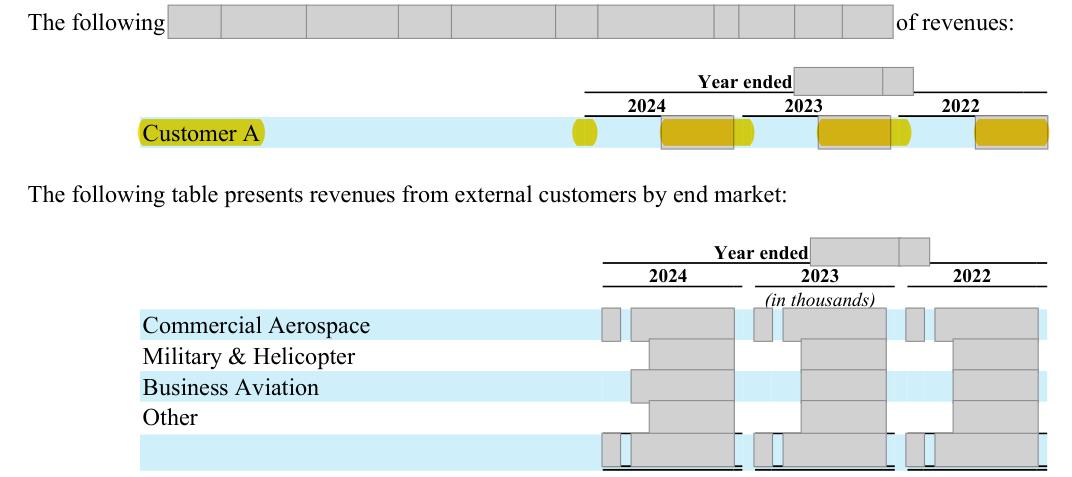
3 further page extracts: screenshot withheld to protect the company’s identity. The rows below say what each shows.
What the filing shows, and what the rule requires
| What the filing shows | What the rule requires |
|---|---|
Note 3 table: 'Customer A [n]% [n]% [n]%'; no revenue amount, no segment identified anywhere in the report. | For each customer at or above 10% of revenue: the revenue amount for each year presented and the segment or segments reporting it (the customer need not be named). |
The rule
Regulation S-X Rule 4-01(a)(1)
Financial statements filed with the Commission which are not prepared in accordance with generally accepted accounting principles will be presumed to be misleading or inaccurate, despite footnote or other disclosures
Version: Text in force at the date of this review · Source: 17 CFR 210.4-01 (Regulation S-X Rule 4-01), eCFR text as at the law pack date
Why it applies here. The percentages imply about [amount] in 2025, [amount] in 2024 and [amount] in 2023 (approximate, since the percentages are rounded), but the reporting segment cannot be derived from anything in the report. The concentration fell from [n]% to [n]% in one year, which makes the segment exposure more relevant, not less.
Why it matters
- Readers cannot tell which segment carries the company's largest customer concentration, in a year when that customer's share of revenue fell by eight points.
- Segment reporting is among the SEC staff's most frequent comment topics; a comment asking for the amount and the segment in future filings is the realistic outcome. No fine applies and no reported amount changes.
How often the SEC staff raises this. In 1,100 SEC staff comment letters on fiscal 2023 and 2024 Forms 10-K, released January 2025 to October 2026, segment reporting drew 191 of the 1,774 numbered comments (10.8%): topic 4 of 25 by frequency.
Exposure
No fixed penalty; the realistic consequence is a staff comment letter and a future-filings undertaking.
Our workings
the revenue note presents revenues from customers that contributed more than 10% of revenues as a percentage table with one line, Customer A. The company has two reportable segments, [segment] and [segment]. Neither the revenue note nor the segment note (which gives revenue by segment, by geography and long-lived assets by geography) identifies the segment that reports Customer A's revenue or states its revenue in dollars; the prior-year Form 10-K used the same percentage-only table. Requirement: under the entity-wide major-customer paragraph of the FASB segment-reporting topic (not changed by the 2023 segment amendments), when a single customer supplies 10 percent or more of revenues the entity discloses that fact, the revenue amount from each such customer and the identity of the reporting segment or segments; it need not name the customer. Under Regulation S-X, statements that depart from US GAAP are presumed misleading despite other disclosure.
the approximate dollar amounts implied by the percentages are shown in the workings (approximate only, because the percentages are rounded to one decimal).
a reader can approximate the revenue amount, but the segment identity cannot be derived from anything in the report, so that element is wholly omitted. The concentration is also falling sharply (from [n]% to [n]%), which makes the segment exposure more relevant to a reader, not less.
| Year | Total revenue (USD thousand) | Customer A share | Implied Customer A revenue (USD thousand) |
|---|---|---|---|
| 2025 | [n] | [n]% | [n] x [n]% = [n] |
| 2024 | [n] | [n]% | [n] x [n]% = [n] |
| 2023 | [n] | [n]% | [n] x [n]% = [n] |
Management’s best defense, and our reply
The finance team would argue that the percentages let any reader compute the revenue amount, and that disclosing which segment serves Customer A could help identify a customer the company is not obliged to name. They might add that [segment] is by far the larger segment, so a reader can assume the revenue sits there. The answer: the codification asks for the segment identity in terms and does not require the customer's name, and the segment cannot be inferred from the report because the company also provides component repairs to its large OEM customers; the percentages also give only an approximate amount.
The fix
- Add the revenue amount and the segment(s) to the table, e.g. 'Customer A: [amount] ([n]%), reported in the [segment] segment' (or both segments, as applies).
Note 3, major customer table, page 91
Also: the amounts shown are approximations from the rounded percentages; use the recorded figures
Evidence relied on
| # | What it shows | Type | Where |
|---|---|---|---|
| 1 | Heading of the major customer table | Document | Form 10-K 2025, page 91 |
| 2 | Only a percentage is given for each year; no amount, no segment | Document | Form 10-K 2025, page 91 |
| 3 | Total revenue used to approximate the omitted amounts | Document | Form 10-K 2025, page 91 |
| 4 | Two reportable segments, so the reporting segment is not self-evident | Document | Form 10-K 2025, page 81 |
Absence check
- Document
- Form 10-K 2025
- Where it would appear
- The following table presents revenues from customers that contributed to more than 10% of revenues
- What is missing
- the revenue amount from Customer A and the segment or segments reporting it
- Pages looked at
- p.91 (Note 3), p.122-126 (Note 24 segment information), p.6 and [n] (Item 1 and Item 1A customer concentration)
- Result
- 'Customer A' as a phrase and '10% of revenues' hit only p.91, the percentage table itself; the other pages listed for 'Customer A' (p.24, [n]) are case-insensitive matches inside words such as 'customer attraction' and 'customer attrition', not the customer. 'major customer' hits p.83, the revenue policy on long-term agreements with major customers, with no amount or segment. 'single customer' hits p.6 and p.16, where the [wording masked] are given as an aggregate percentage of revenue, with no segment. 'largest customer' has no hits.
Prepared by Pramanex from the company’s public SEC filings, without the company’s involvement, to show how a 10-K Pre-filing Check reads. The company is not named, and nothing on this page is a statement about any identifiable company. Observations are not an audit, review or other attestation or assurance engagement, and not legal advice. An SEC-style question is a question, not a conclusion.
Want this on your own 10-K, before you file?
Start with three free findings on your latest 10-K, or book a fixed-price 10-K Pre-filing Check.
Your next 10-K will be in draft before the audit is done.
Have it read before you file.
Start with three free findings on your latest 10-K, or book a fixed-price 10-K check. Drafts only under NDA, inside your insider trading policy.