4.06 Accounting-policy note: superseded impairment wording, a wrong Codification subtopic and a misstated effective date
Company G · a US-listed specialty pharmaceutical company · Drafting slip
In brief
Four wording slips sit in the policy and pronouncement paragraphs. The investments policy still refers to declines 'judged to be other than temporary', a model the credit-loss standard replaced for available-for-sale debt securities; the expense-disaggregation standard is cited as 'Subtopic 220-04' instead of 220-40 (in both years); the internal-use software standard is said to apply from a 'fiscal year ending [date]'; and one sentence in Note 3 is ungrammatical.
The evidence, as filed
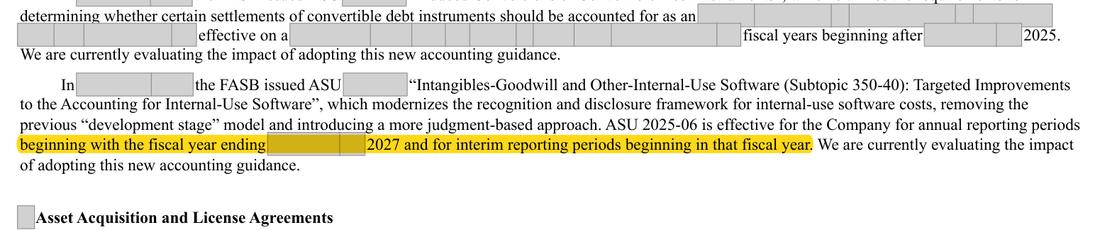
3 further page extracts: screenshot withheld to protect the company’s identity. The rows below say what each shows.
What the filing shows, and what the rule requires
| What the filing shows | What the rule requires |
|---|---|
'declines in value judged to be other than temporary on investments'; '(Subtopic 220-04)'; 'beginning with the fiscal year ending [date]'; '[wording masked] [product] and was expensed' | Credit-loss wording for available-for-sale debt securities (allowance for credit losses, ASC 326-30); 'Subtopic 220-40'; 'annual reporting periods beginning after [date] (fiscal 2028 for the Company)'; '[wording masked] [product] and was expensed...' reworded as '[wording masked], which related to [product], was expensed...' |
Why it matters
Policy text that names a superseded impairment model and a wrong Codification reference weakens the reader's confidence in the note; no amount is affected.
Exposure
No measurement effect; a wording correction in the next annual report.
Our workings
the investments policy describes realized gains and losses and 'declines in value judged to be other than temporary'; the pronouncements paragraph names ASU 2024-03 as Subtopic 220-04 and gives ASU 2025-06 an effective point of a fiscal year 'ending [date]'; the prior-year 10-K carries the same 'other than temporary' wording and the same 220-04 reference.
since the Company's adoption of the credit-loss standard, impairment of available-for-sale debt securities is assessed under ASC 326-30 (credit loss allowance, not other-than-temporary write-down); the expense-disaggregation guidance sits in Subtopic 220-40; ASU 2025-06 applies to annual periods beginning after [date], so the Company's first year is the one beginning [date]. None of these changes a recognized amount: the available-for-sale holdings are money market funds and time deposits whose carrying values, the fair value note says, were approximately equal to their fair values.
Management’s best defense, and our reply
Management could say the holdings are money market funds and time deposits carried at approximately their fair values, so the impairment wording has no practical effect, and that the other slips are clerical and change no figure. The auditor would add that the policy note as a whole was reviewed and no amount depends on these sentences. The answer: that is why the point is only a drafting slip, but a policy that names a superseded model and a Codification reference that does not exist should still be corrected, and two of the slips have now run for two years.
The fix
- Replace the 'other than temporary' sentence with the credit-loss wording; read 'Subtopic 220-40'; state ASU 2025-06 as effective for annual periods beginning after [date]; reword the Note 3 sentence.
Evidence relied on
| # | What it shows | Type | Where |
|---|---|---|---|
| 1 | Investments policy still uses the superseded other-than-temporary impairment wording | Document | Form 10-K 2025, financial-statement pages (printed F-n; see folios) |
| 2 | Expense-disaggregation standard cited under the wrong subtopic number | Document | Form 10-K 2025, financial-statement pages (printed F-n; see folios) |
| 3 | Effective point of the internal-use software standard misstated (a fiscal year 'ending' [date]) | Document | Form 10-K 2025, financial-statement pages (printed F-n; see folios) |
| 4 | Ungrammatical sentence in the asset-acquisition note | Document | Form 10-K 2025, financial-statement pages (printed F-n; see folios) |
| 5 | Prior-year 10-K carries the same superseded wording | Document | Form 10-K 2024 (prior year), financial-statement pages (printed F-n; see folios) |
| 6 | Prior-year 10-K carries the same wrong subtopic number | Document | Form 10-K 2024 (prior year), financial-statement pages (printed F-n; see folios) |
Prepared by Pramanex from the company’s public SEC filings, without the company’s involvement, to show how a 10-K Pre-filing Check reads. The company is not named, and nothing on this page is a statement about any identifiable company. Observations are not an audit, review or other attestation or assurance engagement, and not legal advice. An SEC-style question is a question, not a conclusion.
Want this on your own 10-K, before you file?
Start with three free findings on your latest 10-K, or book a fixed-price 10-K Pre-filing Check.
Your next 10-K will be in draft before the audit is done.
Have it read before you file.
Start with three free findings on your latest 10-K, or book a fixed-price 10-K check. Drafts only under NDA, inside your insider trading policy.