1.11 The goodwill roll-forward covers only the current year, although two balance sheets are presented: should the 2024 movement be shown?
Company G · a US-listed specialty pharmaceutical company · SEC-style question
In brief
Note 9 rolls goodwill forward from [n] to [n] for fiscal 2025 only. The 2024 movement, a foreign-exchange decrease of [n], is not given anywhere in this 10-K, although the balance sheet presents both year-ends; the prior-year 10-K likewise showed only its current year. Common practice, and the Codification's illustration, show a roll-forward for each balance-sheet year, but the Codification text is not held here, so this is put as a question.
The evidence, as filed
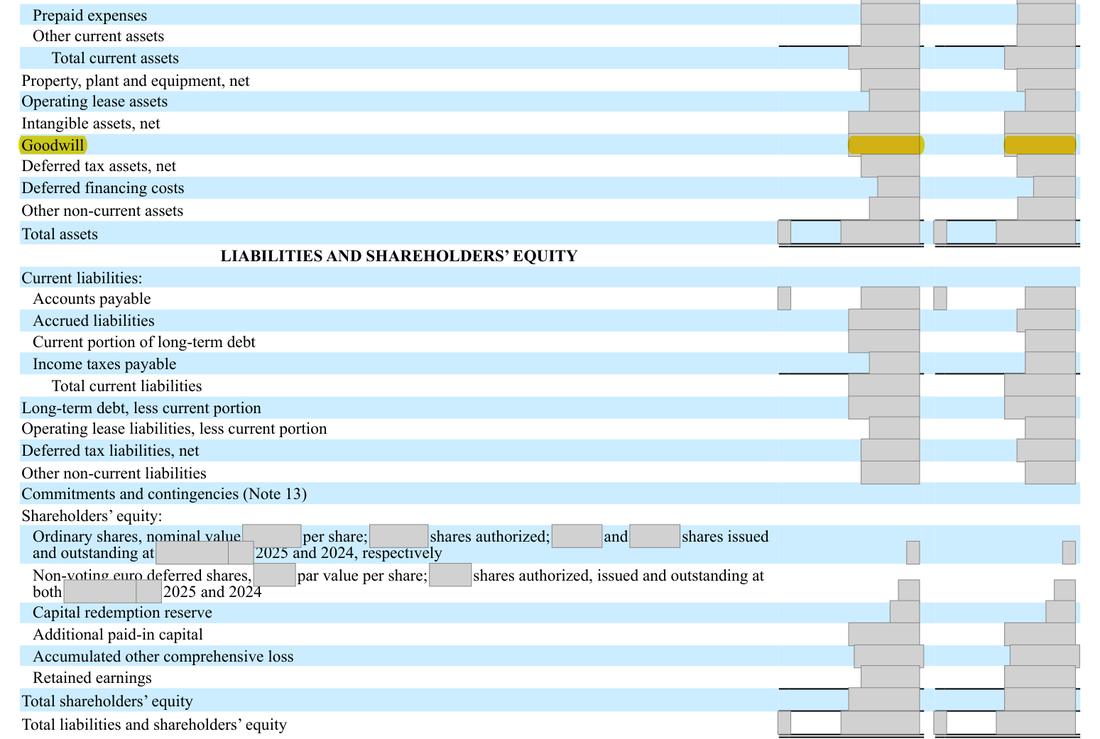
3 further page extracts: screenshot withheld to protect the company’s identity. The rows below say what each shows.
What the filing shows, and what the rule requires
| What the filing shows | What the rule requires |
|---|---|
Fiscal 2025 roll-forward only: opening [n], foreign exchange [n], closing [n]. No roll-forward for fiscal 2024; accumulated impairment losses are not stated. | If the disclosure paragraphs apply to each period for which a balance sheet is presented, a two-year roll-forward (for 2024: opening [n], foreign exchange ([n]), closing [n]), with gross amounts and accumulated impairment losses. |
| What we checked. Note 9 and every goodwill reference in both [n]-Ks (risk factors, critical accounting estimates, balance sheet, policy note) | |
The rule
ASC 350-20-50-1 to 50-2 (goodwill changes; paraphrase, the Codification text is copyrighted)
Summary; FASB/IFRS text is copyrighted Impairment equals carrying amount exceeding reporting unit fair value, capped at goodwill; disclose goodwill changes by segment and impairment circumstances, amount and valuation method.
Version: Text as amended up to [date] · Source: FASB Accounting Standards Codification, ASC 350-20-35-8 and 350-20-50-1 to 50-2; paraphrase
Regulation S-X Rule 4-01(a)(1)
Financial statements filed with the Commission which are not prepared in accordance with generally accepted accounting principles will be presumed to be misleading or inaccurate, despite footnote or other disclosures
Version: Text in force at the date of this review · Source: Regulation S-X, 17 CFR 210.4-01(a)(1) (eCFR, as amended)
Why it applies here. The goodwill disclosure paragraphs ask for the changes in the carrying amount of goodwill, showing gross amounts and accumulated impairment losses, and the Codification's illustration shows two years; most registrants present a roll-forward for each balance-sheet year. The Codification text is not held in this study, so whether the paragraph's words require the comparative year cannot be confirmed from an official text; the point is therefore a question. A reader of this 10-K can see that goodwill fell in 2024 but not why.
Why it matters
The comparative-year change in goodwill is unexplained in this 10-K; the gap repeats each year.
How often the SEC staff raises this. In 1,100 SEC staff comment letters on fiscal 2023 and 2024 Forms 10-K, released January 2025 to October 2026, financial statement presentation drew 254 of the 1,774 numbered comments (14.3%): the second most frequent topic.
Exposure
None until management answers; at most a staff comment and an added comparative table in future filings.
Our workings
The balance sheet presents goodwill of [n] at [date] and [n] at [date]. Note 9 gives one table: balance at [date], foreign exchange [n], balance at [date]. The prior-year 10-K shows that 2024 opened at [n] and fell by a foreign-exchange movement of ([n]); that movement appears nowhere in this 10-K. The prior-year 10-K in turn gave only its 2024 movement.
[n] + [n] = [n] ties the fiscal 2025 table; [n] - [n] = ([n]) is the fiscal 2024 movement not shown, [n] / [n] = 7.83% of fiscal 2024 pre-tax income (workings).
| Line | Arithmetic (thousands) | Source |
|---|---|---|
| Fiscal 2025 roll-forward ties | [n] + [n] = [n] | Note 9, financial-statement pages (printed F-n; see folios); balance sheet financial-statement pages (printed F-n; see folios) |
| Omitted fiscal 2024 movement | [n] - [n] = ([n]) | Prior-year 10-K financial-statement pages (printed F-n; see folios) |
| Size against fiscal 2024 pre-tax income | [n] / [n] = 7.83% | financial-statement pages (printed F-n; see folios) |
Management’s best defense, and our reply
Management would argue that the 2024 movement can be worked out from the two balance sheets, that it was disclosed in last year's 10-K, that goodwill has never been impaired, and that the only movement in either year is translation, so a second table adds nothing a reader needs. It may also read the paragraph's 'during the period' as the latest period. That reading cannot be ruled out without the Codification text, so the defense is tenable; against it, the balance sheets show only that goodwill changed, not that the change was translation, and the prior 10-K is not part of these financial statements, which is why the question is worth asking.
The fix
- Extend the Note 9 table to two years: balance at [date] (gross and accumulated impairment losses), foreign exchange ([n]), balance at [date], foreign exchange [n], balance at [date].
Question for the company
Note 9 reconciles goodwill for fiscal 2025 only. Does management read the goodwill disclosure paragraphs (ASC 350-20-50-1) as requiring the change in carrying amount only for the latest year, and if so on what basis, given that the balance sheet presents both year-ends and the fiscal 2024 decrease of [n] (foreign exchange) is not explained anywhere in this 10-K? Should the table also state the gross amount and accumulated impairment losses (nil, if that is the case)?
Evidence relied on
| # | What it shows | Type | Where |
|---|---|---|---|
| 1 | Balance sheet (F-3): goodwill at both year-ends | Document | Form 10-K 2025, financial-statement pages (printed F-n; see folios) |
| 2 | Note 9 (F-21): the roll-forward starts at [date] | Document | Form 10-K 2025, financial-statement pages (printed F-n; see folios) |
| 3 | The only 2025 movement | Document | Form 10-K 2025, financial-statement pages (printed F-n; see folios) |
| 4 | Closing balance; no 2024 table follows | Document | Form 10-K 2025, financial-statement pages (printed F-n; see folios) |
| 5 | Fiscal 2024 pre-tax income used for size | Document | Form 10-K 2025, financial-statement pages (printed F-n; see folios) |
| 6 | Prior-year 10-K: 2024 opening goodwill | Document | Form 10-K 2024 (prior year), financial-statement pages (printed F-n; see folios) |
| 7 | The 2024 movement that this 10-K leaves out | Document | Form 10-K 2024 (prior year), financial-statement pages (printed F-n; see folios) |
Absence check
- Document
- Form 10-K 2025
- Where it would appear
- The gross carrying amount of goodwill was as follows
- What is missing
- The fiscal 2024 goodwill roll-forward (opening [n], foreign exchange ([n])) and the accumulated impairment losses
- Pages looked at
- p.44, [n], 103-104, [n]
- Result
- 'Goodwill' hits p.44 and [n] (risk factors), 104-105 (critical accounting estimates: test method and the [amount] balance), [n] (balance sheet), [n] (policies and the asset acquisition) and [n] (the one-year table); none gives a 2024 movement. '[n]', '[n]' and 'accumulated impairment' have no hits.
Absence check
- Document
- Form 10-K 2024 (prior year)
- Where it would appear
- The gross carrying amount of goodwill was as follows
- What is missing
- The fiscal 2023 goodwill roll-forward
- Pages looked at
- Form 10-K 2024 (prior year) p.67, 98-99, [n]
- Result
- 'Goodwill' hits risk factors, critical accounting estimates, the balance sheet, policies and the one-year table on financial-statement pages (printed F-n; see folios); 'Balance at [date]' hits only p.97 (the MD&A sales-deduction reserve table, not goodwill); 'accumulated impairment' has no hits.
Prepared by Pramanex from the company’s public SEC filings, without the company’s involvement, to show how a 10-K Pre-filing Check reads. The company is not named, and nothing on this page is a statement about any identifiable company. Observations are not an audit, review or other attestation or assurance engagement, and not legal advice. An SEC-style question is a question, not a conclusion.
Want this on your own 10-K, before you file?
Start with three free findings on your latest 10-K, or book a fixed-price 10-K Pre-filing Check.
Your next 10-K will be in draft before the audit is done.
Have it read before you file.
Start with three free findings on your latest 10-K, or book a fixed-price 10-K check. Drafts only under NDA, inside your insider trading policy.