1.10 Entity-wide disclosures: no revenue figure for the country of domicile ([country]), and major customers given only as percentages
Company G · a US-listed specialty pharmaceutical company · SEC-style question
In brief
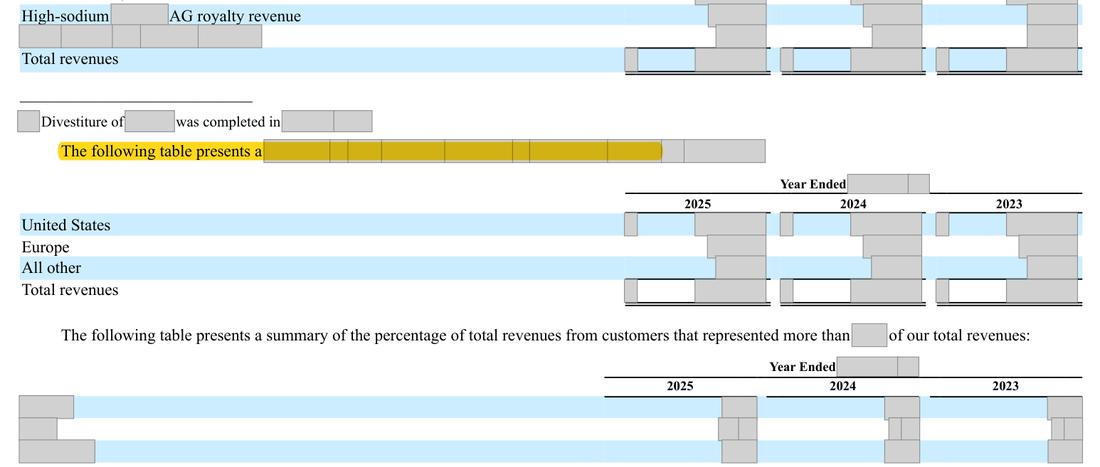
The Company is incorporated and headquartered in [country], and its long-lived assets table shows [country] separately. The revenue-by-geography table, however, shows only the United States, Europe and All other, so revenue attributed to the country of domicile is not given. The major-customer table gives each customer's share of revenue as a percentage but not the amount, which the entity-wide disclosure rules also ask for.
The evidence, as filed

3 further page extracts: screenshot withheld to protect the company’s identity. The rows below say what each shows.
What the filing shows, and what the rule requires
| What the filing shows | What the rule requires |
|---|---|
Revenue by geography: United States [n]; Europe [n]; All other [n] (total [n]); no [country] line. Major customers: [distributor] [n]%, [distributor] [n]%, [distributor] 10%, with no revenue amounts. Long-lived assets do show [country] ([n]) | Revenue attributed to [country] (the country of domicile) and to all foreign countries in total, with the United States shown as a material individual foreign country; the revenue amount from each customer of 10% or more; or a statement that [country] revenue is immaterial |
The rule
FASB ASC 280-10-50-40 to 50-42
Summary; FASB/IFRS text is copyrighted Disclose revenues by product or service group and by geography (domicile and material individual foreign countries), long-lived assets by geography, and reliance on 10%-plus customers.
Version: Text as amended up to ASU 2023 · Source: FASB Accounting Standards Codification, ASC 280-10-50-40 to 50-42 (as amended to ASU 2023-07); paraphrase, the Codification text is licensed
Regulation S-X Rule 4-01(a)(1)
Financial statements filed with the Commission which are not prepared in accordance with generally accepted accounting principles will be presumed to be misleading or inaccurate, despite footnote or other disclosures, unless the Commission has otherwise provided.
Version: Text in force at the date of this review · Source: Regulation S-X, 17 CFR 210.4-01(a)(1), eCFR text
Why it applies here. the entity-wide paragraphs of the segment standard ask for revenue attributed to the country of domicile and to all foreign countries in total (with material individual countries shown), and for the amount of revenue from each 10%-plus customer, whether or not the CODM uses that information. [country] revenue is probably small and sits inside Europe, and amounts can be roughly derived from the percentages, so whether either omission matters is a judgment for management: a question, not a finding.
Why it matters
Readers cannot see how much revenue arises in the country of domicile; customer concentration is given only approximately.
How often the SEC staff raises this. In 1,100 SEC staff comment letters on fiscal 2023 and 2024 Forms 10-K, released January 2025 to October 2026, segment reporting drew 191 of the 1,774 numbered comments (10.8%): topic 4 of 25 by frequency.
Exposure
A question for management; if [country] revenue is material, the realistic outcome is a staff comment and a future-filings undertaking. No figure in the statements is affected.
Our workings
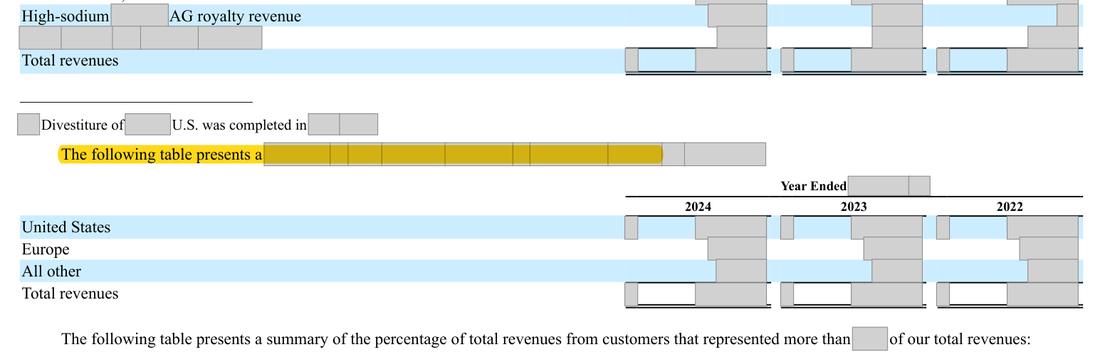
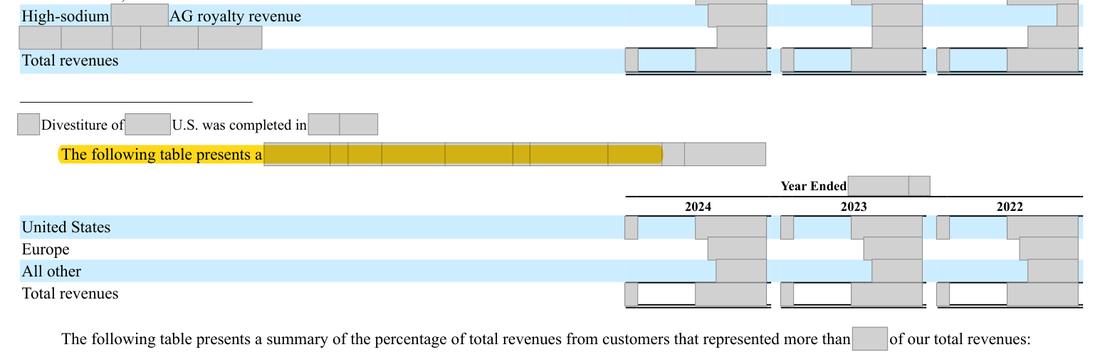
Note 18 (F-38) presents revenue attributed to geographic sources as United States [n], Europe [n] and All other [n], totalling [n]. Note 17 (F-37) presents long-lived assets with [country] first at [n]. The Company states elsewhere that it is an [country] company headquartered in [city], and the tax note says [country] is the jurisdiction in which the parent is incorporated. A search of the whole 10-K for 'country of domicile', 'attributed to [country]', 'revenues from [country]' and '[country] revenue' finds nothing. The major-customer table shows percentages only. The 2024 Form 10-K used the same layout.
the three geographic lines foot to total revenue ([n] + [n] + [n] = [n]).
| Entity-wide element | Where the 10-K gives it | Status |
|---|---|---|
| Revenue by country of domicile ([country]) | Not separately shown; inside Europe [n] at most | Not given |
| Revenue from all foreign countries in total | United States [n] + All other [n] + Europe excluding [country] | Not derivable without the [country] figure |
| Footing of the geographic table | [n] + [n] + [n] = [n] | Agrees to total revenues |
| Long-lived assets in the country of domicile | [country] [n] (Note 17) | Given |
| Revenue amount from each 10%-plus customer | [distributor] [n]%, [distributor] [n]%, [distributor] 10% | Percentages only |
Management’s best defense, and our reply
Management could argue that revenue earned in [country] is immaterial, so separate presentation adds nothing, and that the United States, where most revenue arises, is already shown as a material individual country. It could add that the customer amounts can be derived from the percentages and total revenue, and that this layout has been used for years without staff comment. That position is tenable, which is why this is a question. However, the entity-wide paragraphs name the country of domicile specifically and ask for revenue amounts from major customers, and the note gives no statement that [country] revenue is immaterial.
The fix
- Split the geographic table into [country], United States and Other foreign (or add a sentence such as 'Revenues attributed to [country], our country of domicile, were $[x] million, $[y] million and $[z] million in 2025, 2024 and 2023'), and add the revenue amounts beside the major-customer percentages.
Question for the company
How much revenue is attributed to [country], the country of domicile, in 2025, 2024 and 2023, and was its omission from the geographic table a materiality judgment? Will the major-customer table give revenue amounts as well as percentages?
Evidence relied on
| # | What it shows | Type | Where |
|---|---|---|---|
| 1 | Revenue by geography starts with the United States | Document | Form 10-K 2025, financial-statement pages (printed F-n; see folios) |
| 2 | [country], if any, is inside Europe; no [country] line | Document | Form 10-K 2025, financial-statement pages (printed F-n; see folios) |
| 3 | Third and last geographic line | Document | Form 10-K 2025, financial-statement pages (printed F-n; see folios) |
| 4 | The three lines foot to total revenue | Document | Form 10-K 2025, financial-statement pages (printed F-n; see folios) |
| 5 | Major customers are shown as percentages, not amounts | Document | Form 10-K 2025, financial-statement pages (printed F-n; see folios) |
| 6 | Long-lived assets do show [country] separately | Document | Form 10-K 2025, financial-statement pages (printed F-n; see folios) |
| 7 | The Company's domicile is [country] | Document | Form 10-K 2025, page 53 |
| 8 | The parent is incorporated in [country] | Document | Form 10-K 2025, financial-statement pages (printed F-n; see folios) |
| 9 | Prior-year 10-K, Note 18: revenue by geography, United States line | Document | Form 10-K 2024 (prior year), financial-statement pages (printed F-n; see folios) |
| 10 | Europe line; [country], the country of domicile, sits inside it | Document | Form 10-K 2024 (prior year), financial-statement pages (printed F-n; see folios) |
| 11 | Prior-year Note 17 shows [country] separately for long-lived assets only | Document | Form 10-K 2024 (prior year), financial-statement pages (printed F-n; see folios) |
Absence check
- Document
- Form 10-K 2025
- Where it would appear
- The following table presents a summary of total revenues attributed to geographic sources
- What is missing
- revenue attributed to [country], the country of domicile, and the revenue amount from each customer of 10% or more
- Pages looked at
- p.155-156 (Notes 17 and 18), p.91-95 (MD&A results of operations), p.53 (risk factor on [country] domicile)
- Result
- None of the four terms hits anywhere in the 10-K.
Absence check
- Document
- Form 10-K 2024 (prior year)
- Where it would appear
- The following table presents a summary of total revenues attributed to geographic sources
- What is missing
- Revenue attributed to [country], the country of domicile, for fiscal 2024, 2023 and 2022
- Pages looked at
- Form 10-K 2024 (prior year) p.158-159
- Result
- 'revenues attributed' hits only the table on financial-statement pages (printed F-n; see folios); 'domicile' hits only stamp-duty and tax-rate text; '[country] revenue' and 'sales in [country]' have no hits.
Prepared by Pramanex from the company’s public SEC filings, without the company’s involvement, to show how a 10-K Pre-filing Check reads. The company is not named, and nothing on this page is a statement about any identifiable company. Observations are not an audit, review or other attestation or assurance engagement, and not legal advice. An SEC-style question is a question, not a conclusion.
Want this on your own 10-K, before you file?
Start with three free findings on your latest 10-K, or book a fixed-price 10-K Pre-filing Check.
Your next 10-K will be in draft before the audit is done.
Have it read before you file.
Start with three free findings on your latest 10-K, or book a fixed-price 10-K check. Drafts only under NDA, inside your insider trading policy.