5.06 Item 1A still uses the superseded 'reasonably assured' collection wording for revenue (both years)
Company F · a US-listed networking equipment company · Drafting slip
In brief
The credit-risk risk factor (page 28) says revenue from shipments cannot be recognized until collection 'becomes reasonably assured', wording of the revenue guidance that the current US GAAP revenue standard replaced; the policy note (page 77) applies the current five-step model. The prior-year Form 10-K printed the same sentence (page 30). No figure or policy is affected.
The evidence, as filed

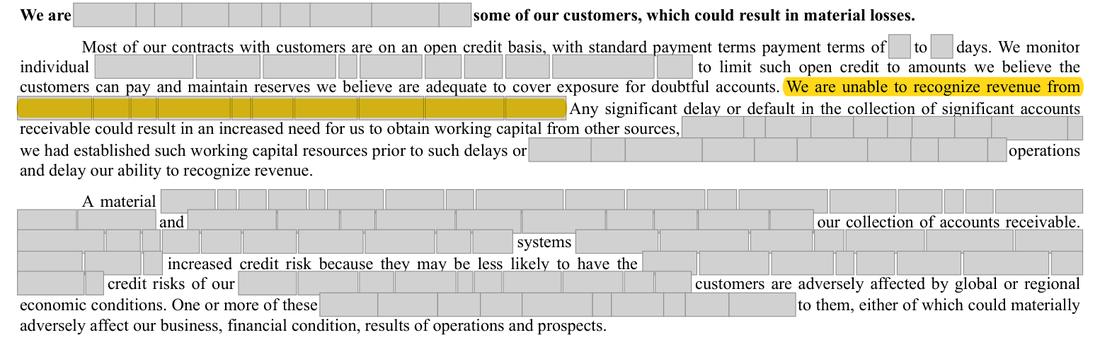
2 further page extracts: screenshot withheld to protect the company’s identity. The rows below say what each shows.
What the filing shows, and what the rule requires
| What the filing shows | What the rule requires |
|---|---|
Item 1A (page 28): 'We are unable to recognize revenue from [wording masked].' | Wording that follows the current revenue standard, for example: revenue is not recognized under a contract until collection of substantially all of the consideration is probable. |
| What we checked. Item 1A credit-risk paragraph against the revenue recognition policy and the allowance policy in the notes, and the same paragraph in the prior-year Form 10-K | |
Why it matters
Cosmetic: the risk factor uses outdated accounting terminology.
Exposure
No consequence beyond presentation.
Our workings
the risk factor on p.28 reads as quoted, and the prior-year Form 10-K printed the identical sentence on p.30 (both seen on the page images). The revenue policy on p.77 recognizes revenue on transfer of control under the five-step model, the first step of which is identifying the contract with a customer.
under the current standard (ASC 606-10-25-1(e)) collectibility is a contract-existence criterion assessed against a 'probable' threshold; 'reasonably assured' is the wording of the guidance it replaced. In substance the sentence is not wrong (where collection is not probable, revenue waits for cash), so this is a stale-terminology slip, listed as drafting only.
Management’s best defense, and our reply
The finance team would say the risk factor is plain-English narrative and is right in substance: under the current revenue standard, where collection is not probable no contract exists and revenue on shipments waits until consideration is received and non-refundable. That defense holds on substance, which is why the point is listed only as a terminology slip; the phrase is still the superseded guidance's wording and costs one sentence to update.
The fix
- Replace 'until the collection of those amounts becomes reasonably assured' with wording that follows the current standard, such as 'until collection of substantially all of the consideration is probable'.
Evidence relied on
| # | What it shows | Type | Where |
|---|---|---|---|
| 1 | Item 1A ties revenue recognition on shipments to collection becoming reasonably assured | Document | Form 10-K 2025, page 28 |
| 2 | the revenue policy recognizes revenue on transfer of control | Document | Form 10-K 2025, page 77 |
| 3 | the policy applies the five-step model, in which collectibility is a contract-existence criterion | Document | Form 10-K 2025, page 77 |
| 4 | the prior-year Form 10-K carried the same sentence | Document | Form 10-K 2024 (prior year), page 30 |
Prepared by Pramanex from the company’s public SEC filings, without the company’s involvement, to show how a 10-K Pre-filing Check reads. The company is not named, and nothing on this page is a statement about any identifiable company. Observations are not an audit, review or other attestation or assurance engagement, and not legal advice. An SEC-style question is a question, not a conclusion.
Want this on your own 10-K, before you file?
Start with three free findings on your latest 10-K, or book a fixed-price 10-K Pre-filing Check.
Your next 10-K will be in draft before the audit is done.
Have it read before you file.
Start with three free findings on your latest 10-K, or book a fixed-price 10-K check. Drafts only under NDA, inside your insider trading policy.