3.02 Two of the three critical accounting estimates repeat the accounting policies almost word for word, and none gives a figure, no change over time and no sensitivity
Company F · a US-listed networking equipment company · Compliance or disclosure gap
In brief
The management's discussion and analysis (MD&A) names three critical accounting estimates: revenue recognition, inventory valuation and supplier liabilities, and income taxes. The revenue and inventory texts repeat the Note 1 accounting policies almost word for word, and none of the three gives a single figure, how the estimate changed over the period, or how sensitive the reported amount is to its key assumption. The figures were available: Note 1 shows inventory write-downs of [amount] in 2025 against [amount] in 2024, and the auditor chose this same estimate as its critical audit matter (CAM).
The evidence, as filed
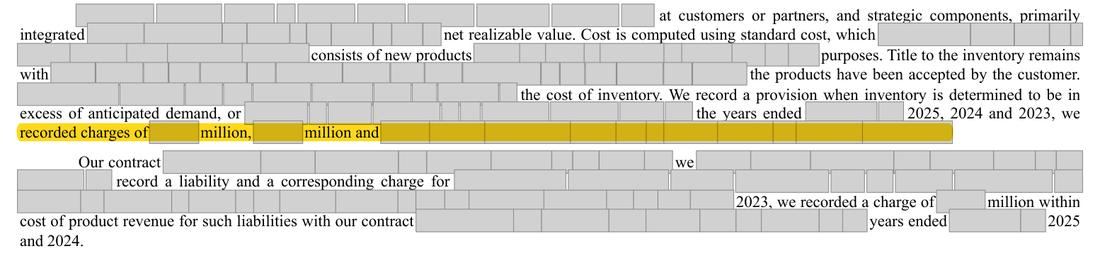
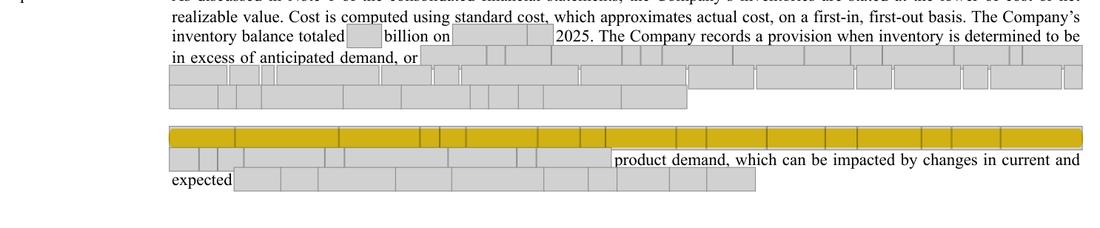
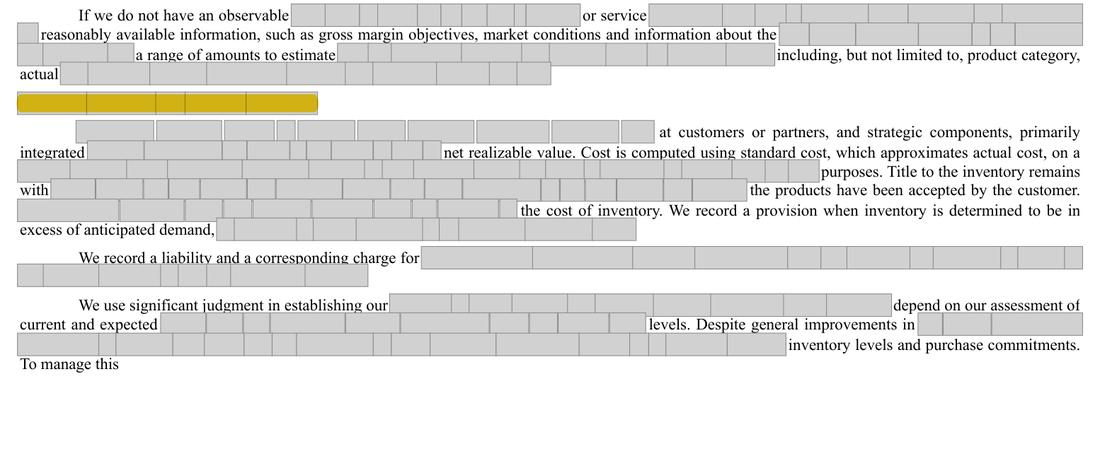
4 further page extracts: screenshot withheld to protect the company’s identity. The rows below say what each shows.
What the filing shows, and what the rule requires
| What the filing shows | What the rule requires |
|---|---|
Inventory estimate text: [n] of [n] words repeat Note 1 (97.2%); revenue estimate text: [n] of [n] words repeat Note 1 (99.3%); no amount, change or sensitivity for any of the three estimates, although Note 1 gives write-downs of [amounts] and Note 8 gives unrecognized tax benefits of [amounts]. | For each critical accounting estimate: why it is uncertain for this company this year, how much the estimate and its key assumptions changed (for example write-downs fell from [amount] to [amount]), and the sensitivity of the reported amount to a reasonably possible change in the key assumption (for example the forecast demand behind the inventory reserve and supplier liabilities), written to supplement Note 1 rather than repeat it. |
The rule
Regulation S-K Item 303(b)(3) (critical accounting estimates)
This information should include why each critical accounting estimate is subject to uncertainty and, to the extent the information is material and reasonably available, how much each estimate and/or assumption has changed over a relevant period, and the sensitivity of the reported amount to the methods, assumptions and estimates underlying its calculation.
Version: Text in force at the date of this review · Source: 17 CFR 229.303(b)(3), Regulation S-K, as amended by Release 33-10890 (eCFR current text)
Regulation S-K Item 303(b), Instruction 3
For critical accounting estimates, this disclosure must supplement, but not duplicate, the description of accounting policies or other disclosures in the notes to the financial statements.
Version: Text in force at the date of this review · Source: 17 CFR 229.303, Instructions to paragraph (b), Regulation S-K, as amended by Release 33-10890 (eCFR current text)
Why it applies here. The change figures are printed in the same filing, so they are reasonably available, and the [amount] fall in write-downs is 3.19% of pre-tax income. The fiscal 2024 Form 10-K was written the same way.
Why it matters
- Investors cannot see how far the inventory reserve and supplier liabilities, the estimate the auditor singled out, depend on demand forecasts, or why write-downs halved.
- Critical estimates are a standing SEC staff comment topic; a request for quantified disclosure in future filings is the realistic outcome, with no fine.
How often the SEC staff raises this. In 1,100 SEC staff comment letters on fiscal 2023 and 2024 Forms 10-K, released January 2025 to October 2026, critical accounting estimates drew 23 of the 1,774 numbered comments (1.3%): topic 16 of 25 by frequency.
Exposure
A staff comment letter asking for quantified change and sensitivity, and a future-filings undertaking; no fine
Our workings
the Critical Accounting Estimates section covers revenue recognition, inventory valuation and supplier liabilities, and income taxes. It contains no dollar amount or percentage. Note 1 records inventory write-downs of [amounts] for 2025, 2024 and 2023; Note 8 gives gross unrecognized tax benefits of [amounts]. The auditor's report names inventory valuation and supplier liability as the critical audit matter because the demand forecasts behind it are complex and highly judgmental. The MD&A cash-flow discussion attributes a [amount] increase in deferred revenue to product deferrals under contracts with acceptance terms, but the revenue estimate text now covers only the allocation of price between products and support; the fiscal 2024 text (Form 10-K 2024 (prior year) p.66) also described the acceptance-term deferral, which has been dropped.
word-sequence comparison of each estimate text with the matching Note 1 policy gives 97.2% (inventory) and 99.3% (revenue) repeated in runs of five or more words; the write-down charge moved by [amount], 3.19% of pre-tax income.
Item 303(b)(3) requires, to the extent material and reasonably available, how much each estimate changed and its sensitivity, and Instruction 3 to Item 303(b) requires the section to supplement, not duplicate, the policy note. The change figures are in the same filing, so they are reasonably available, and a movement of 3.19% of pre-tax income in the estimate the auditor singled out is material. The section as written meets neither requirement, and the same pattern appears in the fiscal 2024 Form 10-K.
| Critical accounting estimate | Why uncertain | Change over a period | Sensitivity | Supplements the notes? |
|---|---|---|---|---|
| Inventory valuation and supplier liabilities | Given qualitatively: demand forecasts, supplier lead times | Absent; Note 1 gives write-downs [n] / [n] / [n] | Absent | No: [n] / [n] = 97.2% of words repeat Note 1 |
| Revenue recognition | Partial: standalone selling price judgment only; acceptance-term deferral text dropped | Absent | Absent | No: [n] / [n] = 99.3% of words repeat Note 1 (p.73-74, 77-78) |
| Income taxes | Given qualitatively: valuation allowance and uncertain positions | Absent; Note 8 gives unrecognized tax benefits [n] / [n] | Absent | Yes: [n] / [n] = [n]% repeats Note 1 |
| Change in inventory write-downs, $ million | [n] - [n] = [n] | |||
| Share of pre-tax income | [n] / [n] = 3.19% | |||
| Change in unrecognized tax benefits, $ million | [n] - [n] = [n] |
Management’s best defense, and our reply
Management would say the quantitative elements of Item 303(b)(3) apply only to the extent material and reasonably available, that a reserve driven by thousands of part-level forecasts has no single assumption whose sensitivity can be stated meaningfully, and that the write-down figures are already in Note 1 by cross-reference. It would add that the staff reviewed the fiscal 2023 Form 10-K, whose estimates were written the same way, and closed its review in [date] without a comment on this section. However, the change figures are printed in the same filing, so they are reasonably available, and Instruction 3 forbids duplicating the policy note, which is what 97.2% and 99.3% repetition does. The staff's closing letter states that the company remains responsible for the adequacy of its disclosure notwithstanding the absence of comment, and the auditor's choice of this estimate as its critical audit matter confirms its significance.
The fix
- Rewrite each estimate to add the period figures and a sensitivity, for example: 'Inventory write-downs were [amount] in 2025 ([amount] in 2024); the decrease reflects [reason]. A 10% reduction in forecast demand for [product families] would have increased write-downs and supplier liabilities by approximately $[x] million.' Restore the acceptance-term revenue judgment and give the product deferred revenue balance subject to acceptance.
Evidence relied on
| # | What it shows | Type | Where |
|---|---|---|---|
| 1 | The inventory estimate is described only in qualitative policy terms | Document | Form 10-K 2025, page 61 |
| 2 | The inventory estimate text ends without any amount, change or sensitivity | Document | Form 10-K 2025, page 62 |
| 3 | Note 1 gives the write-down charges for 2025, 2024 and 2023: the change figures were available | Document | Form 10-K 2025, page 75 |
| 4 | The auditor's critical audit matter is the same estimate | Document | Form 10-K 2025, page 66 |
| 5 | The revenue estimate covers only the allocation of price between products and support | Document | Form 10-K 2025, page 61 |
| 6 | MD&A itself shows the acceptance-term deferral grew sharply in 2025 | Document | Form 10-K 2025, page 59 |
| 7 | Note 8 gives the uncertain-tax-position amounts the income-tax estimate does not mention | Document | Form 10-K 2025, page 93 |
| 8 | The fiscal 2024 revenue estimate described the acceptance-term deferral that fiscal 2025 drops | Document | Form 10-K 2024 (prior year), page 66 |
| 9 | The prior-year critical accounting estimate for inventory opens with the policy wording | Document | Form 10-K 2024 (prior year), page 66 |
| 10 | The prior-year accounting-policy note uses the same words | Document | Form 10-K 2024 (prior year), page 81 |
Absence check
- Document
- Form 10-K 2025
- Where it would appear
- Inventory Valuation and Supplier Liabilities
- What is missing
- any amount for the inventory and supplier-liability estimate, how it changed over the period, and its sensitivity to the demand forecast
- Pages looked at
- p.61-62 (critical accounting estimates), p.66 (critical audit matter), p.75-76 (Note 1 inventory policy)
- Result
- 'sensitiv' hits only risk factors on p.13, [n] ('sensitive data', 'price sensitivities') and Item 7A on p.63 ('Interest Rate Sensitivity'); 'hypothetical' and 'basis point' hit only p.63 (the interest-rate effect on the investment portfolio). None concerns an accounting estimate. 'reasonably possible change' and '10% increase' have no hits.
Absence check
- Document
- Form 10-K 2025
- Where it would appear
- Income Taxes
- What is missing
- any amount, change or sensitivity for the income-tax estimate (unrecognized tax benefits, valuation allowance)
- Pages looked at
- p.62 (critical accounting estimates), p.90-93 (Note 8)
- Result
- 'sensitiv' hits only p.13, [n] (risk factors) and p.63 (Item 7A interest rates); 'hypothetical' hits only p.63. None concerns the income-tax estimate. 'reasonably possible change' has no hits.
Prepared by Pramanex from the company’s public SEC filings, without the company’s involvement, to show how a 10-K Pre-filing Check reads. The company is not named, and nothing on this page is a statement about any identifiable company. Observations are not an audit, review or other attestation or assurance engagement, and not legal advice. An SEC-style question is a question, not a conclusion.
Want this on your own 10-K, before you file?
Start with three free findings on your latest 10-K, or book a fixed-price 10-K Pre-filing Check.
Your next 10-K will be in draft before the audit is done.
Have it read before you file.
Start with three free findings on your latest 10-K, or book a fixed-price 10-K check. Drafts only under NDA, inside your insider trading policy.