1.12 Stock-based compensation: the fair value of RSUs vested cannot be reproduced from the RSU table, and no ESPP valuation inputs are given
Company F · a US-listed networking equipment company · SEC-style question
In brief
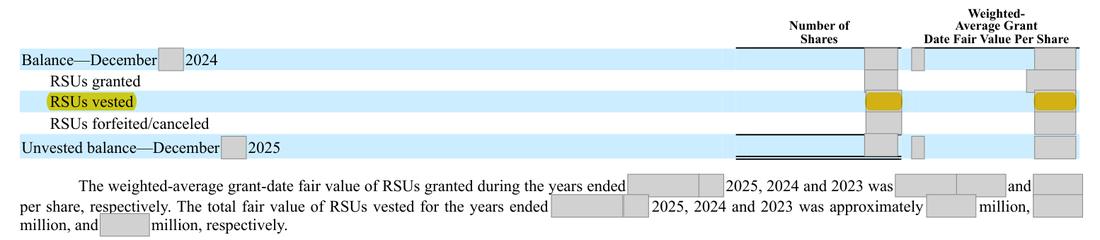
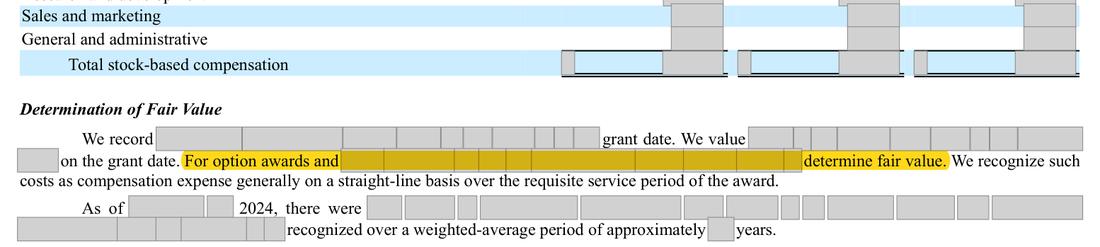
Note 6 says the total fair value of restricted stock units (RSUs) vested in 2025 was [amount], but the RSU table shows [n] units vested at a weighted-average grant-date fair value of [amount], which gives [amount]; the prior year shows the same kind of gap. The note also says the employee stock purchase plan (ESPP) is valued with the Black-Scholes model but gives none of its inputs (volatility, expected term, risk-free rate, dividend yield), in either year. We ask how the vested figure is measured and whether the ESPP inputs were left out as immaterial.
The evidence, as filed
1 further page extract: screenshot withheld to protect the company’s identity. The rows below say what each shows.
What the filing shows, and what the rule requires
| What the filing shows | What the rule requires |
|---|---|
Total fair value of RSUs vested 2025: [amount]; RSU table: [n] vested at [amount] (= [amount]). ESPP valued by Black-Scholes; no assumptions disclosed; [n] ESPP shares issued in 2025 at [amount]. | A vested-RSU fair value that the reader can tie to the table (or a note of its basis, for example vesting-date value or a scope difference), and the significant Black-Scholes assumptions used for ESPP offerings granted in the year, or a statement that ESPP cost is not material. |
The rule
Regulation S-X Rule 4-01(a)(1), read with FASB ASC paragraph 718-10-50-2 (share-based payment disclosures)
Financial statements filed with the Commission which are not prepared in accordance with generally accepted accounting principles will be presumed to be misleading or inaccurate, despite footnote or other disclosures
Version: Text in force at the date of this review · Source: Regulation S-X, 17 CFR 210.4-01
Why it applies here. either the vested figure has a basis the note does not explain (for example, units withheld or a different population), or one of the figures is misstated; only the company can say which.
Why it matters
A reader cannot tie the vested-award value to the award roll-forward, nor judge the inputs behind the ESPP expense.
Exposure
A question only; no reported amount in the statements is affected.
Our workings
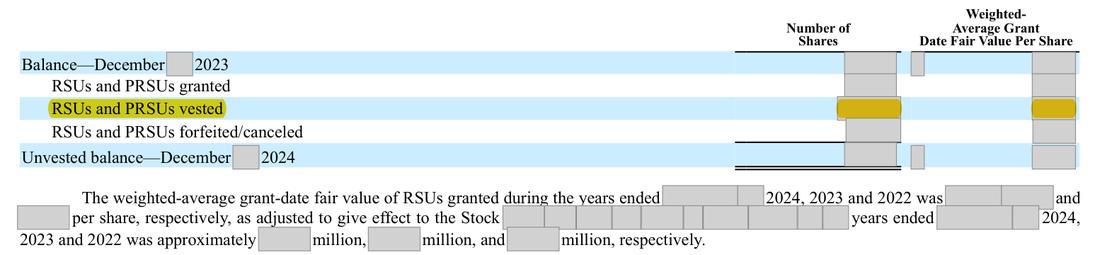
page 88 gives the RSU roll-forward ([n] vested at a weighted-average grant-date fair value of [amount]) and, below it, a total fair value of RSUs vested of [amount]. The prior-year table showed [n] units vested at [amount] against a stated [amount]. Page [n] says option awards and ESPP offerings are valued with the Black-Scholes model; 'risk-free', 'dividend yield' and 'expected term' appear nowhere in either year's report.
[n] x [n] = [n], against [n] printed, a gap of [n] (5.3% of the figure); share rounding ([n] to [n]) moves the product only between [n] and [n]. Prior year: [n] x [n] = [n], or [n], against [n]. Law: Financial Accounting Standards Board (FASB) Accounting Standards Codification (ASC) paragraph 718-10-50-2 asks for the total fair value of shares vested during each year and, for awards granted in the year, a description of the method and the significant assumptions used to estimate fair value (expected term, volatility, dividends, risk-free rate). Grey area: the Codification does not fix whether 'fair value of shares vested' uses grant-date or vesting-date values, and the assumptions need not be given if the ESPP cost is immaterial; no option grants were made, so only ESPP offerings are in scope.
| Item | Computation | Result |
|---|---|---|
| Grant-date value of RSUs vested per the 2025 table | [n] x [n] = [n] | [n] |
| Range allowing for share rounding | [n] x [n] = [n]; [n] x [n] = [n] | [n] to [n] |
| Printed less recomputed | [n] - [n] = ([n]) | ([n]) |
| Gap against the printed figure | [n] / [n] = 5.3% | 5.3% |
| Gap against pre-tax income | [n] / [n] = 0.39% | 0.39% |
| Prior year, same test (thousands) | [n] x [n] = [n] | [n] |
| Prior year in millions (that 10-K prints thousands) | [n] / [n] = [n]; [n] - [n] = -[n] | -[n] |
Management’s best defense, and our reply
The vested figure may be measured on a different basis from the table, for example excluding units withheld for taxes or using a different population of awards, and the Codification does not prescribe which. The ESPP cost is likely small against total stock-based compensation of [amount], so its valuation inputs may be immaterial, and the same presentation was used the year before without comment. However, the note states no basis that reconciles the two figures, the gap is 5.3% of the stated amount and recurs in the prior year, and the model is named without any input. Because the figure may be right on a basis the company has not described, the point is put as a question.
The fix
- State the basis of the vested-RSU fair value (and correct it if it is misstated), and add the ESPP Black-Scholes assumptions for the year, or a sentence that ESPP compensation cost is not material.
Question for the company
On what basis is the 'total fair value of RSUs vested' of [amount] measured, given that the RSU table implies [amount] ([n] units at [amount])? Were the Black-Scholes inputs for ESPP offerings left out because ESPP cost is immaterial?
Evidence relied on
| # | What it shows | Type | Where |
|---|---|---|---|
| 1 | [n] RSUs vested at a weighted-average grant-date fair value of [amount] | Document | Form 10-K 2025, page 88 |
| 2 | The note states [amount] for 2025 | Document | Form 10-K 2025, page 88 |
| 3 | Prior-year table: [n] units vested at [amount] (stated total [amount]) | Document | Form 10-K 2024 (prior year), page 97 |
| 4 | ESPP offerings are valued with the Black-Scholes model | Document | Form 10-K 2025, page 89 |
| 5 | The ESPP was active in 2025: [n] shares issued at [amount] | Document | Form 10-K 2025, page 87 |
Absence check
- Document
- Form 10-K 2025
- Where it would appear
- Determination of Fair Value
- What is missing
- the Black-Scholes assumptions (expected volatility, expected term, risk-free rate, dividend yield) for ESPP offerings granted in the year
- Pages looked at
- p.87-89 (Note 6), p.72-80 (accounting policies)
- Result
- 'risk-free', 'dividend yield' and 'expected term' do not appear in the report. 'volatility' hits p.3, [n], all about business, demand, inventory, interest-rate or share-price risk narrative; none gives a valuation input.
Prepared by Pramanex from the company’s public SEC filings, without the company’s involvement, to show how a 10-K Pre-filing Check reads. The company is not named, and nothing on this page is a statement about any identifiable company. Observations are not an audit, review or other attestation or assurance engagement, and not legal advice. An SEC-style question is a question, not a conclusion.
Want this on your own 10-K, before you file?
Start with three free findings on your latest 10-K, or book a fixed-price 10-K Pre-filing Check.
Your next 10-K will be in draft before the audit is done.
Have it read before you file.
Start with three free findings on your latest 10-K, or book a fixed-price 10-K check. Drafts only under NDA, inside your insider trading policy.