1.06 The note on investments in privately-held companies, given last year with an [amount] carrying amount, has been dropped
Company F · a US-listed networking equipment company · SEC-style question
In brief
The company still holds equity investments in privately-held start-ups: the impairment policy, a risk factor and Item 7A all refer to them. The prior-year Form 10-K gave their measurement policy, a table of cost, upward adjustments and carrying amount ([amount] at [date]) and the related fair-value hierarchy treatment. This year's 10-K gives none of it, so the reader cannot tell the balance, the 2025 gains or losses, or the measurement basis.
The evidence, as filed

4 further page extracts: screenshot withheld to protect the company’s identity. The rows below say what each shows.
What the filing shows, and what the rule requires
| What the filing shows | What the rule requires |
|---|---|
No carrying amount, measurement policy, upward or downward adjustments or impairments for equity securities without readily determinable fair values; the investments are mentioned only in the impairment policy, the segment note's long-lived-asset definition, a risk factor and Item 7A. | For equity securities measured under the measurement alternative: the carrying amount, impairments and downward adjustments, and upward adjustments for the year and cumulatively, with the fair-value level of the remeasurements; or a statement that the investments are not material. |
The rule
ASC 321-10-50-3 (equity securities under the measurement alternative) and ASC 820-10-50-2 (fair-value disclosures, incl. nonrecurring Level 3)
Summary; FASB/IFRS text is copyrighted Disclose fair values by hierarchy level, Level 3 techniques and significant unobservable inputs with ranges and weighted averages, Level 3 changes and measurement uncertainty.
Version: Text in force at the date of this review · Source: FASB Accounting Standards Codification, ASC 820-10-50-2 (as amended by ASU 2018-13) and ASC 321-10-50-3 (as amended by ASU 2016-01); paraphrase
Why it applies here. the Accounting Standards Codification (ASC) asks an entity using the measurement alternative for equity securities to disclose their carrying amount, impairments and downward adjustments, and upward adjustments, for the period and cumulatively, and nonrecurring fair-value remeasurements have their own fair-value disclosures. The company may have judged the balance immaterial, but Item 7A calls the investments a primary exposure, which sits uneasily with that.
Why it matters
Readers cannot see the size of the start-up portfolio, the gains taken to other income on observable price changes, or any impairment, although Item 7A calls it a primary market risk.
Exposure
A question for management; if material, the realistic consequence is restored disclosure in the next Form 10-K after a staff comment.
Our workings
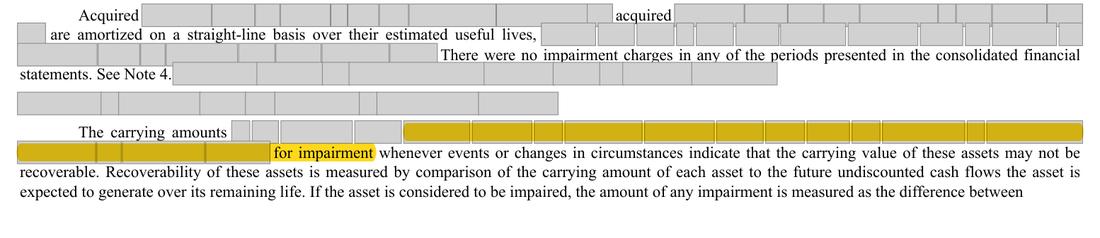
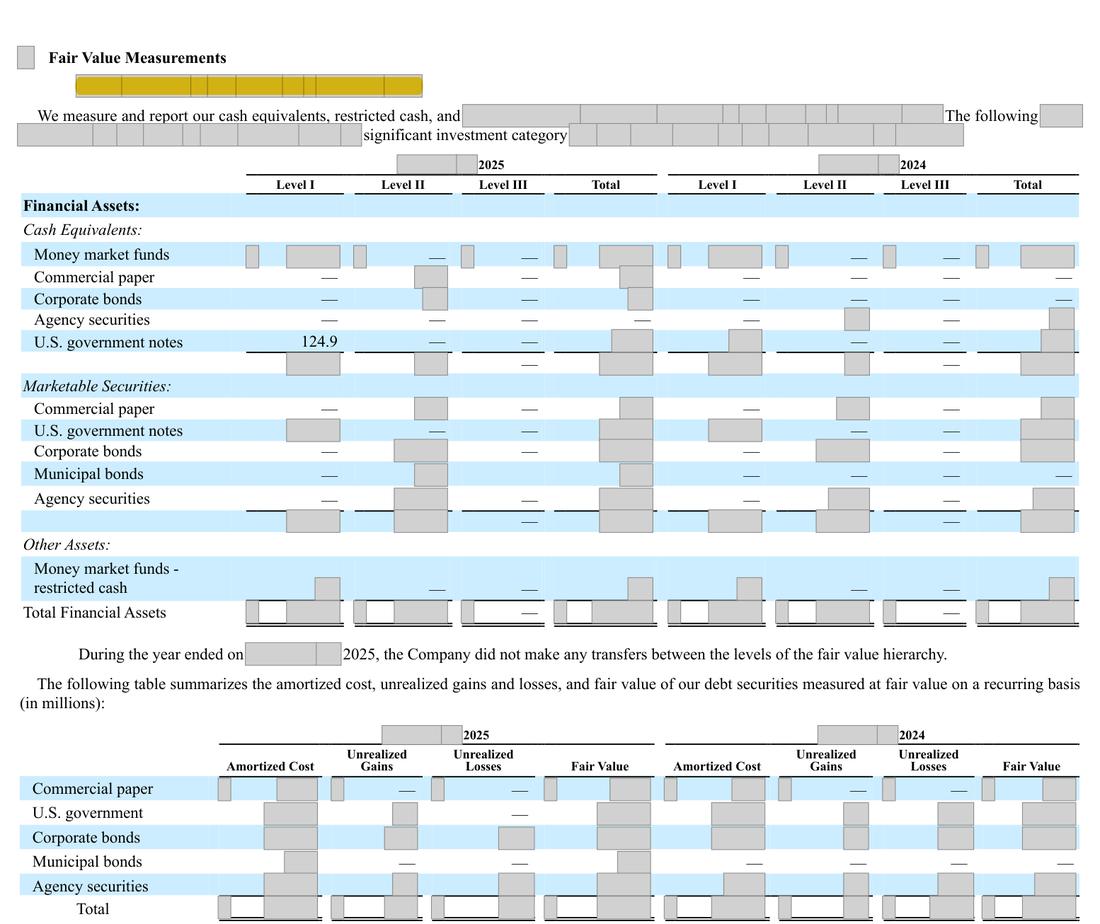
the prior-year Form 10-K carried a paragraph on non-marketable equity securities in privately-held companies (adjusted to fair value on observable price changes, classified in Level III) and a table showing cost of [n], cumulative upward adjustments of [n] and a carrying amount of [n] in other assets at [date]. In this 10-K the investments are still referred to in the impairment policy on Note 1, in the segment note's definition of long-lived assets, in a risk factor ('the privately held companies in which we invest') and in Item 7A, which names strategic equity investments as a primary market-risk exposure; the fair-value note covers only recurring measurements.
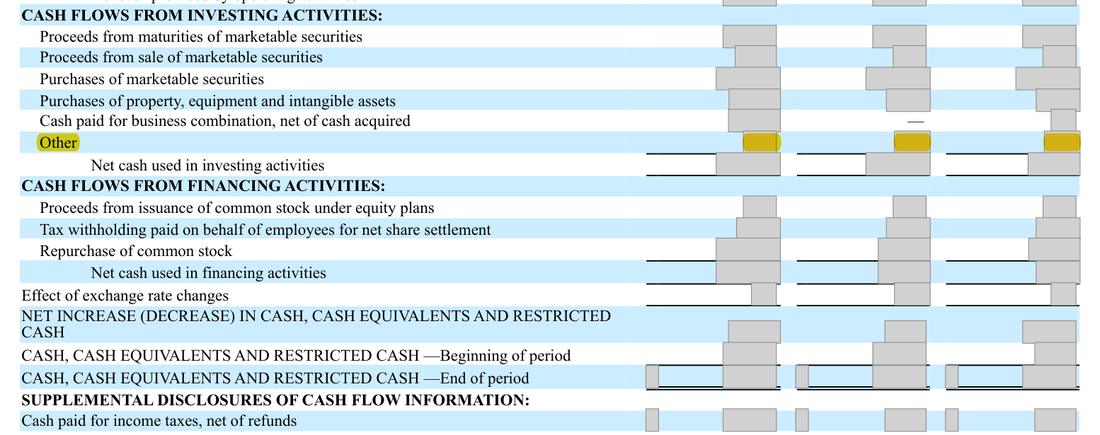
the carrying amount was [n] / [n] = [n]; 2024 upward adjustments were [n] - [n] = [n] = [n], 0.38% of 2024 pre-tax income; 2024 additions of [n] - [n] = [n] match the 'other' investing outflow of ([n]) thousand, and the 2025 'other' investing line turned to an inflow of [n], which may include proceeds from these investments.
| Line | Arithmetic | Source |
|---|---|---|
| Carrying amount [date] (thousands to millions) | [n] / [n] = [n] | Form 10-K 2024 (prior year) p.89 (prior 10-K printed thousands) |
| Upward adjustments in 2024 | [n] - [n] = [n] = [n] | Form 10-K 2024 (prior year) p.89 |
| 2024 upward adjustments against 2024 pre-tax income | [n] / [n] = 0.38% | p.69 |
| Additions in 2024 | [n] - [n] = [n] = [n] (= other investing outflow ([n]) thousand) | Form 10-K 2024 (prior year) p.89 and p.78 |
| 2025 other investing line | [n] inflow (2024: ([n]) outflow) | p.72 |
| Carrying amount against 2025 total assets (2024 balance) | [n] / [n] = 0.42% | p.68 |
Management’s best defense, and our reply
Management would say the start-up portfolio is small against the balance sheet, at 0.42% of total assets on the last disclosed carrying amount. They would say the 2024 gains were only 0.38% of pre-tax income, so the specific disclosures could be omitted as immaterial in a year when the notes were streamlined. They would add that the impairment policy still tells readers how the assets are reviewed. The defense is tenable on those numbers, which is why this is a question. However, the 2025 balance is not given, so materiality cannot be checked, and Item 7A still presents the investments as a primary exposure.
The fix
- Restore the paragraph and table: 'Our non-marketable equity securities ... had a carrying amount of $[ ] million at [date] (2024: [amount]), including cumulative upward adjustments of $[ ] million and impairments of $[ ] million; upward adjustments of $[ ] million were recorded in other income, net in 2025.'
Question for the company
What was the carrying amount of the investments in privately-held companies at [date], and what upward adjustments, impairments or disposals were recorded in 2025 (including any in the [n] 'other' investing inflow)? If the disclosure was removed as immaterial, how does that square with Item 7A naming these investments as a primary market-risk exposure?
Evidence relied on
| # | What it shows | Type | Where |
|---|---|---|---|
| 1 | The investments are still held and subject to the impairment policy | Document | Form 10-K 2025, page 76 |
| 2 | Risk factor confirms continuing investments | Document | Form 10-K 2025, page 23 |
| 3 | Item 7A names the investments as a primary market-risk exposure | Document | Form 10-K 2025, page 63 |
| 4 | Segment note excludes the investments from long-lived assets | Document | Form 10-K 2025, page 94 |
| 5 | Other investing cash flows: inflow of [n] in 2025 | Document | Form 10-K 2025, page 72 |
| 6 | Prior year: cumulative upward adjustments (thousands) | Document | Form 10-K 2024 (prior year), page 89 |
| 7 | Prior year: cost of the investments (thousands) | Document | Form 10-K 2024 (prior year), page 89 |
| 8 | Prior year: other investing outflow equals the 2024 additions | Document | Form 10-K 2024 (prior year), page 78 |
| 9 | Pre-tax income benchmark (2024: [n]) | Document | Form 10-K 2025, page 69 |
| 10 | Total assets benchmark | Document | Form 10-K 2025, page 68 |
Absence check
- Document
- Form 10-K 2025
- Where it would appear
- Assets measured at fair values on a recurring basis
- What is missing
- the measurement policy, carrying amount and adjustments for non-marketable equity securities in privately-held companies (nonrecurring Level III)
- Pages looked at
- p.52-63 (MD&A and Item 7A), 72-76 (statements), 77-98 (notes)
- Result
- 'non-marketable', 'measurement alternative', 'upward adjustment' and 'readily determinable' have no hits. 'privately-held' hits the impairment policy and the segment note's long-lived-asset definition; 'privately held' hits a risk factor; 'strategic equity' hits Item 7A. None gives a carrying amount, measurement basis or adjustment.
Prepared by Pramanex from the company’s public SEC filings, without the company’s involvement, to show how a 10-K Pre-filing Check reads. The company is not named, and nothing on this page is a statement about any identifiable company. Observations are not an audit, review or other attestation or assurance engagement, and not legal advice. An SEC-style question is a question, not a conclusion.
Want this on your own 10-K, before you file?
Start with three free findings on your latest 10-K, or book a fixed-price 10-K Pre-filing Check.
Your next 10-K will be in draft before the audit is done.
Have it read before you file.
Start with three free findings on your latest 10-K, or book a fixed-price 10-K check. Drafts only under NDA, inside your insider trading policy.