1.04 The lease disclosures given last year are cut to one sentence, with no lease liability, right-of-use asset or maturity analysis, although the tax note shows lease balances growing
Company F · a US-listed networking equipment company · SEC-style question
In brief
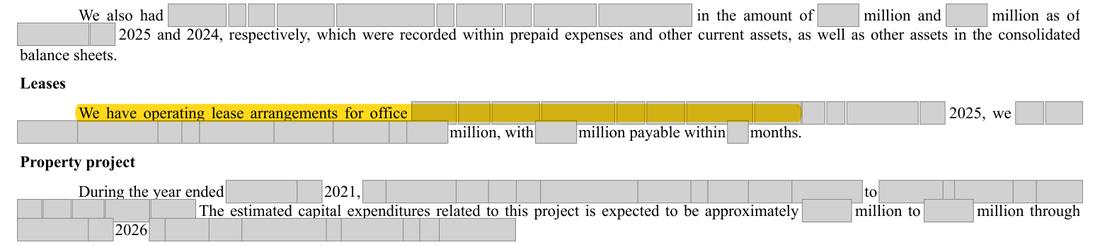
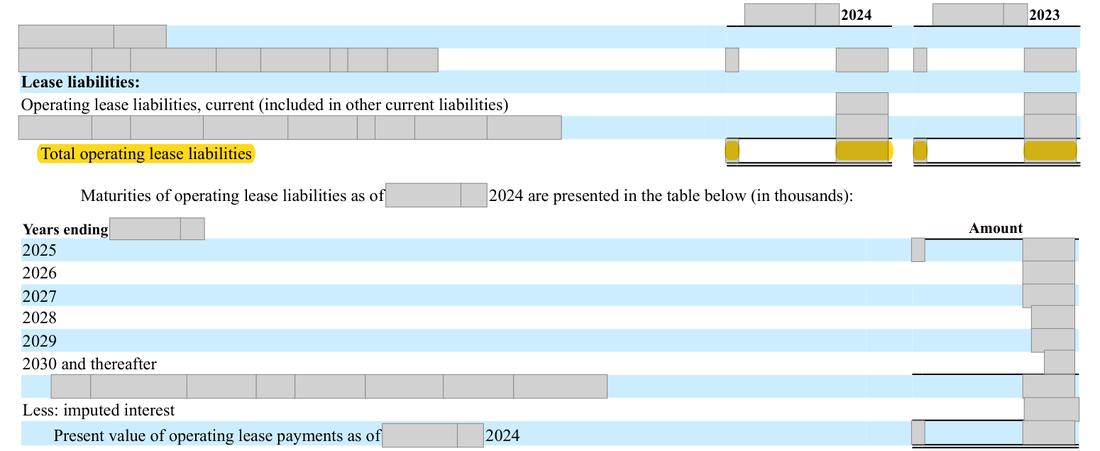
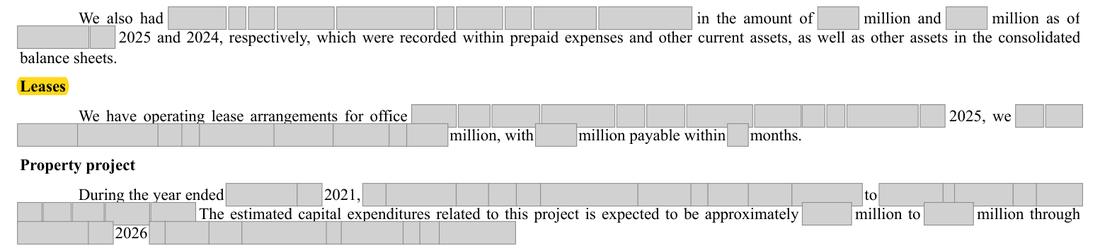
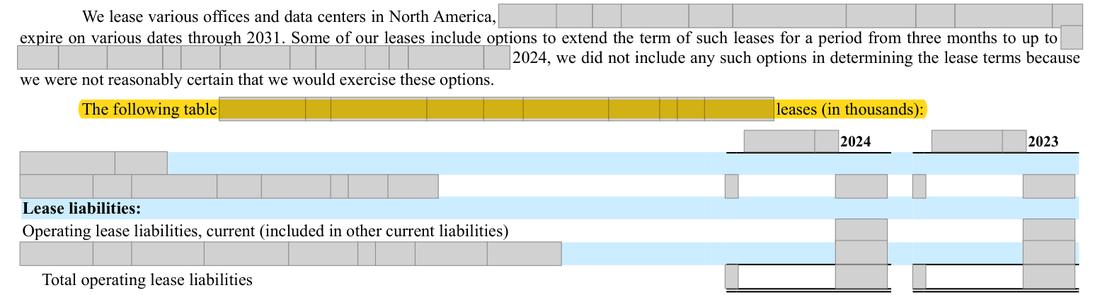
Note 5 now says only that operating lease payment obligations were [amount], with [amount] due within 12 months. The prior-year Form 10-K gave the right-of-use asset, the current and non-current lease liabilities and the balance-sheet lines holding them, and a maturity analysis reconciled to the liability ([amount] undiscounted, [amount] discounted); the lease accounting policy has also gone from the policy note. Obligations rose 38.6% in the year, and the tax note's deferred tax on the lease obligation rose from [amount] to [amount], yet this 10-K gives no lease liability at all (fiscal 2025, consolidated statements). We ask whether the company judged the lease disclosures immaterial.
The evidence, as filed
What the filing shows, and what the rule requires
| What the filing shows | What the rule requires |
|---|---|
One sentence: 'lease payment obligations, net of immaterial sublease income, of [amount], with [amount] payable within 12 months'; no right-of-use asset, lease liability, balance-sheet line, maturity table, lease cost, weighted-average term, discount rate or lease accounting policy; the only lease balances are the deferred tax lines in the income-tax note ([n] and [n]). | The lessee disclosures (right-of-use asset and lease liabilities with their balance-sheet lines, a maturity analysis for each of the next five years and thereafter reconciled to the liability, lease cost, weighted-average remaining term and discount rate, cash paid), or a statement that leases are not material. |
The rule
Regulation S-X Rule 4-01(a)(1), read with FASB ASC paragraphs 842-20-45-1 and 842-20-50-1 to 50-10 (lessee disclosures)
Financial statements filed with the Commission which are not prepared in accordance with generally accepted accounting principles will be presumed to be misleading or inaccurate, despite footnote or other disclosures
Version: Text in force at the date of this review · Source: Regulation S-X, 17 CFR 210.4-01
Why it applies here. the company appears to have judged leases immaterial, but the note does not say so, and the change came in a year when the obligations grew.
Why it matters
Readers cannot find the lease liability or right-of-use asset inside other liabilities and other assets, or see the discounting and maturity profile behind obligations that grew in the year.
Exposure
A question only; if leases are material, a staff comment and a future-filings undertaking would be the realistic outcome.
Our workings
the Leases paragraph on page 86 is one sentence. The prior-year Form 10-K gave a supplemental balance-sheet table (right-of-use assets in other assets; current and non-current lease liabilities in other current and other long-term liabilities) and a maturity table reconciled from [amount] undiscounted to [amount]. The words 'right-of-use', 'lease liability', 'discount rate' and 'lease cost' appear nowhere in this report (the abbreviation 'ROU assets' appears once, in the impairment policy on page 76, with no amount), and the lease accounting policy that the prior-year report carried is no longer in the policy note. The only lease balances left are tax effects: the income-tax note (page 92) shows a deferred tax asset on a 'lease financing obligation' of [n] (2024: [n]) and a deferred tax liability on a 'right of use asset' of [n] (2024: [n]), both higher than a year earlier, so the lease balances behind them grew rather than fell away.
[n] - [n] = [n], a rise of 38.6%; the obligations are 0.47% of total assets. Law: Financial Accounting Standards Board (FASB) Accounting Standards Codification (ASC) paragraphs 842-20-50-1 to 50-10 set a lessee disclosure objective and then specific items: lease cost by component, weighted-average remaining lease term and discount rate, cash paid and right-of-use assets obtained (paragraph 842-20-50-4), and a maturity analysis for each of the first five years and thereafter, reconciled to the lease liabilities (paragraph 842-20-50-6); paragraph 842-20-45-1 asks which balance-sheet lines hold the right-of-use assets and lease liabilities when they are not shown separately. Regulation S-X Rule 4-01(a)(1) makes GAAP compliance a filing condition. Grey area: the Codification need not be applied to immaterial items, and a lessee whose leases are immaterial may drop these tables.
| Item | Computation | Result |
|---|---|---|
| Prior-year undiscounted payments in millions (that 10-K prints thousands) | [n] / [n] = [n] | [n] |
| Change in undiscounted obligations | [n] - [n] = [n] | [n] |
| Growth in the year | [n] / [n] = 38.6% | 38.6% |
| Obligations against total assets | [n] / [n] = 0.47% | 0.47% |
| Obligations against pre-tax income | [n] / [n] = 2.13% | 2.13% |
| Deferred tax on lease balances (tax note, page 92) | lease financing obligation [n] - [n] = [n]; right of use asset [n] - [n] = [n] | both up |
Management’s best defense, and our reply
Lease obligations of [amount] are 0.47% of total assets, and lease cost is small against operating expenses. The Codification need not be applied to immaterial items, so the detailed lease tables can be left out. The note still gives the total obligation and the portion due within 12 months, and removing immaterial detail makes the filing clearer. However, the company gave the full disclosures the year before at a lower level of obligations, the note neither states the liability nor says leases are immaterial, and the lease policy was removed at the same time. Because a reasonable preparer could judge these leases immaterial, the point is put as a question.
The fix
- Restore the lessee disclosures in the next Form 10-K, or state: 'Our operating leases are not material to our consolidated financial statements; right-of-use assets and lease liabilities are included in other assets and other current and long-term liabilities.'
Question for the company
Did the company conclude that its operating leases are immaterial, so that the disclosures given in the prior-year Form 10-K (right-of-use asset, lease liabilities and their balance-sheet lines, maturity analysis reconciled to the liability, lease cost, weighted-average term and discount rate) could be dropped, although undiscounted obligations rose 38.6% to [amount]? What was the lease liability at [date]?
Evidence relied on
| # | What it shows | Type | Where |
|---|---|---|---|
| 1 | The company has operating leases of offices, data centers and equipment | Document | Form 10-K 2025, page 86 |
| 2 | The only lease figures given: [amount] of obligations, [amount] within 12 months | Document | Form 10-K 2025, page 86 |
| 3 | The prior-year 10-K gave the lease liability on the balance sheet ([amount] at [date]) | Document | Form 10-K 2024 (prior year), page 94 |
| 4 | The prior-year maturity table reconciled [amount] of undiscounted payments to the liability | Document | Form 10-K 2024 (prior year), page 94 |
| 5 | The policy note runs straight from property and equipment to business combinations: no lease policy | Document | Form 10-K 2025, page 76 |
| 6 | The prior-year policy note carried a lease policy (right-of-use assets and lease liabilities) | Document | Form 10-K 2024 (prior year), page 82 |
| 7 | Deferred tax asset on lease liabilities rose from [n] to [n] | Document | Form 10-K 2025, page 92 |
| 8 | Deferred tax liability on right-of-use assets rose from [n] to [n] | Document | Form 10-K 2025, page 92 |
Absence check
- Document
- Form 10-K 2025
- Where it would appear
- Leases
- What is missing
- right-of-use asset, lease liabilities and their balance-sheet lines, maturity analysis reconciled to the liability, lease cost, weighted-average remaining term and discount rate
- Pages looked at
- p.86 (Note 5), p.76 (property and equipment and business-combination policies), p.68 (balance sheet), p.60 (MD&A cash requirements)
- Result
- 'right-of-use', 'lease liabilit', 'discount rate' and 'lease cost' do not appear in the report; the abbreviation 'ROU assets' appears once on p.76 in the impairment policy, with no amount. 'remaining lease term' hits only p.76, in the depreciation policy for leasehold improvements. 'operating lease' hits p.60 (MD&A repeating the same one-sentence obligation figure) and p.86 (this sentence).
Absence check
- Document
- Form 10-K 2025
- Where it would appear
- Property and Equipment
- What is missing
- the lease accounting policy (right-of-use assets, lease liabilities, discount rate, short-term lease exemption) carried the year before
- Pages looked at
- p.72-80 (summary of significant accounting policies)
- Result
- None of the four terms appears anywhere in the report.
Prepared by Pramanex from the company’s public SEC filings, without the company’s involvement, to show how a 10-K Pre-filing Check reads. The company is not named, and nothing on this page is a statement about any identifiable company. Observations are not an audit, review or other attestation or assurance engagement, and not legal advice. An SEC-style question is a question, not a conclusion.
Want this on your own 10-K, before you file?
Start with three free findings on your latest 10-K, or book a fixed-price 10-K Pre-filing Check.
Your next 10-K will be in draft before the audit is done.
Have it read before you file.
Start with three free findings on your latest 10-K, or book a fixed-price 10-K check. Drafts only under NDA, inside your insider trading policy.