4.09 Item 7A discusses interest-rate risk only on undrawn borrowings, not on the cash invested in money market funds that earns interest income
Company E · a US-listed home furnishings retailer · SEC-style question
In brief
Item 7A says the company is primarily exposed to interest-rate risk on borrowing under its credit facility, on which nothing is drawn, and that a [n] basis point change would not be material 'to the extent borrowings were outstanding'. The notes say cash is invested in money market funds and interest-bearing accounts that earned [amount] of interest income in 2025, on a cash balance of [n] (US dollars in thousands). A [n] basis point change on the balance excluding card receipts in transit is about [n] a year, [n]% of pre-tax income and 27.3% of interest income; Item 7A does not mention this exposure.
The evidence, as filed

What the filing shows, and what the rule requires
| What the filing shows | What the rule requires |
|---|---|
Interest Rate Risk paragraph limited to the 2021 Credit Facility (no borrowings) with a [n] basis point statement that applies only 'to the extent borrowings were outstanding'; no mention of the cash and money market balance of [n] or of the interest income it earns ([amount] in 2025). | Item 7A identifies the cash and money market balance as the primary interest-rate exposure and gives either a sensitivity (for example the effect of a [n] basis point change on annual interest income, about [n]) or a reasoned statement that the exposure is not material, with the prior-year comparison. |
The rule
Regulation S-K Item 305(b)(1)(iii)
Changes in either the registrant's primary market risk exposures or how those exposures are managed, when compared to what was in effect during the most recently completed fiscal year and what is known or expected to be in effect in future reporting periods.
Version: Text in force at the date of this review · Source: Regulation S-K, 17 CFR 229.305 (eCFR, current text)
Regulation S-K Item 305(a)(1)
Within both the trading and other than trading portfolios, separate quantitative information shall be presented, to the extent material, for each market risk exposure category (i.e., interest rate risk, foreign currency exchange rate risk, commodity price risk, and other relevant market risks, such as equity price risk).
Version: Text in force at the date of this review · Source: Regulation S-K, 17 CFR 229.305 (eCFR, current text)
Regulation S-K Item 305, General Instruction 3.C.i to paragraphs 305(a) and 305(b)
Other financial instruments include, but are not limited to, trade accounts receivable, investments, loans, structured notes, mortgage-backed securities, trade accounts payable, indexed debt instruments, interest-only and principal-only obligations, deposits, and other debt obligations;
Version: Text in force at the date of this review · Source: Regulation S-K, 17 CFR 229.305, General Instructions to paragraphs (a) and (b) (eCFR, current text)
Why it applies here. Item 305(b)(1) asks for the registrant's primary market risk exposures and Item 305(a)(1) for quantitative information, to the extent material, for each exposure category; money market funds and deposits are other financial instruments within the Item. The undrawn facility carries no rate exposure today, while the cash balance does; whether that exposure is material is a judgment for management, which is why the point is a question.
Why it matters
Readers are told the interest-rate exposure is on borrowings that do not exist, while the exposure that does exist, on a cash balance earning [amount] a year, is not described; a staff comment could ask for the sensitivity.
Exposure
A question for management on materiality; if the exposure is judged material, the realistic consequence is a staff comment and a future-filings undertaking, with no fine.
Our workings
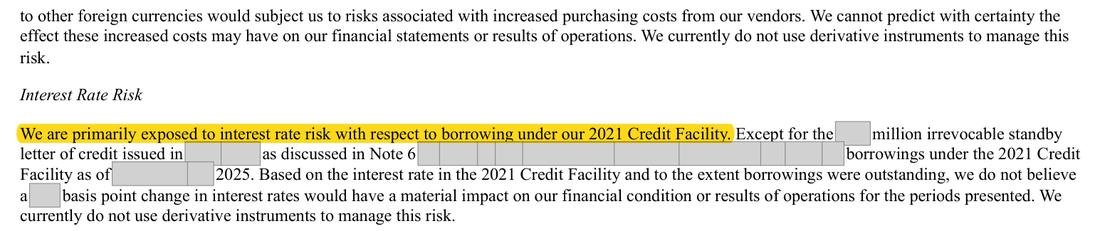
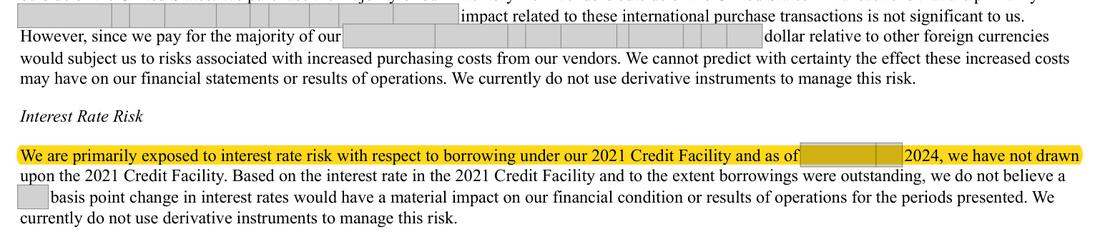
Item 7A (p.52) says 'We are primarily exposed to interest rate risk with respect to borrowing under our 2021 Credit Facility', that there are no borrowings other than a standby letter of credit, and that 'to the extent borrowings were outstanding' a [n] basis point change would not be material. Note 2 (p.61) says the company invests in money market funds and interest-bearing checking accounts and earned [amounts] of interest income in 2025, 2024 and 2023, and that cash includes [amount] of credit card receipts in transit. The balance sheet shows cash and cash equivalents of [n]. The prior-year Item 7A has the same wording.
[n] = [n]; [n] - [n] = [n] of balances that can earn interest; 1% of [n] = [n] a year; [n] / [n] = [n]% of pre-tax income; [n] / [n] = 27.3% of 2025 interest income.
- Card receipts in transit: [n] = [n]
- Interest-earning balance: [n] - [n] = [n]
- Effect of [n] basis points: [n] x 1% = [n]
- Against pre-tax income: [n] / [n] = [n]%
- 2025 interest income: [n] = [n]
- Against interest income: [n] / [n] = 27.3%
Management’s best defense, and our reply
Management would say a [n] basis point move on the cash balance changes pre-tax income by about [n]%, below any reasonable materiality threshold, so Item 305 requires nothing more, and the existing statement that a [n] basis point change would not have a material impact already covers the periods presented. It would add that money market funds carry negligible fair-value risk because of their short maturity. The answer: the 7A statement is expressly limited to borrowings 'to the extent borrowings were outstanding', so it does not speak to the cash exposure at all, and the effect is over a quarter of interest income; whether that is material is management's call, which is why the point is put as a question rather than a breach.
The fix
- Add to Item 7A: 'Our primary interest-rate exposure is on cash and cash equivalents, held mainly in money market funds and interest-bearing accounts. A [n] basis point decrease in rates would reduce annual interest income by approximately [amount] based on balances at [date] (2024: $[x] million).'
Question for the company
Does management regard the interest-rate exposure on cash and money market balances (about [amount] of annual interest income per [n] basis points) as not material, and if so would it state that in Item 7A; otherwise will the next Form 10-K present that exposure and its sensitivity in place of the borrowing-only paragraph?
Evidence relied on
| # | What it shows | Type | Where |
|---|---|---|---|
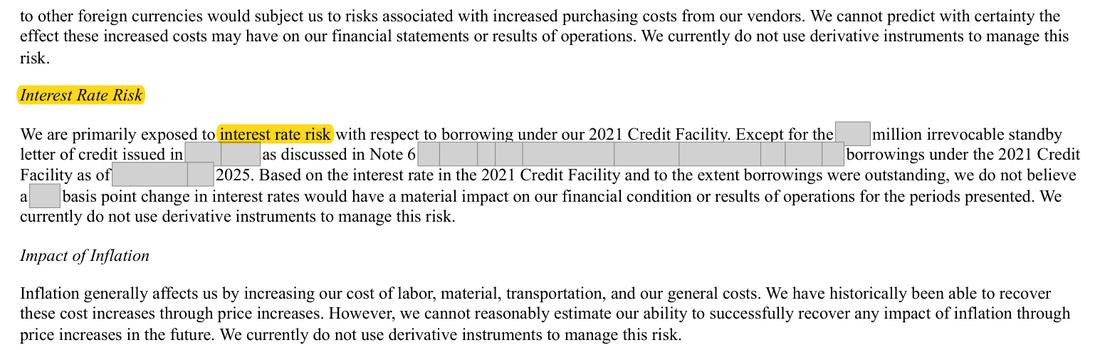
| 1 | Item 7A names borrowings as the primary interest-rate exposure | Document | Form 10-K 2025, page 52 |
| 2 | The [n] basis point statement is limited to borrowings, which are nil | Document | Form 10-K 2025, page 52 |
| 3 | The [n] basis point sensitivity statement | Document | Form 10-K 2025, page 52 |
| 4 | Cash is held in interest-earning instruments | Document | Form 10-K 2025, page 61 |
| 5 | Interest income earned on the cash balance, 2025, 2024, 2023 | Document | Form 10-K 2025, page 61 |
| 6 | Non-interest-bearing card receipts in transit, excluded from the sensitivity base | Document | Form 10-K 2025, page 61 |
| 7 | Cash balance at year end | Document | Form 10-K 2025, page 56 |
| 8 | Pre-tax income used as the benchmark | Document | Form 10-K 2025, page 57 |
Absence check
- Document
- Form 10-K 2025
- Where it would appear
- Interest Rate Risk
- What is missing
- Any discussion or sensitivity of the interest-rate exposure on cash, money market funds and interest-bearing accounts
- Pages looked at
- p.51-52 (Item 7A), p.61 (Note 2 cash and cash equivalents)
- Result
- 'money market' hits only Note 2 on p.61 (the investment policy, no sensitivity); 'interest income' hits the income statement and MD&A lines (p.45-48, [n]), Note 2 and lease notes (p.64, [n]), none in Item 7A; 'cash equivalents' hits risk factors, MD&A liquidity, statements and Note 2, none in Item 7A; '[n] basis point' hits only the borrowings sentence on p.52.
Prepared by Pramanex from the company’s public SEC filings, without the company’s involvement, to show how a 10-K Pre-filing Check reads. The company is not named, and nothing on this page is a statement about any identifiable company. Observations are not an audit, review or other attestation or assurance engagement, and not legal advice. An SEC-style question is a question, not a conclusion.
Want this on your own 10-K, before you file?
Start with three free findings on your latest 10-K, or book a fixed-price 10-K Pre-filing Check.
Your next 10-K will be in draft before the audit is done.
Have it read before you file.
Start with three free findings on your latest 10-K, or book a fixed-price 10-K check. Drafts only under NDA, inside your insider trading policy.