4.07 Tariffs already paid in 2025 are described in Item 1A only as a possible future cost
Company E · a US-listed home furnishings retailer · SEC-style question
In brief
The tariff risk factor notes that the U.S. announced tariff measures from the beginning of 2025, but describes their effect on the company only as something that could or may happen. Later in 2026 the company requested refunds of [amount] of tariffs it had paid under the International Emergency Economic Powers Act (IEEPA), equal to 41.10% of fiscal 2025 pre-tax income. The management's discussion and analysis (MD&A) explains the gross-margin decline to [n]% without naming tariffs. Management should say how much tariff cost fell into 2025 and why the risk factor was not updated to say the risk had materialised.
The evidence, as filed
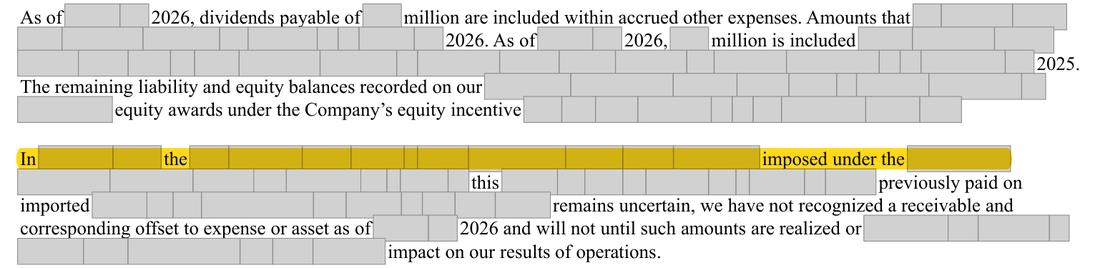
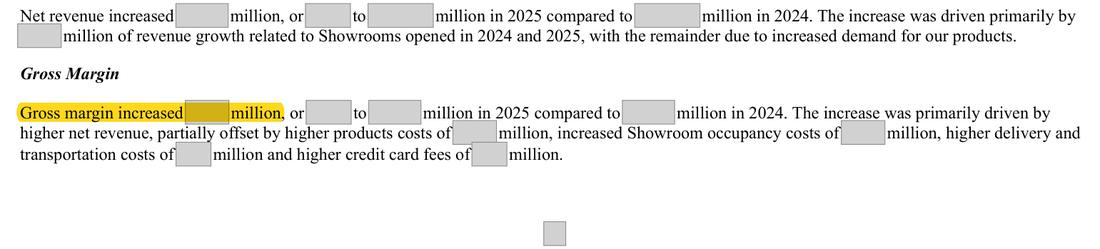
2 further page extracts: screenshot withheld to protect the company’s identity. The rows below say what each shows.
What the filing shows, and what the rule requires
| What the filing shows | What the rule requires |
|---|---|
Item 1A: tariffs 'may affect the prices of and supply of the products available to us' and 'We may not be able to fully or substantially mitigate the impact of these or future tariffs'. MD&A: 'higher products costs of [amount]'; gross margin down [n] basis points to [n]%; no mention of tariffs anywhere outside Item 1A and the forward-looking statements. Later 10-Q: refunds of [amount] requested [wording masked]. | Where tariffs had already raised product costs in 2025, Item 1A should say so (the risk has occurred, not merely may occur), with the order of magnitude, and the MD&A margin discussion should identify tariffs among the drivers if material. |
The rule
Regulation S-K Item 105(a)
Where appropriate, provide under the caption “Risk Factors” a discussion of the material factors that make an investment in the registrant or offering speculative or risky.
Version: Text in force at the date of this review · Source: Regulation S-K, 17 CFR 229.105, as amended by Release 33-10825
Regulation S-K Item 105(b)
Concisely explain how each risk affects the registrant or the securities being offered.
Version: Text in force at the date of this review · Source: Regulation S-K, 17 CFR 229.105, as amended by Release 33-10825
Why it applies here. IEEPA tariffs were imposed during 2025 and invalidated in [date], so most of the [amount] was paid in fiscal 2025; part was charged to 2025 cost of goods sold and part sat in year-end inventory. The split is not disclosed, so whether the 2025 effect was material cannot be settled from the filing. Regulation S-K Item 105 calls for the material factors that make the investment risky, explained by how each affects the registrant; Securities and Exchange Commission (SEC) staff practice is to ask registrants to revise a risk factor presented as hypothetical when the event has occurred.
Why it matters
A reader of Item 1A and MD&A cannot tell that tariffs were already a cost of the business in 2025, nor their order of magnitude, which also matters for reading the 2026 margin recovery once the refunds were booked.
Exposure
A question for management; if the 2025 tariff effect was material, the realistic consequence is a staff comment asking that the risk factor say the risk has occurred and that MD&A quantify tariff effects in future filings.
Our workings
the import risk factor states that since the beginning of 2025 the U.S. announced several tariff measures and that further tariffs may be added; every statement of effect on the company is conditional ('could increase the cost', 'may affect the prices', 'We may not be able to fully or substantially mitigate').
the word 'tariff' appears nowhere in MD&A or the notes; the gross-margin analysis attributes the year's margin pressure to product costs, Showroom occupancy, delivery and credit card fees.
the Form 10-Q for the quarter to [date] states that the company requested refunds of [amount] [wording masked], that [amount] of the recovery related to inventory sold before [date], and that all [amount] had been received by [date].
[n] / [n] = 41.10% of fiscal 2025 pre-tax income; [n] / [n] = 16.85%.
| Item | USD thousand | Working |
|---|---|---|
| IEEPA tariff refunds requested (tariffs previously paid) | [n] | [amount] (Form 10-Q, quarter to [date]) |
| Share of fiscal 2025 pre-tax income | 41.10% | [n] / [n] = 41.10% |
| Recovery relating to inventory sold before [date] | [n] | [amount] (same 10-Q) |
| Share of fiscal 2025 pre-tax income | 16.85% | [n] / [n] = 16.85% |
| Increase in product costs named in the 2025 MD&A | [n] | [amount] (no driver named) |
Management’s best defense, and our reply
The company can argue that Item 1A is forward-looking by design: the risk factor already says that tariff measures were announced from the beginning of 2025, and the cost of tariffs paid is fully reflected in the audited cost of goods sold and in the [amount] product-cost increase discussed in MD&A. It can add that much of the tariff cost was still capitalized in inventory at year end, so the 2025 income-statement effect may have been below its materiality threshold, and that any refund was a gain contingency that could not be recognized or emphasized while recovery was uncertain. Those points are reasonable, which is why this is a question rather than a finding.
The fix
- In the next Form 10-K, state in the import risk factor that tariffs increased product costs in the year (with an amount or range, and the refund position), and identify tariffs among the gross-margin drivers in MD&A if material.
Question for the company
How much IEEPA tariff did the company pay in fiscal 2025, how much of it was charged to 2025 cost of goods sold and how much remained in inventory at [date]? Given those amounts, why does Item 1A describe the effect of tariffs only as a possibility, and why does the MD&A gross-margin analysis not name tariffs? Did the [date] Supreme Court ruling come before the 10-K was filed on [date], and was an update to the risk factor considered?
Evidence relied on
| # | What it shows | Type | Where |
|---|---|---|---|
| 1 | The risk factor acknowledges the 2025 tariff measures | Document | Form 10-K 2025, page 14 |
| 2 | The effect on the company is described only as a possibility | Document | Form 10-K 2025, page 14 |
| 3 | MD&A names higher product costs without naming tariffs | Document | Form 10-K 2025, page 47 |
| 4 | MD&A explanation of the margin decline names occupancy and delivery costs only | Document | Form 10-K 2025, page 48 |
| 5 | First-quarter 2026 report: the ruling came in the month the 10-K was filed | Document | |
| 6 | Second-quarter 2026 report quantifies the IEEPA tariffs the company had paid | Document | |
| 7 | Part of the tariffs had passed through cost of goods sold on inventory sold before [date] | Document | |
| 8 | The refunds were received in full | Document | |
| 9 | The 2025 gross margin analysis attributes [amount] to higher product costs without naming tariffs | Document | Form 10-K 2025, page 47 |
| 10 | The margin-rate explanation names occupancy and delivery costs only | Document | Form 10-K 2025, page 48 |
| 11 | product costs are the largest margin driver, with no cause given | Document | Form 10-K 2025, page 47 |
| 12 | the rest of the revenue increase is put down to demand, with no price and volume split | Document | Form 10-K 2025, page 47 |
| 13 | total revenue increase | Document | Form 10-K 2025, page 47 |
| 14 | gross margin rate fell | Document | Form 10-K 2025, page 48 |
| 15 | the risk factors record tariff measures in 2025 | Document | Form 10-K 2025, page 14 |
| 16 | the company states tariffs could have a material adverse effect | Document | Form 10-K 2025, page 14 |
| 17 | price increases are the stated recovery mechanism, yet no price effect is given in the revenue analysis | Document | Form 10-K 2025, page 52 |
| 18 | the year-end investor presentation describes action taken against tariff risk | Document | |
| 19 | about two-thirds of receipts are sourced abroad | Document |
Absence check
- Document
- Form 10-K 2025
- Where it would appear
- Gross Margin
- What is missing
- any reference to tariffs, their amount or their effect on product costs in the 2025 gross-margin analysis
- Pages looked at
- p.12-16 (Item 1A tariff and cost risk factors), p.42-50 (MD&A), p.61-78 (notes)
- Result
- 'tariff' hits only p.2 (forward-looking statements bullet), p.12 (summary risk bullet), p.14-15 (import risk factor, effects described as possibilities) and p.16 (freight risk factor, 'tariff-related shipment surges'); none is in MD&A or the notes and none gives an amount. 'IEEPA', 'Supreme Court' and 'International Emergency Economic Powers' do not hit.
Absence check
- Document
- Form 10-K 2025
- Where it would appear
- Gross Margin
- What is missing
- Any mention of tariffs or import duties as a driver of 2025 product costs or gross margin, or as a known trend
- Pages looked at
- p.47-48 (MD&A results and gross margin), p.50-51 (liquidity)
- Result
- 'tariff' and 'trade polic' hit only the forward-looking statements list and the risk factors (p.12, 14-16); 'duties' hits the risk factors on p.14-15 and 'segregation of duties' in the control sections; none is in the MD&A results or liquidity discussion.
Absence check
- Document
- Form 10-K 2025
- Where it would appear
- Gross margin increased [amount], or [n]%
- What is missing
- any discussion of tariffs as a known trend affecting product costs, margins or prices, and the price and volume split of the revenue increase
- Pages looked at
- p.42-52 (Items 7 and 7A)
- Result
- 'tariff' and 'trade polic' hit only p.2 (forward-looking statements) and p.12-16 (risk factors), none in Item 7; 'duties' hits risk factors, the auditor's report and Item 9A (segregation of duties), not customs duties in MD&A; 'price increase' hits p.14 (risk factor) and p.52 (Item 7A inflation paragraph, which states the historical recovery policy but no 2025 effect).
Prepared by Pramanex from the company’s public SEC filings, without the company’s involvement, to show how a 10-K Pre-filing Check reads. The company is not named, and nothing on this page is a statement about any identifiable company. Observations are not an audit, review or other attestation or assurance engagement, and not legal advice. An SEC-style question is a question, not a conclusion.
Want this on your own 10-K, before you file?
Start with three free findings on your latest 10-K, or book a fixed-price 10-K Pre-filing Check.
Your next 10-K will be in draft before the audit is done.
Have it read before you file.
Start with three free findings on your latest 10-K, or book a fixed-price 10-K check. Drafts only under NDA, inside your insider trading policy.