3.01 Note 12 gives the rent on three related-party leases but not the lease liabilities owed to those parties
Company E · a US-listed home furnishings retailer · SEC-style question
In brief
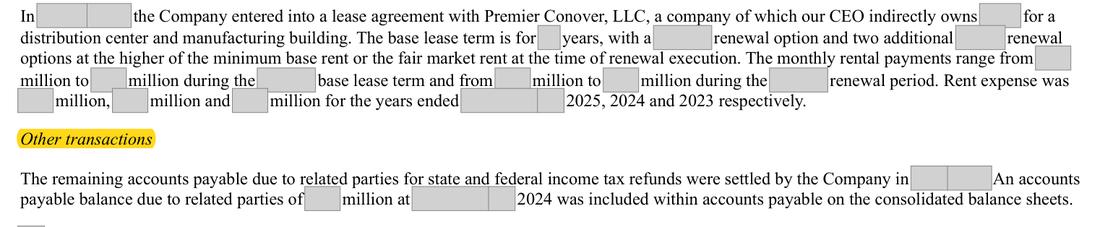
Three of the Company's leases (the Walton Hills warehouse, the [city], [state] Loft and the Conover distribution center) are with entities in which the Chief Executive Officer (CEO) holds interests. Note 12 gives their terms and the rent expense ([amount] in 2025), but not the lease liabilities or right-of-use assets recognized for them, and the balance sheet shows no related-party amount. We ask for those balances and whether they will be presented.
The evidence, as filed



What the filing shows, and what the rule requires
| What the filing shows | What the rule requires |
|---|---|
Note 12 gives rent expense of [amounts] for 2025 and a [amount] payable at [date]; it gives no lease liability or right-of-use asset for the three leases at either year end. The balance sheet lease captions carry no related-party amount, while the lease note sends the reader to Note 12 for the amounts leased from related parties. | The lease liabilities (and right-of-use assets) relating to each related-party lessor at [date] and 2024, in Note 12 and, if material, shown parenthetically on the face of the balance sheet. |
The rule
Regulation S-X Rule 4-08(k)(1)
Amounts of related party transactions should be stated on the face of the balance sheet, statement of comprehensive income, or statement of cash flows.
Version: Text in force at the date of this review · Source: Regulation S-X, 17 CFR 210.4-08(k)(1) (eCFR current text)
Why it applies here. the liabilities recognized under the leases standard for these three leases are amounts owed to related parties at each balance-sheet date; with remaining terms of many years (the Loft lease runs to [n]) they are a multiple of one year's rent, yet neither the face of the balance sheet nor Note 12 states them. Regulation S-X asks that amounts of related-party transactions be stated on the face of the statements, and the related-party standard asks for amounts due to related parties at each balance-sheet date. Published summaries of SEC staff remarks at the [date] AICPA conference report that registrants that are not smaller reporting companies must show material related-party amounts on the face. Because a preparer could reasonably read the existing note as sufficient, the point is put as a question.
Why it matters
A reader cannot see how much of the recognized lease liability is owed to entities in which the CEO holds interests, and the lease note's cross-reference to Note 12 points to amounts that Note 12 does not give.
Exposure
A question for management; if the balances are material the realistic outcome is a staff comment asking for them in future filings.
Our workings
Note 12 describes three leases with entities in which the CEO holds interests and gives, for each, the term, the monthly rent range and the rent expense for three years. The only related-party balance it gives is a [amount] payable at [date], settled in [date]. The maturity table of the lease note carries a footnote that the leases include related-party leases and refers to Note 12 for the amounts leased from related parties. The balance sheet shows operating and financing lease liabilities without any related-party caption or parenthetical.
related-party rent expense for 2025 is [n] + [n] + [n] = [n] ($ million).
| Lease (lessor) | Rent expense 2025 ($ million) | Lease liability given at [date]? |
|---|---|---|
| Walton Hills warehouse (Pagoda Partners, LLC) | [n] | No |
| [city], [state] Loft ([city] the Company) | [n] | No |
| Conover distribution center (Premier Conover, LLC) | [n] | No |
| Total | [n] + [n] + [n] = [n] | No |
Management’s best defense, and our reply
The Company can argue that the related-party standard is met because Note 12 names each lessor, the relationship, the lease term, the monthly rent and three years of rent expense, from which a reader can gauge the obligation, and that a lease liability measured under the leases standard is not an amount that has fallen due like a payable. It can add that the three leases are a small part of total lease liabilities and that the related-person transactions are also described in the proxy statement. That reading is reasonable, so the point is put as a question rather than a compliance gap. However, the lease note itself tells the reader that Note 12 gives the related-party amounts and Note 12 gives only the expense, and recent staff remarks, as reported in published summaries, ask registrants of this size to show material related-party amounts on the face of the statements.
The fix
- Add to Note 12 a table of the right-of-use assets and lease liabilities for each related-party lease at both year ends, and show the related-party lease liabilities parenthetically on the balance sheet, e.g. 'Operating lease liabilities, long-term (including $x with related parties)'.
Question for the company
What were the lease liabilities and right-of-use assets relating to the three leases with entities in which the CEO holds interests at [date] and 2024, and will the Company give them in Note 12 and, if material, on the face of the balance sheet?
Evidence relied on
| # | What it shows | Type | Where |
|---|---|---|---|
| 1 | the Walton Hills warehouse is leased from an entity in which the CEO holds an interest | Document | Form 10-K 2025, page 79 |
| 2 | only the rent expense is given for this lease | Document | Form 10-K 2025, page 79 |
| 3 | [city], [state] Loft lease: term to [n] and rent expense only, no balance | Document | Form 10-K 2025, page 80 |
| 4 | Conover distribution center lease: rent expense only | Document | Form 10-K 2025, page 80 |
| 5 | the only related-party balance Note 12 gives | Document | Form 10-K 2025, page 80 |
| 6 | the lease maturity table refers the reader to Note 12 for the related-party amounts | Document | Form 10-K 2025, page 74 |
| 7 | the balance sheet lease captions carry no related-party amount | Document | Form 10-K 2025, page 56 |
Absence check
- Document
- Form 10-K 2025
- Where it would appear
- Other transactions
- What is missing
- the lease liabilities and right-of-use assets relating to the three related-party leases at [date] and 2024
- Pages looked at
- p.56, 72-74, 79-80
- Result
- 'related part' hits p.72 and [n] (the lease note referring to Note 12) and p.79-80 (Note 12, which gives rent expense and one payable only); 'Pagoda' hits only p.79 and 'Premier Conover' and '[city] the Company' only p.80, in the lease descriptions without balances; 'right-of-use' hits the balance sheet, the lease policy and the lease note, all for the lease portfolio as a whole with no related-party split.
Absence check
- Document
- Form 10-K 2025
- Where it would appear
- Current portion of operating lease liabilities
- What is missing
- a related-party caption or parenthetical amount for lease liabilities owed to entities in which the CEO holds interests
- Pages looked at
- p.56-59
- Result
- 'related part' hits p.72 and [n] (lease note cross-references) and p.79-80 (Note 12); 'Premier Conover' and '[city] the Company' hit only p.80 and 'Pagoda' only p.79, all in Note 12, which gives rent expense, not balances; 'right-of-use' hits the face and the lease notes for the whole portfolio. None is a related-party amount on the face of the balance sheet.
Prepared by Pramanex from the company’s public SEC filings, without the company’s involvement, to show how a 10-K Pre-filing Check reads. The company is not named, and nothing on this page is a statement about any identifiable company. Observations are not an audit, review or other attestation or assurance engagement, and not legal advice. An SEC-style question is a question, not a conclusion.
Want this on your own 10-K, before you file?
Start with three free findings on your latest 10-K, or book a fixed-price 10-K Pre-filing Check.
Your next 10-K will be in draft before the audit is done.
Have it read before you file.
Start with three free findings on your latest 10-K, or book a fixed-price 10-K check. Drafts only under NDA, inside your insider trading policy.