2.02 Item 9A reports a material weakness remediated by year end but also says there were no changes in internal control in the fourth quarter
Company E · a US-listed home furnishings retailer · SEC-style question
In brief
The third-quarter 2025 Form 10-Q listed a material weakness over the identification of and accounting for non-routine or complex transactions. The 10-K says that weakness was remediated as of [date], yet states that there were no changes in internal control over financial reporting (ICFR) during the fourth quarter that materially affected it. Remediation of a material weakness is ordinarily a change that materially affects ICFR, so the two statements need reconciling.
The evidence, as filed
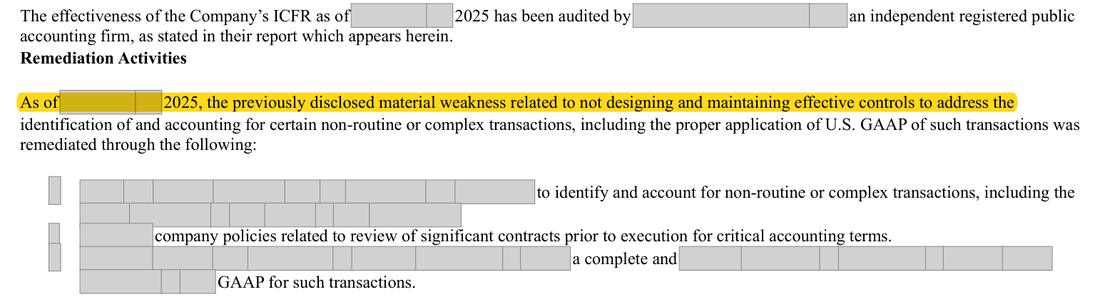

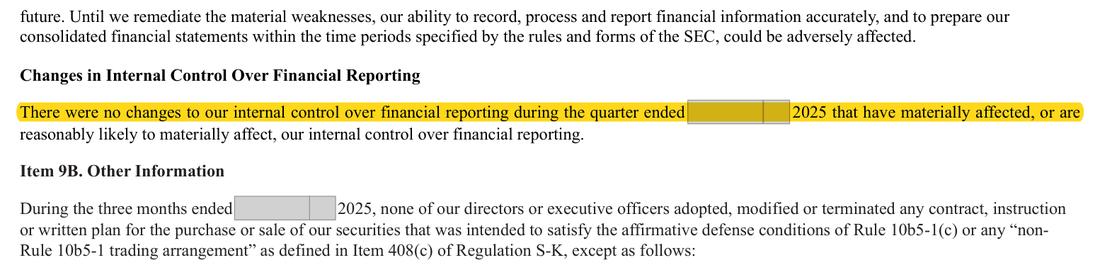
1 further page extract: screenshot withheld to protect the company’s identity. The rows below say what each shows.
What the filing shows, and what the rule requires
| What the filing shows | What the rule requires |
|---|---|
Remediation Activities: the non-routine transactions material weakness 'was remediated' as of [date]; Changes in Internal Control: 'There were no changes ... during the quarter ended [date] that have materially affected, or are reasonably likely to materially affect' ICFR; the third-quarter Form 10-Q still listed the weakness and also reported no change. | Either disclosure under Item 308(c) of the fourth-quarter change that completed the remediation, or a statement that the remediating controls were implemented in an earlier quarter and only their testing was completed in the fourth quarter. |
| What we checked. Item 9A in full; the auditor's adverse ICFR opinion and critical audit matter; the 2024 Form 10-K Item 9A; Item 4 of the Forms 10-Q for the third quarter of 2025 and the first quarter of 2026. | |
The rule
Regulation S-K Item 308(c), changes in internal control over financial reporting
Disclose any change in the registrant's internal control over financial reporting identified in connection with the evaluation required by paragraph (d) of § 240.13a-15 or 240.15d-15 of this chapter that occurred during the registrant's last fiscal quarter (the registrant's fourth fiscal quarter in the case of an annual report) that has materially affected, or is reasonably likely to materially affect, the registrant's internal control over financial reporting.
Version: Text in force at the date of this review · Source: Regulation S-K, 17 CFR 229.308(c), as adopted by Release 33-8238 (2003)
Why it applies here. Item 308(c) requires disclosure of any change in ICFR in the fourth quarter that has materially affected ICFR; the staff has long read the remediation of a material weakness as such a change. The company may be relying on the view that the controls were put in place before the fourth quarter and only the testing that allowed the remediation conclusion was completed in it, which the 2024 Form 10-K's earlier listing of the same step partly supports. Which is the case can only be answered by management, so the point is put as a question.
Why it matters
If the remediating change occurred in the fourth quarter, the 'no changes' statement is incomplete, and the same statement is certified by the principal officers under the Rule 13a-14 certifications.
Exposure
A question for management; a staff comment seeking clarification in future filings would be the usual outcome if the change fell in the fourth quarter.
Our workings
the third-quarter 2025 Form 10-Q (Item 4) listed, among the material weaknesses, that the company did not design and maintain effective controls over the identification of and accounting for certain non-routine or complex transactions, and reported no change in ICFR in that quarter. The 10-K states that as of [date] this weakness 'was remediated', listing hiring, a contract-review policy and [wording masked] transactions. Item 9A then states that there were no changes in ICFR during the fourth quarter that materially affected or are reasonably likely to materially affect ICFR. The contract-review policy already appeared among the remediation steps in the 2024 Form 10-K.
Management’s best defense, and our reply
Management would say the remediating controls (personnel, the contract-review policy, enhanced review of non-routine transactions) were designed and implemented in earlier quarters, and that the fourth quarter only completed the testing needed to conclude the controls operated effectively for a sufficient period; no control changed in the quarter, so Item 308(c) was correctly answered. The 2024 Form 10-K's listing of the contract-review policy supports that the steps pre-date the quarter. That reading is tenable, but the 10-K does not say so, and the staff commonly asks companies reporting remediation alongside a 'no changes' statement to explain the timing.
The fix
- In future filings, either disclose the fourth-quarter change that completed remediation, or add a sentence such as 'The remediated controls were implemented in prior quarters; testing of their operating effectiveness was completed in the fourth quarter.'
Question for the company
In which quarter were the controls that remediated the non-routine or complex transactions material weakness designed and implemented, and if the remediation was completed in the fourth quarter of 2025, why was it not reported as a change in internal control over financial reporting under Item 308(c)?
Evidence relied on
| # | What it shows | Type | Where |
|---|---|---|---|
| 1 | the non-routine transactions weakness is reported remediated at year end | Document | Form 10-K 2025, page 84 |
| 2 | remediation steps listed for that weakness | Document | Form 10-K 2025, page 84 |
| 3 | Item 9A states no fourth-quarter change | Document | Form 10-K 2025, page 86 |
| 4 | the weakness was still open at [date] | Document | |
| 5 | no change was reported in the third quarter either | Document | |
| 6 | one remediation step was already in place in the 2024 Form 10-K | Document | Form 10-K 2024 (prior year), page 88 |
Prepared by Pramanex from the company’s public SEC filings, without the company’s involvement, to show how a 10-K Pre-filing Check reads. The company is not named, and nothing on this page is a statement about any identifiable company. Observations are not an audit, review or other attestation or assurance engagement, and not legal advice. An SEC-style question is a question, not a conclusion.
Want this on your own 10-K, before you file?
Start with three free findings on your latest 10-K, or book a fixed-price 10-K Pre-filing Check.
Your next 10-K will be in draft before the audit is done.
Have it read before you file.
Start with three free findings on your latest 10-K, or book a fixed-price 10-K check. Drafts only under NDA, inside your insider trading policy.