1.07 The debt note does not describe the credit facility's restrictions on dividends or the amount free of restriction
Company E · a US-listed home furnishings retailer · SEC-style question
In brief
The Company is a holding company for the operating LLC, and its revolving credit facility limits 'restricted payments', which Item 1A says in the risk factors. The debt note says only that the facility has restrictive and financial covenants. Regulation S-X asks the notes to describe the most significant restrictions on dividends and the amount of retained earnings restricted or free, and to describe limits on subsidiaries' transfers to the parent; nothing on this appears in either year, while the company declared a [amount] per share special dividend in [date] (about [n]).
The evidence, as filed


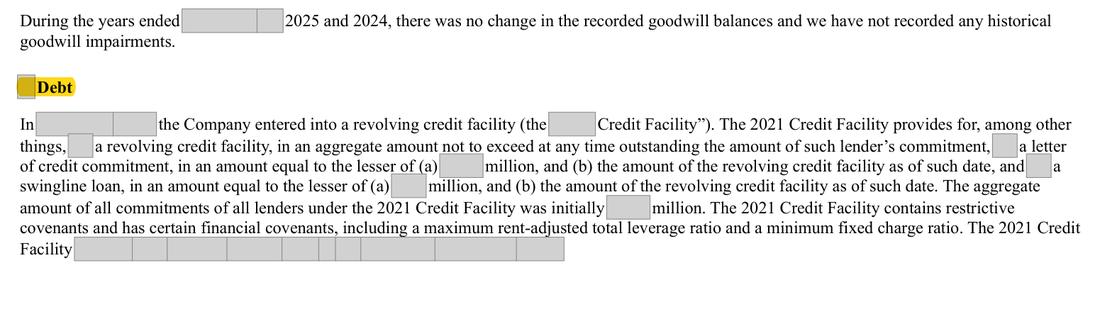

What the filing shows, and what the rule requires
| What the filing shows | What the rule requires |
|---|---|
Note 6 says the facility 'contains restrictive covenants and has certain financial covenants'; no description of the restricted-payment terms, no amount of retained earnings restricted or free, no statement on restricted net assets of subsidiaries, in 2025 or 2024. | A description of the most significant restrictions on dividends by the registrant and on transfers from the subsidiaries (source, pertinent terms, conditions such as availability or fixed-charge tests), the amount of retained earnings or net income restricted or free at [date], and, if restricted net assets of consolidated subsidiaries exceed 25% of consolidated net assets, condensed parent-company information (Schedule I). |
The rule
Regulation S-X Rule 4-08(e)(1)
Describe the most significant restrictions on the payment of dividends by the registrant, indicating their sources, their pertinent provisions, and the amount of retained earnings or net income restricted or free of restrictions.
Version: Text in force at the date of this review · Source: Regulation S-X, 17 CFR 210.4-08 (eCFR text as of the pack date)
Regulation S-X Rule 4-08(e)(3)(i)
Describe the nature of any restrictions on the ability of consolidated subsidiaries and unconsolidated subsidiaries to transfer funds to the registrant in the form of cash dividends, loans or advances
Version: Text in force at the date of this review · Source: Regulation S-X, 17 CFR 210.4-08 (eCFR text as of the pack date)
Regulation S-X Rule 5-04(c), Schedule I
The schedule prescribed by § [n]-04 shall be filed when the restricted net assets (§ 210.1.02(dd)) of consolidated subsidiaries exceed 25 percent of consolidated net assets as of the end of the most recently completed fiscal year.
Version: Text in force at the date of this review · Source: Regulation S-X, 17 CFR 210.5-04 (eCFR text as of the pack date)
Why it applies here. the payment of dividends shows the covenants permit them, but Regulation S-X asks for the restriction and the amount free of it, not only whether a dividend was possible; whether the restricted-payment terms are significant, and whether the subsidiaries' net assets are restricted above the 25% threshold, are facts in the credit agreement that the 10-K does not give, so the point is put as a question.
Why it matters
Shareholders relying on special dividends cannot see how much of retained earnings the lenders' terms leave free, or whether the holding company depends on restricted subsidiary cash.
Exposure
A question for management; if the restrictions are significant, a staff comment asking for the description (and, above the 25% threshold, condensed parent-company information) would be the likely outcome.
Our workings
Note 1 says the company became a holding company for the LLC and its subsidiaries at the 2021 reorganisation. Note 6 says the 2021 Credit Facility contains restrictive covenants and financial covenants (maximum rent-adjusted leverage, minimum fixed charge ratio), with no borrowings at either year end. Item 1A says the facility limits the company's ability to make restricted payments. Note 11 reports a [amount] special dividend paid in 2024 and a [amount] special dividend declared on [date]. The prior-year debt note used the same covenant sentence.
shares outstanding at [date] are [n] Class A and [n] Class B, [n] in all; [n] x [amount] = about [n] for the 2026 dividend; 25% of consolidated net assets is [n] x 25% = [n], the Schedule I threshold.
| Item | Figure | Source |
|---|---|---|
| Class A shares outstanding, [date] | [n] | Balance sheet |
| Class B shares outstanding, [date] | [n] | Balance sheet |
| Total shares outstanding | [n] + [n] = [n] | computed |
| [date] special dividend at [amount] | [n] x [n] = [n] (about [n]) | computed (record-date count may differ) |
| Consolidated net assets (total stockholders' equity) | [n] | Balance sheet |
| Schedule I threshold: 25% of consolidated net assets | [n] x 25% = [n] | computed |
| Dividend restriction described in the notes | none | Note 6, Note 11 |
Management’s best defense, and our reply
Management could argue that the facility is undrawn, that the restricted-payment covenant evidently allowed the [amount] special dividend paid in 2024 and a further special dividend in 2026, and that a restriction which does not bind is not among the 'most significant restrictions' the rule has in mind. It could add that Item 1A already tells investors that the facility limits restricted payments. The answer: the rule asks for the restriction's terms and the amount free of it, not only whether it has bitten, and a risk factor naming the covenant is not the note disclosure; still, whether the terms are significant and whether subsidiary net assets are restricted above 25% depend on the credit agreement's baskets, which the 10-K does not show, so the defense may hold and the point stays a question.
The fix
- Add to Note 6: the restricted-payment provisions (permitted baskets and conditions such as minimum availability or fixed-charge coverage), the amount of retained earnings free of restriction at year end, and a statement on restrictions on transfers from subsidiaries; document the 25% restricted-net-assets test and add Schedule I if it is exceeded.
Question for the company
What do the restricted-payment provisions of the credit agreement permit for dividends by the Company and for distributions from the LLC and other subsidiaries to the parent (baskets, availability or fixed-charge conditions), what amount of retained earnings was free of restriction at [date], and did the company test restricted net assets of consolidated subsidiaries against the 25% threshold for condensed parent-company information?
Evidence relied on
| # | What it shows | Type | Where |
|---|---|---|---|
| 1 | The registrant is a holding company; cash for dividends comes from the subsidiaries | Document | Form 10-K 2025, page 61 |
| 2 | The only covenant description in the notes | Document | Form 10-K 2025, page 71 |
| 3 | Item 1A confirms the facility limits restricted payments (dividends and distributions) | Document | Form 10-K 2025, page 31 |
| 4 | Subsequent-event dividend declared on [date] | Document | Form 10-K 2025, page 79 |
| 5 | The 2024 special dividend | Document | Form 10-K 2025, page 79 |
| 6 | The 2024 dividend paid, showing the covenant allowed a large distribution | Document | Form 10-K 2025, page 79 |
| 7 | Class A shares outstanding | Document | Form 10-K 2025, page 56 |
| 8 | Class B shares outstanding | Document | Form 10-K 2025, page 56 |
| 9 | Consolidated net assets for the 25% test | Document | Form 10-K 2025, page 56 |
| 10 | Prior-year debt note: the same single sentence | Document | Form 10-K 2024 (prior year), page 75 |
Absence check
- Document
- Form 10-K 2025
- Where it would appear
- 6. Debt
- What is missing
- a description of the dividend and distribution restrictions under the credit facility and the amount of retained earnings restricted or free; any restricted-net-assets statement
- Pages looked at
- p.31 (Item 1A), 42-43 (Item 5), 51 (liquidity), [n] (balance sheet), [n] (Note 1), 74-75 (Note 6), 82 (Note 11), 92 (Item 15)
- Result
- 'restricted payments' hits p.31 only, the Item 1A risk factor that lists the covenant without its terms or any amount; 'restricted net assets', 'free of restriction', 'condensed financial information of registrant' and 'pay dividends' have no hits. Item 5's Dividend Policy names 'contractual restrictions' only as one factor in future dividend decisions, with no terms or amount.
Prepared by Pramanex from the company’s public SEC filings, without the company’s involvement, to show how a 10-K Pre-filing Check reads. The company is not named, and nothing on this page is a statement about any identifiable company. Observations are not an audit, review or other attestation or assurance engagement, and not legal advice. An SEC-style question is a question, not a conclusion.
Want this on your own 10-K, before you file?
Start with three free findings on your latest 10-K, or book a fixed-price 10-K Pre-filing Check.
Your next 10-K will be in draft before the audit is done.
Have it read before you file.
Start with three free findings on your latest 10-K, or book a fixed-price 10-K check. Drafts only under NDA, inside your insider trading policy.