1.05 No revenue by product group, although the 10-K names six merchandise categories and sizes one vendor's upholstery products at about 10% of revenue
Company E · a US-listed home furnishings retailer · SEC-style question
In brief
The segment note splits revenue only by sales channel (Retail [n] and eCommerce [n] in 2025). US GAAP asks every public company, even one with a single segment, for revenue from each product or group of similar products unless that is impracticable. The 10-K itself names six categories (furniture, outdoor, bath, lighting, textiles and décor) and says upholstery bought from one vendor alone was about 10% of 2025 revenue, so the data appear to exist. Neither year gives a product split or says it is impracticable.
The evidence, as filed

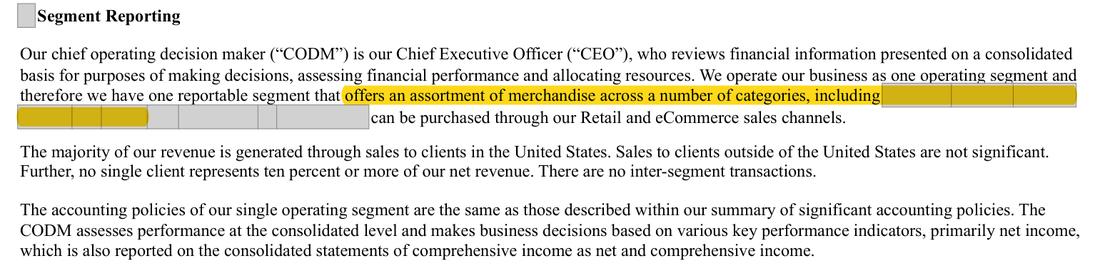
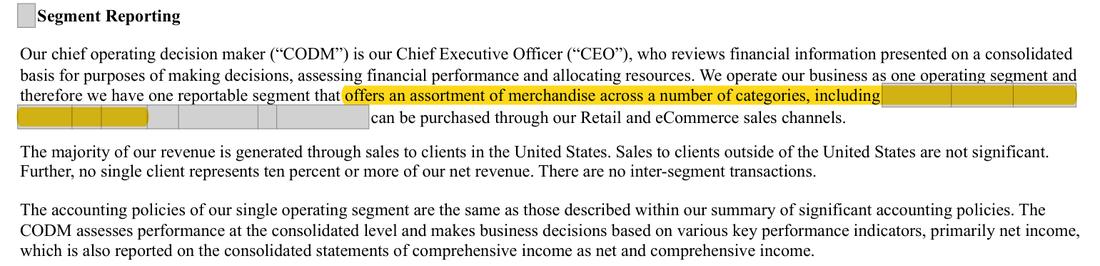
1 further page extract: screenshot withheld to protect the company’s identity. The rows below say what each shows.
What the filing shows, and what the rule requires
| What the filing shows | What the rule requires |
|---|---|
Revenue is disaggregated by channel only (Retail [n]; eCommerce [n]; total [n] for 2025); no product or product-group revenue and no impracticability statement, in 2025 or 2024. | Revenue for each product or group of similar products (for example furniture, outdoor, bath, lighting, textiles and décor, or a furniture / non-furniture split) for 2025, 2024 and 2023, or a statement that providing it is impracticable. |
The rule
FASB ASC 280-10-50-40 to 50-42 (paraphrase; the Codification text is copyrighted)
Summary; FASB/IFRS text is copyrighted Disclose revenues by product or service group and by geography (domicile and material individual foreign countries), long-lived assets by geography, and reliance on 10%-plus customers.
Version: Text in force at the date of this review · Source: FASB Accounting Standards Codification, ASC 280-10-50-40 (as amended by ASU 2023-07)
Regulation S-X Rule 4-01(a)(1)
Financial statements filed with the Commission which are not prepared in accordance with generally accepted accounting principles will be presumed to be misleading or inaccurate, despite footnote or other disclosures
Version: Text in force at the date of this review · Source: Regulation S-X, 17 CFR 210.4-01(a)(1) (eCFR as of the pack date)
Why it applies here. the entity-wide requirement applies whatever the segment structure and asks for revenue by product or service group, not by channel; a channel split meets the revenue disaggregation objective but not this paragraph. Whether the six categories are one group of similar products is a judgment; the company's own category language, category-specific warranty terms and its ability to size upholstery revenue weigh against treating them as one, which is why this is put as a question with a recommended answer rather than as a settled breach.
Why it matters
Investors cannot see the mix of furniture and other categories behind revenue and margin, which the company itself treats as distinct (category warranty terms, a 10% upholstery dependency on one vendor).
Exposure
A question for management; if the categories are not one group, a staff comment asking for revenue by product group in future filings would be the likely outcome. No reported figure changes.
Our workings
Note 9 says the company has one reportable segment offering merchandise across [wording masked], and gives a table of revenue by sales channel and significant segment expenses. Note 1 repeats the six categories; the warranty policy sets terms of three to ten years by merchandise category; and Item 1A says upholstery purchased from one vendor represented about 10% of 2025 net revenue. No page gives revenue by category. The prior-year note had the same channel-only table.
[n] + [n] = [n], so the channel table covers all revenue but by where it is sold, not what is sold; the 10% upholstery figure applied to revenue is about [n] x 10% = [n] of revenue from one product type through one vendor alone.
| Item | FY2025 | FY2024 |
|---|---|---|
| Retail revenue (Note 9) | [n] | [n] |
| eCommerce revenue (Note 9) | [n] | [n] |
| Total net revenue | [n] + [n] = [n] | [n] + [n] = [n] |
| eCommerce share | [n] / [n] = 16.9% | [n] / [n] = 17.3% |
| Upholstery from one vendor, about 10% of revenue (Item 1A) | [n] x 10% = [n] | not given |
| Revenue by product or product group disclosed | none | none |
Management’s best defense, and our reply
Management could argue that all of its merchandise is home furnishings sold to the same clients, through the same Showrooms and website, under one brand and one gross-margin model, so it forms a single group of similar products and the channel table already disaggregates revenue in the way the business is run. It could add that the staff reviewed the 2024 Form 10-K in 2025 and asked only about management's discussion and analysis, not about the segment note. The answer: the entity-wide paragraph is about what is sold, not how, and the company's own disclosures treat the categories as distinct (category warranty terms, a quantified upholstery dependency); a single-group view is possible but should be stated and supported, and the 2025 staff letter covered only one topic. Because a reasonable preparer could reach the single-group view, the point is put as a question.
The fix
- Add to Note 9 a table of [wording masked] category (or at least furniture and non-furniture) for 2025, 2024 and 2023; if management concludes the categories are one group of similar products or that the data are impracticable to produce, say so and why.
Question for the company
Does management regard all of its merchandise as a single group of similar products for the entity-wide product disclosure, and if so on what basis, given that the 10-K names six merchandise categories and quantifies upholstery at about 10% of revenue; if not, can revenue by category (or furniture / non-furniture) for 2025, 2024 and 2023 be given in Note 9?
Evidence relied on
| # | What it shows | Type | Where |
|---|---|---|---|
| 1 | The segment note names six merchandise categories | Document | Form 10-K 2025, page 77 |
| 2 | The only revenue split in the segment note is by sales channel | Document | Form 10-K 2025, page 78 |
| 3 | Retail channel revenue | Document | Form 10-K 2025, page 78 |
| 4 | eCommerce channel revenue | Document | Form 10-K 2025, page 78 |
| 5 | Channel split covers total revenue | Document | Form 10-K 2025, page 78 |
| 6 | One vendor's upholstery products are sized at about 10% of revenue, so product-level revenue data exist | Document | Form 10-K 2025, page 13 |
| 7 | Warranty terms are set by merchandise category: the categories are managed as distinct groups | Document | Form 10-K 2025, page 67 |
| 8 | Prior-year segment note: same category language, channel-only revenue table follows | Document | Form 10-K 2024 (prior year), page 81 |
Absence check
- Document
- Form 10-K 2025
- Where it would appear
- The following table shows revenue by merchandise sales channel
- What is missing
- revenue by product or group of similar products for 2025, 2024 and 2023, or a statement that it is impracticable
- Pages looked at
- p.1-10 (Item 1), 44-48 (MD&A), 64-66 (Notes 1-2), 80-81 (Note 9)
- Result
- 'revenue by product' and 'by category' have no hits; 'product categor' hits p.13 and [n] (risk factors on new product categories) and p.45 (SG&A outlook on new categories); 'merchandise categor' hits p.67 (warranty terms by category); 'similar products' hits p.13 and [n] (risk factors on competitors); none gives revenue by category. 'impracticable' is listed to show no impracticability statement is made.
Prepared by Pramanex from the company’s public SEC filings, without the company’s involvement, to show how a 10-K Pre-filing Check reads. The company is not named, and nothing on this page is a statement about any identifiable company. Observations are not an audit, review or other attestation or assurance engagement, and not legal advice. An SEC-style question is a question, not a conclusion.
Want this on your own 10-K, before you file?
Start with three free findings on your latest 10-K, or book a fixed-price 10-K Pre-filing Check.
Your next 10-K will be in draft before the audit is done.
Have it read before you file.
Start with three free findings on your latest 10-K, or book a fixed-price 10-K check. Drafts only under NDA, inside your insider trading policy.