1.03 Schedule II is omitted, but the notes do not carry the movement in the inventory reserve that the schedule requires
Company E · a US-listed home furnishings retailer · Compliance or disclosure gap
In brief
Item 15 says separate schedules were omitted because the information is in the notes. For the inventory reserve it is not: Note 2 gives only the year-end balances ([amount] at [date], [amount] a year earlier), not the additions charged to costs or the amounts used, which the valuation and qualifying accounts schedule (Schedule II) requires. The reserve doubled in 2025; the increase of [n] is 9.46% of pre-tax income. The prior-year 10-K omitted the movement too.
The evidence, as filed
2 further page extracts: screenshot withheld to protect the company’s identity. The rows below say what each shows.
What the filing shows, and what the rule requires
| What the filing shows | What the rule requires |
|---|---|
Inventory reserve balances only ([n], [n]; [n] at the end of 2023 in the prior-year 10-K); no additions charged to cost of goods sold, no deductions and no Schedule II, under an Item 15 statement that the information is in the notes. | For 2025, 2024 and 2023, the inventory reserve's opening balance, additions charged to costs and expenses, additions charged to other accounts, deductions (described) and closing balance, either as Schedule II or in Note 2, as the returns reserve already is. |
The rule
Regulation S-X Rule 5-04(a)(2)
Schedule II of this section shall be filed for each period for which an audited statement of comprehensive income is required to be filed for each person or group.
Version: Text in force at the date of this review · Source: Regulation S-X, 17 CFR 210.5-04 (eCFR text as of the pack date)
Regulation S-X Rule 5-04(c), Schedule II
Schedule II—Valuation and qualifying accounts. The schedule prescribed by § [n]-09 shall be filed in support of valuation and qualifying accounts included in each balance sheet but not included in Schedule VI.
Version: Text in force at the date of this review · Source: Regulation S-X, 17 CFR 210.5-04 (eCFR text as of the pack date)
Regulation S-X Rule 12-09, note 1
List, by major classes, all valuation and qualifying accounts and reserves not included in specific schedules.
Version: Text in force at the date of this review · Source: Regulation S-X, 17 CFR 210.12-09
Regulation S-X Rule 5-04(b), omission where the note shows the information
If the information required by any schedule (including the notes thereto) may be shown in the related financial statement or in a note thereto without making such statement unclear or confusing, that procedure may be followed and the schedule omitted.
Version: Text in force at the date of this review · Source: Regulation S-X, 17 CFR 210.5-04 (eCFR text as of the pack date)
Why it applies here. Rule 5-04 requires Schedule II for every year an income statement is filed in support of the valuation accounts in each balance sheet, and Rule 5-04(b) permits omission only where the note shows the schedule's information. A balance at each end is the opening and closing columns only; the additions and deductions columns (what was charged to cost of goods sold and what was used or written off) are what tell a reader whether the doubling came from new write-downs or from slower usage, and that is the information missing. The allowance for credit losses ([n] both years) is small enough to group without movements under the schedule's own instruction, so it is not part of this point.
Why it matters
Readers cannot tell whether the doubling of the inventory reserve in 2025 came from new write-downs charged to cost of goods sold or from slower use of existing reserves, and the Item 15 statement that the information is in the notes is not accurate for this account.
Exposure
A staff comment asking for Schedule II or a note roll-forward in future filings is the realistic outcome; no reported figure changes.
Our workings
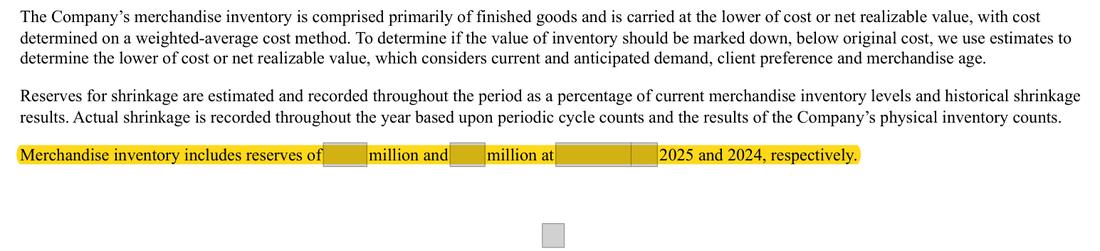
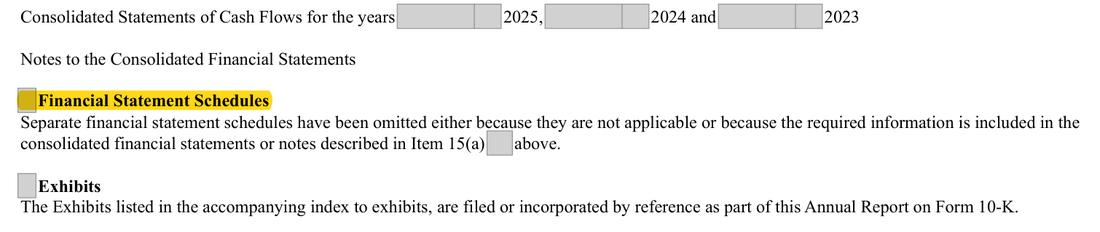
Note 2 states that merchandise inventory includes reserves of [amounts] at [date] and 2024, and that shrinkage reserves are estimated as a percentage of inventory levels and relieved by actual cycle and physical counts. Item 15 states that separate schedules were omitted because they are not applicable or because the information is in the statements or notes. The notes give a full opening / provision / usage / closing table for the sales returns reserve and the warranty liability, but none for the inventory reserve. The prior-year 10-K gave the same balance-only sentence ([amounts]).
the 2025 increase is [n] - [n] = [n], 9.46% of pre-tax income of [n]; the reserve rose from [n]% to 4.88% of gross inventory. In 2024 the increase was [n].
| Item | FY2025 | FY2024 |
|---|---|---|
| Inventory reserve, closing (Note 2) | [n] | [n] |
| Inventory reserve, opening | [n] | [n] (prior-year 10-K) |
| Increase in the year | [n] - [n] = [n] | [n] - [n] = [n] |
| Increase as % of pre-tax income | [n] / [n] = 9.46% | [n] / [n] = 1.21% |
| Gross inventory (net + reserve) | [n] + [n] = [n] | [n] + [n] = [n] |
| Reserve as % of gross inventory | [n] / [n] = 4.88% | [n] / [n] = [n]% |
| Schedule II columns given: opening / additions / deductions / closing | opening yes, additions no, deductions no, closing yes | opening yes, additions no, deductions no, closing yes |
| Account | Movement table in the notes? | Page | Assessment |
|---|---|---|---|
| Reserve for sales returns | Given (opening [n], provision [n], actual returns ([n]), closing [n]) | p.62 | Schedule II information in the notes |
| Inventory reserve (shrink, lower of cost or net realizable value) | Absent: balances [n] and [n] only | p.63 | Additions and deductions missing |
| Allowance for expected credit losses | Balances [n] and [n] only | p.62 | Not individually significant; may be grouped without movements |
| Deferred tax valuation allowance | None recorded | p.81 | Not applicable |
Management’s best defense, and our reply
Management could argue that Rule 5-04(b) lets a schedule be omitted when the information is in the notes, that Note 2 gives the reserve at each year end, and that under SEC staff guidance an inventory write-down creates a new cost basis, so the amount is not a valuation account to be rolled forward. It could add that the staff reviewed the 2024 Form 10-K in 2025 and commented only on management's discussion and analysis. The answer: Rule 5-04(b) allows omission only where the note shows the schedule's information, and the additions and deductions are nowhere in the filing; the shrink reserve is, by the company's own description, a pooled estimate set as a percentage of inventory and relieved by counts, which is a valuation account rather than a new cost basis on identified items; the 2025 increase is 9.46% of pre-tax income, so the movement is individually significant; and a staff review that did not raise a point does not settle it.
The fix
- Add to Note 2 (or file Schedule II) a table for the inventory reserve for 2025, 2024 and 2023: balance at beginning of period, additions charged to cost of goods sold, deductions (inventory written off or shrink realized, described), balance at end of period; keep the Item 15 statement only once every valuation account is covered.
Evidence relied on
| # | What it shows | Type | Where |
|---|---|---|---|
| 1 | Inventory reserve balances at the two year ends: the only figures given for this account | Document | Form 10-K 2025, page 63 |
| 2 | The shrink reserve is a pooled estimate relieved by counts: a valuation account, not a new cost basis on identified items | Document | Form 10-K 2025, page 63 |
| 3 | Item 15 relies on the notes carrying the schedule information | Document | Form 10-K 2025, page 89 |
| 4 | The returns reserve does carry an opening-to-closing movement table, showing the form the inventory reserve lacks | Document | Form 10-K 2025, page 62 |
| 5 | The credit-loss allowance is small and unchanged, so it may be grouped without movements | Document | Form 10-K 2025, page 62 |
| 6 | Inventory is presented net of the reserve; used for gross inventory | Document | Form 10-K 2025, page 56 |
| 7 | Pre-tax income used to size the increase | Document | Form 10-K 2025, page 57 |
| 8 | Prior-year 10-K: balances only, no movement; gives the 2023 closing balance | Document | Form 10-K 2024 (prior year), page 67 |
| 9 | Prior-year 10-K used the same omission statement | Document | Form 10-K 2024 (prior year), page 94 |
Absence check
- Document
- Form 10-K 2025
- Where it would appear
- 2. Financial Statement Schedules
- What is missing
- Schedule II (or a note table) with additions charged to costs and expenses and deductions for the inventory reserve, for 2025, 2024 and 2023
- Pages looked at
- p.56 (balance sheet), 64-73 (Note 2), 74 (Note 4), 92 (Item 15)
- Result
- 'Schedule II', 'valuation and qualifying' and 'charged to costs and expenses' have no hits; 'Balance as of beginning of the period' hits p.62 (sales returns reserve) and p.67 (warranty liability), roll-forwards of other accounts; 'inventory reserve' hits p.45, [n] and [n] only in lists of what cost of goods sold and the estimates include, with no movement figures.
Prepared by Pramanex from the company’s public SEC filings, without the company’s involvement, to show how a 10-K Pre-filing Check reads. The company is not named, and nothing on this page is a statement about any identifiable company. Observations are not an audit, review or other attestation or assurance engagement, and not legal advice. An SEC-style question is a question, not a conclusion.
Want this on your own 10-K, before you file?
Start with three free findings on your latest 10-K, or book a fixed-price 10-K Pre-filing Check.
Your next 10-K will be in draft before the audit is done.
Have it read before you file.
Start with three free findings on your latest 10-K, or book a fixed-price 10-K check. Drafts only under NDA, inside your insider trading policy.