6.02 Income taxes note: a 2023 pre-tax loss described as income, and a taxes-paid table headed as a balance date
Company D · a US-listed cloud communications software company · Drafting slip
In brief
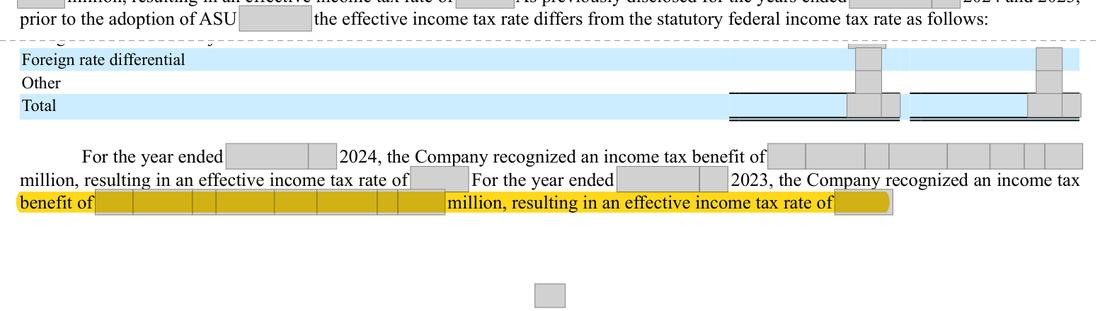
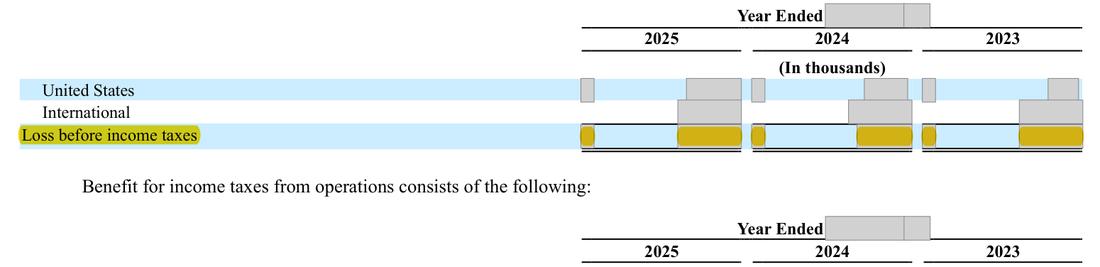
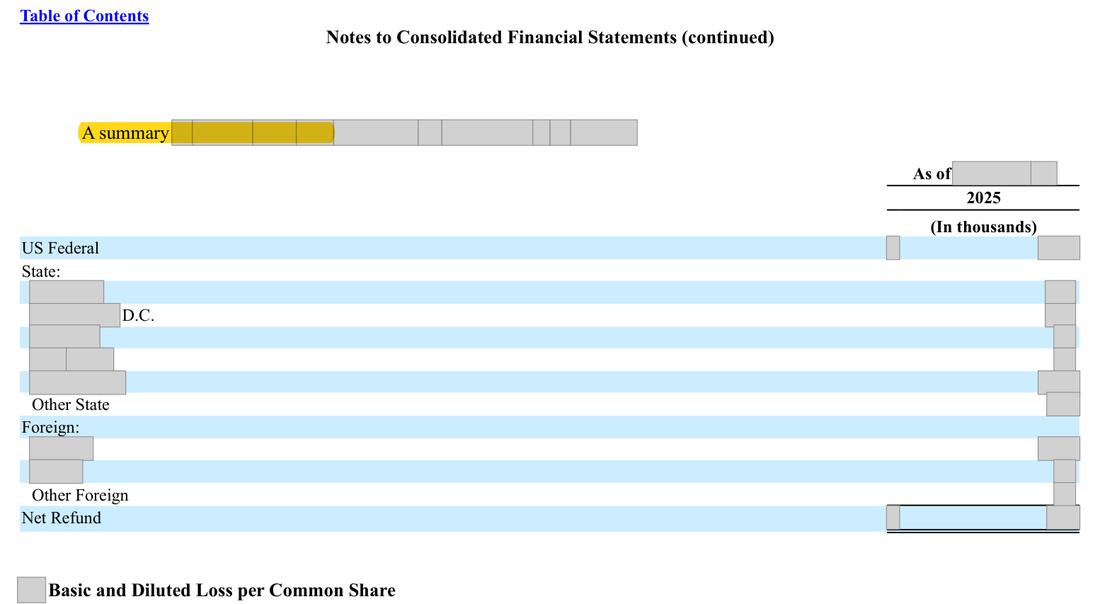
The income taxes note says the 2023 income tax benefit of [amount] arose on pre-tax book income of [amount]. The statement of operations and the note's own domestic and foreign table show a loss before income taxes of ([n]) thousand for 2023, and the prior-year Form 10-K called it a pre-tax book loss. Separately, the new table of income taxes paid, a cash flow for the year, is headed 'As of [date]'.
The evidence, as filed
1 further page extract: screenshot withheld to protect the company’s identity. The rows below say what each shows.
What the filing shows, and what the rule requires
| What the filing shows | What the rule requires |
|---|---|
The 2023 sentence reads 'benefit of [amount] on pre-tax book income of [amount]'; the income taxes paid table is headed 'As of [date],' 2025 | 'benefit of [amount] on pre-tax book loss of [amount]'; the taxes-paid table headed 'Year Ended [date],' 2025 |
Why it matters
A reader comparing the sentence with the statement of operations sees an internal contradiction in the note; the period label of the new taxes-paid table is imprecise.
Exposure
Wording only; no figure changes.
Our workings
the 2023 loss before income taxes is ([n]) thousand on the domestic and foreign components table, and the prior-year report described the same year as a pre-tax book loss.
income taxes paid is the net refund of ([n]) thousand for the year, the same figure the cash flow statement shows as cash refunded for taxes.
both are wording slips; no reported amount changes, but a benefit described as arising on income reads as a negative effective rate and contradicts the [n]% printed in the same sentence.
Management’s best defense, and our reply
The figures themselves are right: the rate of [n]% and the loss in the statement of operations make the meaning plain, and the prior year's wording was correct. The taxes-paid table is a first-year table under the new standard and the column year is clear. However, the sentence as printed states the opposite of the audited result, and the heading gives a balance date to a flow; both are worth correcting in the next filing.
The fix
- Next Form 10-K: read 'pre-tax book loss of [amount]' and head the taxes-paid table 'Year Ended [date],'.
Evidence relied on
| # | What it shows | Type | Where |
|---|---|---|---|
| 1 | The 2023 sentence calls the pre-tax result income | Document | Form 10-K 2025, page 120 |
| 2 | The 2023 pre-tax result is a loss of ([n]) thousand | Document | Form 10-K 2025, page 118 |
| 3 | The prior-year Form 10-K described the same 2023 result as a loss | Document | Form 10-K 2024 (prior year), page 125 |
| 4 | The taxes-paid table, a flow for the year, is headed 'As of [date],' 2025 | Document | Form 10-K 2025, page 123 |
Prepared by Pramanex from the company’s public SEC filings, without the company’s involvement, to show how a 10-K Pre-filing Check reads. The company is not named, and nothing on this page is a statement about any identifiable company. Observations are not an audit, review or other attestation or assurance engagement, and not legal advice. An SEC-style question is a question, not a conclusion.
Want this on your own 10-K, before you file?
Start with three free findings on your latest 10-K, or book a fixed-price 10-K Pre-filing Check.
Your next 10-K will be in draft before the audit is done.
Have it read before you file.
Start with three free findings on your latest 10-K, or book a fixed-price 10-K check. Drafts only under NDA, inside your insider trading policy.