1.09 The revenue note gives neither the remaining performance obligation nor a statement that a practical expedient is used
Company D · a US-listed cloud communications software company · SEC-style question
In brief
The revenue note reports contract liabilities of [amount] and says [amount] of them will be recognized over the next 12 months. It never discloses the transaction price allocated to remaining performance obligations, and it never says that the company relies on one of the practical expedients that allow short or usage-based contracts to be left out. The Codification asks for one or the other, and the same silence is in the prior-year report and in both 2026 quarterly reports.
The evidence, as filed
What the filing shows, and what the rule requires
| What the filing shows | What the rule requires |
|---|---|
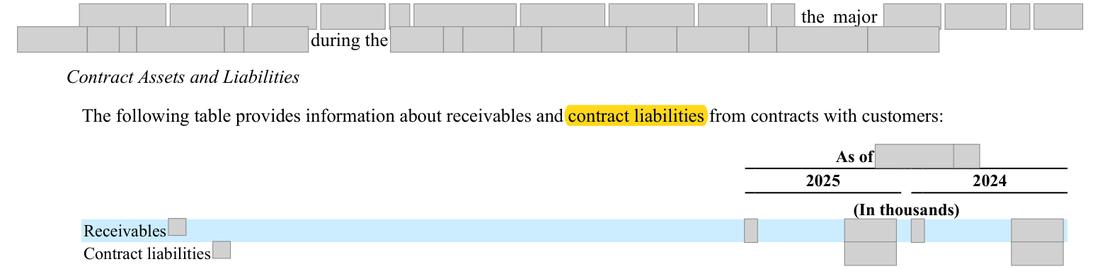
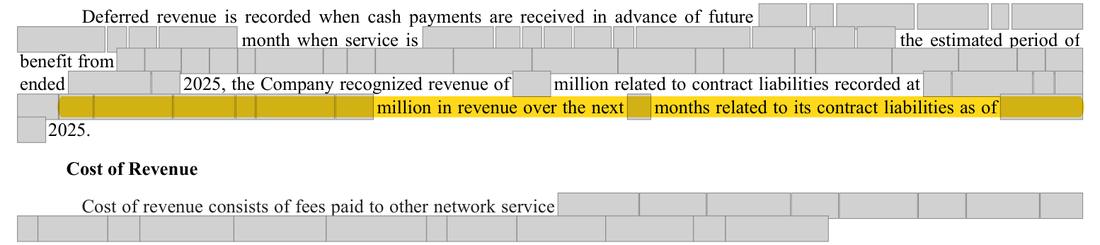
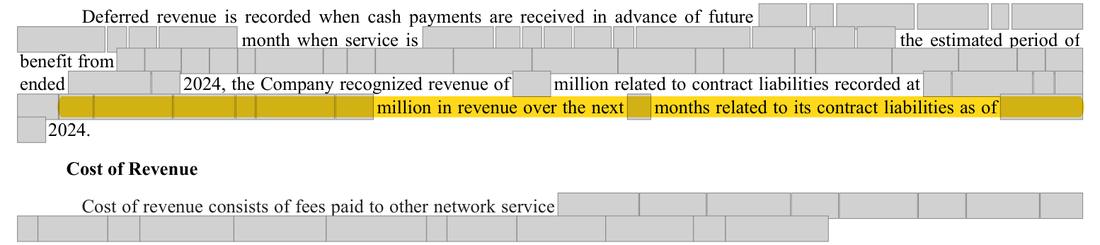
Note 1 shows contract liabilities of [amount] (2024: [amount]) and states that [amount] will be recognized over the next 12 months; usage fees are recognized as traffic crosses the network and recurring fees ratably, typically over one month. No remaining performance obligation amount, no timing beyond 12 months and no statement of an expedient appears anywhere in the report. | Either the transaction price allocated to remaining performance obligations with the expected timing of recognition (by period, including beyond 12 months), or a statement that the Company applies the practical expedients for contracts of one year or less and for usage-based variable consideration, with a description of what is left out. |
| What we checked. Revenue policy, contract balances and deferred revenue (Note 1), balance sheet, critical accounting estimates, the prior-year report and the two later quarterly reports | |
The rule
FASB ASC 606-10-50-13 to 50-15 (paraphrase; the Codification text is copyrighted)
Summary; FASB/IFRS text is copyrighted Disclose transaction price allocated to unsatisfied performance obligations and expected timing of recognition, or state use of the permitted practical expedients and what is excluded.
Version: Text in force at the date of this review · Source: FASB Accounting Standards Codification, ASC 606-10-50-13 to 50-15 (as issued by ASU 2014-09 and amended by ASU 2016-20)
Regulation S-X Rule 4-01(a)
The information required with respect to any statement shall be furnished as a minimum requirement to which shall be added such further material information as is necessary to make the required statements, in the light of the circumstances under which they are made, not misleading.
Version: Text in force at the date of this review · Source: Regulation S-X, 17 CFR 210.4-01(a)
Why it applies here. the Codification requires the amount of the transaction price allocated to unsatisfied performance obligations and when it is expected to be recognized, unless the company uses one of the practical expedients (contracts of one year or less, the right to invoice for usage, or variable consideration allocated to a wholly unsatisfied distinct period), in which case it must say which expedient it uses and what is left out. The note does neither. The usage-based model makes the expedients very likely to apply, so the question is mainly whether the company relies on them and whether any fixed committed charges sit outside the contract liabilities.
Why it matters
Readers cannot tell whether contracted revenue beyond the contract liabilities exists, or whether the absence of an amount reflects an expedient. The realistic result is a staff comment and a future-filings undertaking; no reported amount changes.
Exposure
A question for management; the realistic consequence is a staff comment and a future-filings disclosure, with no change to any reported amount.
Our workings
the policy treats access to the platform as a series of distinct services forming one performance obligation; usage fees are recognized in the period the traffic crosses the network and recurring fees ratably, typically over one month; upfront activation fees are deferred over the longer of the contract period or the estimated customer life. The contract balances table shows contract liabilities of [amount], and the note says [amount] will be recognized over the next 12 months.
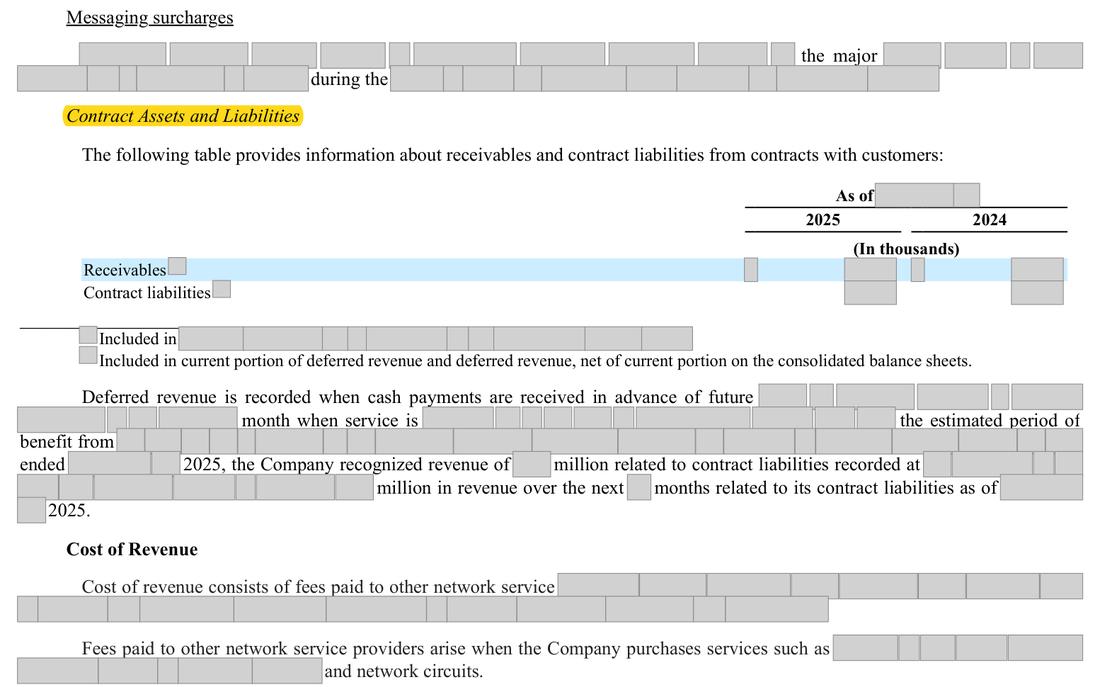
the balance sheet splits deferred revenue into a current portion of [amount] and a non-current portion of [amount], together [amount]; so [amount] is expected to be recognized after more than 12 months, but the note gives no timing for it.
| Item | Amount (USD thousand) | Source |
|---|---|---|
| Contract liabilities, [date] | [n] | Note 1 contract balances table |
| Current portion of deferred revenue | [n] | Balance sheet |
| Deferred revenue, net of current portion | [n] | Balance sheet |
| Check: current plus non-current | [n] + [n] = [n] | computed |
| Contract liabilities recognized after 12 months | [n] - [n] = [n] | computed (no timing given in the note) |
Management’s best defense, and our reply
The finance team will say almost all revenue is usage-based or billed monthly, so it is variable consideration allocated to distinct service periods or arises under contracts of a month, which the expedients exclude; the only fixed consideration received in advance is the contract liability, and the note already gives its amount and the part to be recognized within 12 months, which is the remaining obligation in substance. They will add that the amounts are small against total revenue. That reading is credible, which is why this is a question. However, the Codification asks a company that relies on an expedient to say so and to describe what it leaves out, and the note does not say whether the contract liability figure is the whole remaining obligation or whether committed monthly charges under longer contracts also exist.
The fix
- Add after the contract balances table: 'The Company applies the optional exemptions in ASC 606-10-50-14 and does not disclose remaining performance obligations for contracts with an original expected duration of one year or less or for usage-based variable consideration allocated to wholly unsatisfied distinct service periods.' If fixed committed charges exist beyond one year, give their amount and timing.
Question for the company
Does the Company rely on the practical expedients for remaining performance obligations (contracts of one year or less, usage-based variable consideration), and will it say so; if not, what transaction price was allocated to unsatisfied performance obligations at [date] and when will it be recognized?
Evidence relied on
| # | What it shows | Type | Where |
|---|---|---|---|
| 1 | Contract liabilities of [amount] at [date] and [amount] a year earlier | Document | Form 10-K 2025, page 92 |
| 2 | Only the next-12-months part of the contract liabilities is timed; no remaining performance obligation or expedient statement follows | Document | Form 10-K 2025, page 92 |
| 3 | Platform access is one performance obligation made of distinct service periods | Document | Form 10-K 2025, page 91 |
| 4 | Recurring fees are recognized ratably over short periods, the setting in which the expedients usually apply | Document | Form 10-K 2025, page 92 |
| 5 | Current portion of the contract liabilities | Document | Form 10-K 2025, page 84 |
| 6 | Non-current portion of the contract liabilities, to be recognized after more than 12 months | Document | Form 10-K 2025, page 84 |
Absence check
- Document
- Form 10-K 2025
- Where it would appear
- Contract Assets and Liabilities
- What is missing
- the transaction price allocated to remaining performance obligations and when it will be recognized, or a statement of the practical expedients applied and what they leave out
- Pages looked at
- p.75-76, [n], 90-92 (critical accounting estimates, balance sheet, revenue policy and contract balances)
- Result
- Only 'practical expedient' hits, twice on p.100, both about the credit-loss expedient in a standard not yet adopted, not about revenue. The other five terms have no hits anywhere in the report.
Prepared by Pramanex from the company’s public SEC filings, without the company’s involvement, to show how a 10-K Pre-filing Check reads. The company is not named, and nothing on this page is a statement about any identifiable company. Observations are not an audit, review or other attestation or assurance engagement, and not legal advice. An SEC-style question is a question, not a conclusion.
Want this on your own 10-K, before you file?
Start with three free findings on your latest 10-K, or book a fixed-price 10-K Pre-filing Check.
Your next 10-K will be in draft before the audit is done.
Have it read before you file.
Start with three free findings on your latest 10-K, or book a fixed-price 10-K check. Drafts only under NDA, inside your insider trading policy.