1.01 The equity note says dividends are not restricted, but the revolving credit agreement restricts them
Company D · a US-listed cloud communications software company · Compliance or disclosure gap
In brief
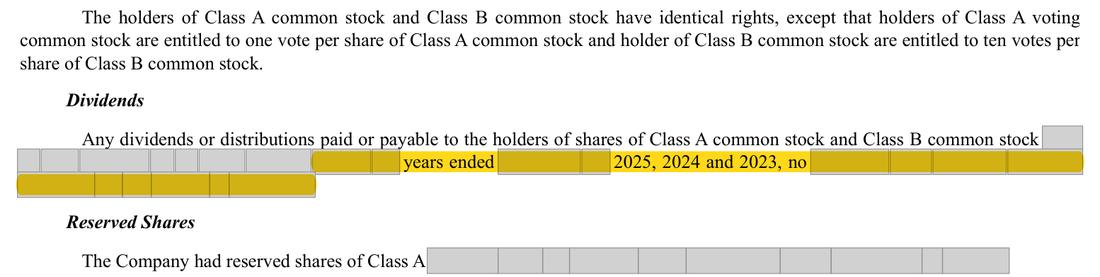
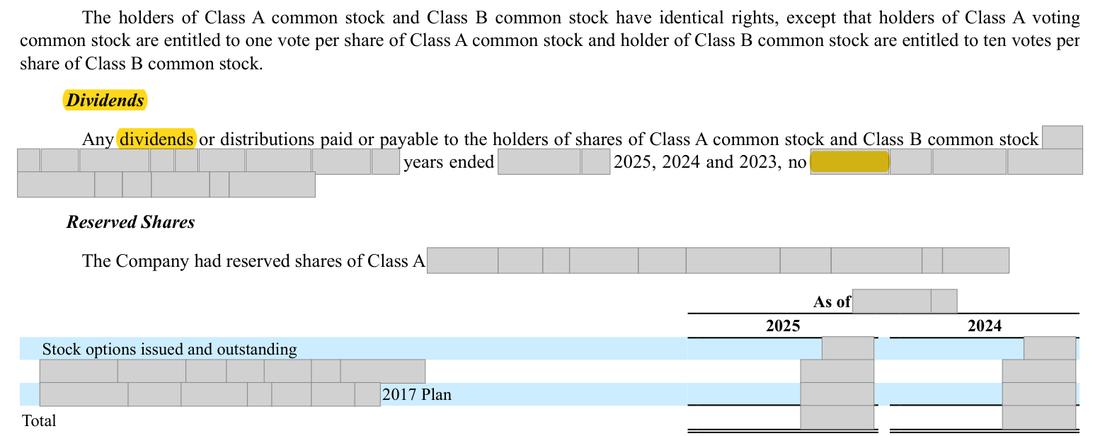
Note 9 ends its dividends paragraph with the sentence "Dividend payments are not subject to restriction." The revolving Credit Agreement with Bank of America, filed as an exhibit to this Form 10-K together with its second amendment, prohibits the Company from declaring or paying any cash dividend except within listed baskets, the general one capped at the greater of [amount] and 20% of trailing EBITDA and subject to a leverage condition. Regulation S-X requires the most significant dividend restrictions to be described with their source and terms; the note instead states there are none. The same sentence was in the prior-year 10-K, when the same agreement was in force.
The evidence, as filed

What the filing shows, and what the rule requires
| What the filing shows | What the rule requires |
|---|---|
Note 9: "Dividend payments are not subject to restriction." Note 7 mentions only "customary negative covenants" and gives no dividend restriction; Item 5 states a policy of not paying dividends, with no reference to the Credit Agreement. | Note 9 (or Note 7) describes the restriction: Credit Agreement section [n] bars cash dividends on the Company's stock except within its permitted baskets (the general basket being the greater of [amount] and 20% of trailing twelve-month consolidated EBITDA per fiscal year, subject to a pro forma senior secured leverage condition, and none while an event of default continues), and states the amount of retained earnings or net income restricted or free of restriction. The sentence saying dividends are unrestricted is deleted. |
| What we checked. Note 9 dividends paragraph and the whole 10-K text; Note 7 credit facility terms; Item 5 dividend policy and the dividend risk factor; exhibit index; Credit Agreement section [n] as filed and its second amendment; prior-year 10-K Note 9 | |
The rule
Regulation S-X Rule 4-08(e)(1)
Describe the most significant restrictions on the payment of dividends by the registrant, indicating their sources, their pertinent provisions, and the amount of retained earnings or net income restricted or free of restrictions.
Version: Text as amended up to [date] · Source: Regulation S-X, 17 CFR 210.4-08(e)(1)
Exchange Act Rule 12b-20
there shall be added such further material information, if any, as may be necessary to make the required statements, in the light of the circumstances under which they are made not misleading.
Version: Text as amended up to [date] · Source: Exchange Act Rule 12b-20, 17 CFR 240.12b-20
Why it applies here. cash dividends on the Class A and Class B common stock were restricted by a filed debt agreement at the end of both fiscal 2024 and fiscal 2025, so the sentence in Note 9 is untrue and the description that Rule 4-08(e)(1) of Regulation S-X requires (source, pertinent provisions, amount restricted or free) is not given anywhere in the 10-K. The point carries no misstated amount; its weight is that an audited note makes an affirmative statement contradicted by the Company's own exhibit, in two consecutive years. Later filing: The Company's own Form 8-K filed on [date] describes the provision as a limit on 'certain restricted payments' and reports that, effective as of [date], the third amendment raised the general basket from [amount] to [amount]; the restriction therefore continues into fiscal 2026 at the higher amount.
Why it matters
Readers of the audited statements are told there is no restriction on dividends when the Company's lenders control cash distributions; the 10-K does not give the disclosure Regulation S-X requires.
Exposure
A staff comment asking the Company to revise the disclosure in future filings is the realistic consequence; no amount is misstated, so an amended 10-K is unlikely.
Our workings
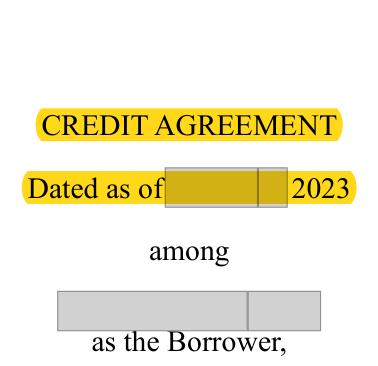
Note 9 (p.114) says "Dividend payments are not subject to restriction." Note 7 (p.109) describes the Credit Agreement and says "Exceptions to certain customary negative covenants" require a pro forma senior secured leverage ratio of at least [n] to [n] inside the maximum; it does not say what those covenants restrict. The exhibit index (printed pages 129-130) lists the Credit Agreement dated [date] and its first and second amendments as exhibits to this 10-K. Section 7.06 of the Credit Agreement, as filed, says the Company shall not "declare or pay any dividend" (other than dividends paid in its own stock) except as the section permits, and the second amendment, dated [date], restates the general basket in clause (j) as the greater of [amount] and 20% of trailing EBITDA in any fiscal year, available only if a pro forma leverage condition is met.
| Element of Regulation S-X Rule 4-08(e)(1) | Where the 10-K gives it | Status |
|---|---|---|
| Most significant restriction on dividends | Nowhere; Note 9 says there is none | Not given; statement contrary to Credit Agreement section [n] |
| Source of the restriction | Credit Agreement is described in Note 7 for borrowing terms only | Not linked to dividends |
| Pertinent provisions | General basket of the greater of [amount] and 20% of trailing EBITDA with a leverage condition, in the filed second amendment only | Not in the notes |
| Amount of retained earnings or net income restricted or free | Nowhere | Not given |
Management’s best defense, and our reply
The Company has never paid a dividend, says in Item 5 that it does not intend to, and has an accumulated deficit, so the finance team could argue that no restriction is significant and that the sentence speaks only to the charter, which puts Class A and Class B on equal terms. The lenders' baskets also allow some payments, so dividends are not wholly barred. However, Rule 4-08(e)(1) asks for the most significant restriction whatever the Company's intention, and the sentence is written without qualification right after the charter terms, so a reader takes it to mean no restriction of any kind exists; a capped basket is itself the restriction that has to be described. The Credit Agreement is the Company's own filed exhibit, so the contradiction cannot be put down to lack of information.
The fix
- Replace the last sentence of the Note 9 dividends paragraph with a description of the restriction as it stands at the balance-sheet date, for example: "The Credit Agreement restricts the Company's ability to declare or pay cash dividends other than within specified baskets, including a general basket per fiscal year of the greater of [amount] (from [date]; previously [amount]) and 20% of trailing twelve-month consolidated EBITDA, subject to a pro forma leverage condition and only while no event of default exists", and state the amount free of restriction.
Evidence relied on
| # | What it shows | Type | Where |
|---|---|---|---|
| 1 | Note 9 states that dividend payments are not restricted | Document | Form 10-K 2025, page 114 |
| 2 | Note 7 refers to negative covenants in the Credit Agreement without saying they restrict dividends | Document | Form 10-K 2025, page 109 |
| 3 | The Credit Agreement is an exhibit to this 10-K | Document | Form 10-K 2025, page 129 |
| 4 | The second amendment (dated [date]) is also an exhibit to this 10-K | Document | Form 10-K 2025, page 130 |
| 5 | The Credit Agreement as filed on EDGAR (exhibit [n] to the Form 10-Q for the quarter ended [date]) | Document | |
| 6 | Section 7.06 Restricted Payments: The Company may not declare or pay cash dividends except as the section permits | Document | |
| 7 | The second amendment restates the general Restricted Payments basket, with a pro forma leverage condition, in force at both year ends | Document | |
| 8 | Later filing (Form 8-K, Item 1.01, filed [date]): The Company itself describes the provision as a limit on restricted payments and raises the general basket | Document |
Absence check
- Document
- Form 10-K 2025
- Where it would appear
- Dividends
- What is missing
- a description of the dividend restriction in the Credit Agreement (source, pertinent provisions, amount restricted or free)
- Pages looked at
- p.109-114 (Note 7 Debt and Note 9 Stockholders' Equity images), p.55 and [n] (dividend risk factor and Item 5)
- Result
- 'pay dividends' hits p.5, [n] and [n]: the risk-factor summary, the risk factor and Item 5 say the Company does not intend to pay dividends and that the decision rests with the board; none mentions the Credit Agreement. 'negative covenants' hits p.109: Note 7 says exceptions to customary negative covenants need a leverage test, without saying the covenants cover dividends. 'Restricted Payment', 'restrictions on the payment of dividends' and 'ability to pay dividends' do not hit.
Prepared by Pramanex from the company’s public SEC filings, without the company’s involvement, to show how a 10-K Pre-filing Check reads. The company is not named, and nothing on this page is a statement about any identifiable company. Observations are not an audit, review or other attestation or assurance engagement, and not legal advice. An SEC-style question is a question, not a conclusion.
Want this on your own 10-K, before you file?
Start with three free findings on your latest 10-K, or book a fixed-price 10-K Pre-filing Check.
Your next 10-K will be in draft before the audit is done.
Have it read before you file.
Start with three free findings on your latest 10-K, or book a fixed-price 10-K check. Drafts only under NDA, inside your insider trading policy.