3.01 Year-end results release: non-GAAP operating expenses exclude a fourth item, beyond the three the company told the SEC staff it would exclude
Company C · a US-listed specialty healthcare products company · SEC-style question
In brief
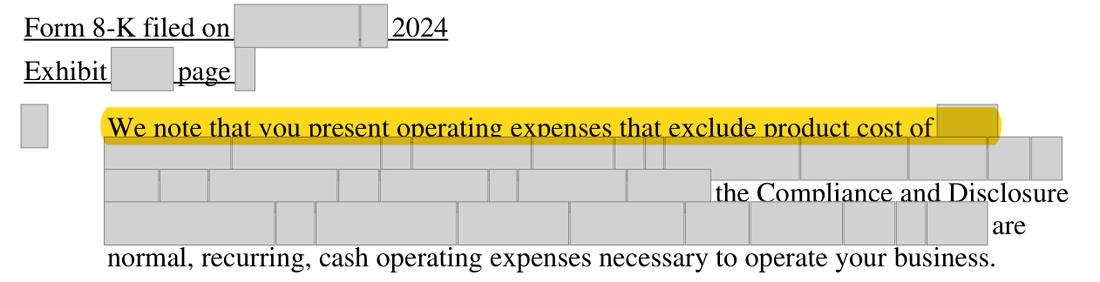
In [date], answering an SEC staff comment, the company undertook that its non-GAAP operating expense measure would in future exclude only three items: the contingent royalty revaluation, stock-based compensation, and depreciation and amortization. The 10-K delivers the rest of that response: cost of goods sold now sits above a gross profit line, with the distribution-right amortization inside it. But the year-end 2025 results release, furnished on the day the 10-K was filed, also excludes restructuring costs of [amount]. Its non-GAAP operating income adds back [amount] of distribution-right amortization that the stated definition does not name separately (it lists depreciation and amortization only in general terms). Management should explain how these changes fit the response given to the staff.
The evidence, as filed

1 further page extract: screenshot withheld to protect the company’s identity. The rows below say what each shows.
What the filing shows, and what the rule requires
| What the filing shows | What the rule requires |
|---|---|
Year-end 2025 release: non-GAAP operating expenses exclude four items (the three undertaken plus restructuring costs of [n]); non-GAAP income from operations also adds back distribution-right amortization of [n], which the definition in the release does not name separately from depreciation and amortization. | Either the measure keeps to the three exclusions described to the staff, or the release explains the added exclusion; and the stated definition of each non-GAAP measure lists every adjustment its reconciliation makes. |
| What we checked. Staff letter of [date] and company response of [date] (closing letter [date]); 2025 Form 10-K statement of operations and cost-of-goods-sold policy; year-end 2025 results release (definitions and reconciliations); first-quarter 2026 release. | |
The rule
Regulation G, Rule 100(b) (17 CFR 244.100(b))
shall not make public a non-GAAP financial measure that, taken together with the information accompanying that measure and any other accompanying discussion of that measure, contains an untrue statement of a material fact
Version: Text in force at the date of this review · Source: Regulation G, 17 CFR 244.100 (eCFR, in force for fiscal 2025)
Why it applies here. restructuring is a cost the staff generally accepts as an adjustment, and the measure no longer excludes product cost of sales, so the substance of the staff's concern is met. But the measure is not the one described in the response, and the stated definition does not match the reconciliation. Regulation G applies to the release, and Item 2.02 of Form 8-K applies the presentation requirements of Item 10(e)(1)(i) of Regulation S-K to it although it is furnished; the 10-K itself presents no non-GAAP measure. The first-quarter 2026 release returns to three exclusions.
Why it matters
A measure presented to investors differs from the one the company described to the SEC staff when the staff closed its review, and the stated definition does not match the reconciliation; a renewed staff comment on non-GAAP measures is the realistic risk.
Exposure
A question for management; if the staff disagrees, a comment letter and a revised definition in later releases.
Our workings
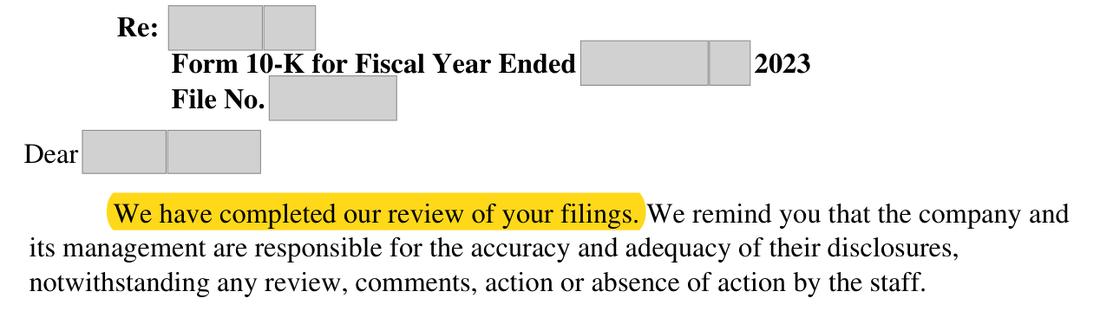
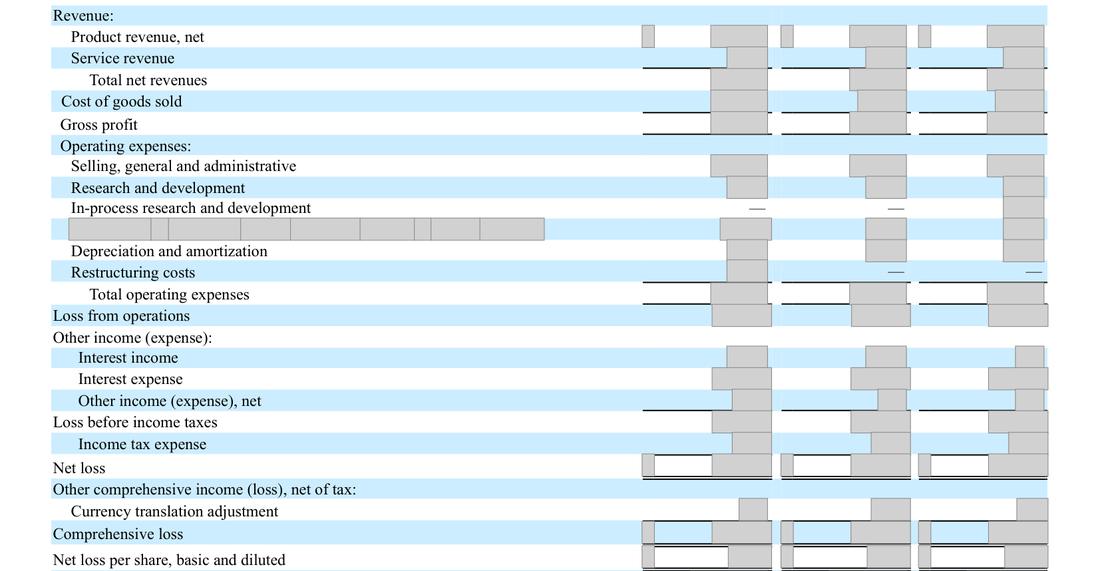
the staff questioned a non-GAAP operating expense measure that excluded product cost of sales. The company answered that it would present cost of sales above a gross profit subtotal, move the distribution-right amortization into cost of sales, and redefine non-GAAP operating expenses to exclude only three items; the staff closed its review six days later. The 2025 Form 10-K shows the new presentation (cost of goods sold of [n] above a gross profit line) and says cost of goods sold includes the distribution-right amortization, so those parts of the commitment are delivered.
the year-end 2025 release defines non-GAAP operating expenses and non-GAAP income from operations as excluding four items, the fourth being restructuring costs ([n] in 2025), and its reconciliation of non-GAAP income from operations adds back a further item, distribution-right amortization of [n], that the definition does not name separately (the definition lists depreciation and amortization in general terms, while the reconciliation shows the two as separate lines); one bullet in the same release lists that amortization as an exclusion for the quarter and another omits it for the year.
Management’s best defense, and our reply
Management would say the [date] response dealt with product cost of sales, which is no longer excluded, and that restructuring costs first arose in 2025, are not normal recurring operating costs, and are an adjustment the staff routinely accepts. They would add that the reconciliation shows every adjustment, so no investor is misled, and the first-quarter 2026 release has already returned to the three exclusions. That case is tenable; the remaining question is whether the response, which said 'only', should have been revisited, and why the definition omits an adjustment the table makes.
The fix
- State in each release every adjustment its reconciliation makes (including the distribution-right amortization), and keep a note of why restructuring costs were added to the adjustments after the [date] response.
Question for the company
How does the exclusion of restructuring costs from non-GAAP operating expenses, and the add-back of distribution-right amortization in non-GAAP income from operations, in the year-end 2025 release fit the [date] response to the SEC staff that the measure would exclude only three items, and why does the release's definition not name the amortization add-back separately?
Evidence relied on
| # | What it shows | Type | Where |
|---|---|---|---|
| 1 | The staff comment on the non-GAAP operating expense measure | Document | |
| 2 | The company's commitment: exclude only three items | Document | |
| 3 | The staff closed its review on the strength of the response | Document | |
| 4 | The 10-K presents cost of goods sold above gross profit, as committed | Document | Form 10-K 2025, page 63 |
| 5 | Distribution-right amortization moved into cost of goods sold, as committed | Document | Form 10-K 2025, page 70 |
| 6 | Year-end release: a fourth exclusion, restructuring costs | Document | |
| 7 | Restructuring costs excluded from non-GAAP operating expense for 2025 | Document | |
| 8 | Non-GAAP income from operations also adds back distribution-right amortization | Document | |
| 9 | The full-year definition does not list the amortization add-back | Document |
Prepared by Pramanex from the company’s public SEC filings, without the company’s involvement, to show how a 10-K Pre-filing Check reads. The company is not named, and nothing on this page is a statement about any identifiable company. Observations are not an audit, review or other attestation or assurance engagement, and not legal advice. An SEC-style question is a question, not a conclusion.
Want this on your own 10-K, before you file?
Start with three free findings on your latest 10-K, or book a fixed-price 10-K Pre-filing Check.
Your next 10-K will be in draft before the audit is done.
Have it read before you file.
Start with three free findings on your latest 10-K, or book a fixed-price 10-K check. Drafts only under NDA, inside your insider trading policy.