2.05 The tax-attribute risk factor says the carryforwards expire from 2034, but the tax note says the state losses begin to expire in 2026
Company C · a US-listed specialty healthcare products company · Presentation point
In brief
The risk factor lists federal, foreign and [amount] of state net operating losses (NOLs) and then says these tax attributes are set to expire at various dates beginning in 2034. The income tax note says the state NOLs begin to expire in 2026, and that most federal and all foreign NOLs never expire. The prior-year Form 10-K had the same sentence while its note gave 2024 for the state losses.
The evidence, as filed
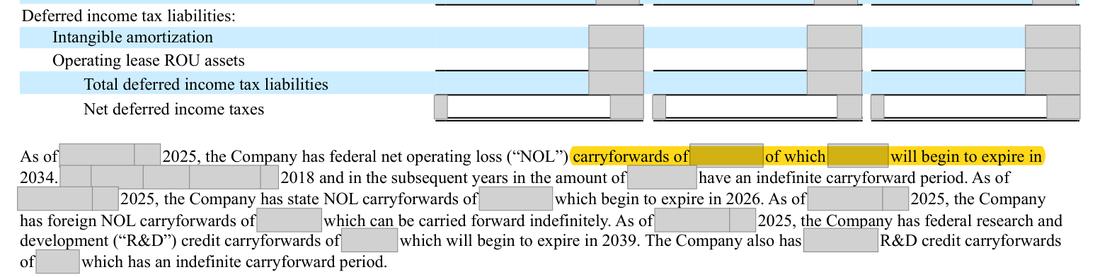
3 further page extracts: screenshot withheld to protect the company’s identity. The rows below say what each shows.
What the filing shows, and what the rule requires
| What the filing shows | What the rule requires |
|---|---|
"[wording masked] tax credit carryforwards are set to expire at various dates beginning in 2034" | An expiry statement by type that matches the note: state NOLs begin to expire in 2026; the pre-2018 federal NOLs begin to expire in 2034; the remaining federal NOLs and all foreign NOLs do not expire. |
The rule
Regulation S-K Item 105(b) (17 CFR 229.105(b))
Concisely explain how each risk affects the registrant or the securities being offered.
Version: In force from [date] · Source: Regulation S-K, Item 105, as amended by Release 33-10825
Exchange Act Rule 12b-20
there shall be added such further material information, if any, as may be necessary to make the required statements, in the light of the circumstances under which they are made not misleading.
Version: Text in force at the date of this review · Source: 17 CFR 240.12b-20, as in force for fiscal 2025
Why it applies here. the sentence understates how soon part of the attributes start to lapse (the state layer, from 2026) and overstates how much expires at all (the indefinite federal and foreign layers). The amounts themselves agree with the note; only the expiry statement is inconsistent. The same sentence appeared in the prior-year Form 10-K when that year's note gave 2024 as the first state expiry, so the risk factor has not been updated against the note.
Why it matters
A reader of Item 1A is told that no tax attribute lapses before 2034, when the audited note shows state losses lapsing from 2026 and most federal and all foreign losses never lapsing; the risk factor misdescribes the timing profile it exists to explain.
Exposure
Narrative inconsistency between a risk factor and the audited note; no fixed penalty. The realistic consequence if noticed in a staff review is a comment asking the Company to conform the risk factor to the note in future filings.
Our workings
the risk factor on p.27 gives the federal, foreign and state NOL balances and then a single expiry start of 2034 for 'these tax attributes'. The income tax note on p.92 gives different expiry terms for each type: federal NOLs of [amount], of which [amount] begin to expire in 2034 and [amount] carry forward indefinitely; state NOLs of [amount] begin to expire in 2026; foreign NOLs of [amount] carry forward indefinitely.
the workings split the federal balance; 2034 is right only for the pre-2018 federal layer.
| NOL layer | Amount (USD thousand) | Expiry per income tax note |
|---|---|---|
| Federal, generated before 2018 | [n] - [n] = [n] | begin to expire in 2034 |
| Federal, generated 2018 onward | [n] | indefinite |
| State | [n] | begin to expire in 2026 |
Management’s best defense, and our reply
Management may say the sentence sits in a paragraph about the federal Section 382 limitation and so refers to federal attributes, for which 2034 is the first expiry. It may add that the income tax note, which is audited and appears in the same filing, gives the precise expiry terms, so an investor who reads the whole document is not misled. However, the sentence follows a list that names the state NOLs and refers to 'these tax attributes', and the same wording has been carried over two years while the note's state expiry date changed; the two places disagree on the face of the filing.
The fix
- Replace the sentence with: "Our state NOLs begin to expire in 2026 and our federal NOLs generated before 2018 begin to expire in 2034; our remaining federal NOLs and our foreign NOLs may be carried forward indefinitely."
Evidence relied on
| # | What it shows | Type | Where |
|---|---|---|---|
| 1 | risk factor lists the federal, foreign and state NOL balances | Document | Form 10-K 2025, page 27 |
| 2 | risk factor gives one expiry start, 2034, for these attributes | Document | Form 10-K 2025, page 27 |
| 3 | income tax note: only [amount] of federal NOLs begin to expire in 2034 | Document | Form 10-K 2025, page 92 |
| 4 | income tax note: federal NOLs from 2018 onward never expire | Document | Form 10-K 2025, page 92 |
| 5 | income tax note: state NOLs begin to expire in 2026, not 2034 | Document | Form 10-K 2025, page 92 |
| 6 | income tax note: foreign NOLs never expire | Document | Form 10-K 2025, page 92 |
| 7 | prior-year Form 10-K risk factor: same 2034 sentence | Document | Form 10-K 2024 (prior year), page 27 |
| 8 | prior-year income tax note: state NOLs then began to expire in 2024 | Document | Form 10-K 2024 (prior year), page 93 |
Prepared by Pramanex from the company’s public SEC filings, without the company’s involvement, to show how a 10-K Pre-filing Check reads. The company is not named, and nothing on this page is a statement about any identifiable company. Observations are not an audit, review or other attestation or assurance engagement, and not legal advice. An SEC-style question is a question, not a conclusion.
Want this on your own 10-K, before you file?
Start with three free findings on your latest 10-K, or book a fixed-price 10-K Pre-filing Check.
Your next 10-K will be in draft before the audit is done.
Have it read before you file.
Start with three free findings on your latest 10-K, or book a fixed-price 10-K check. Drafts only under NDA, inside your insider trading policy.