1.14 No remaining performance obligation disclosure, and no statement that the one-year expedient is used
Company C · a US-listed specialty healthcare products company · SEC-style question
In brief
The revenue policy says the consumer loyalty program (a material right) and co-branded advertising are separate performance obligations, with the price allocated to them held as deferred revenue inside contract liabilities of [amount]. Neither the 2025 nor the 2024 Form 10-K discloses the transaction price allocated to these unsatisfied performance obligations or when it will be recognized, and neither says that the one-year practical expedient is applied. The only expedients listed are for sales commissions and significant financing components.
The evidence, as filed

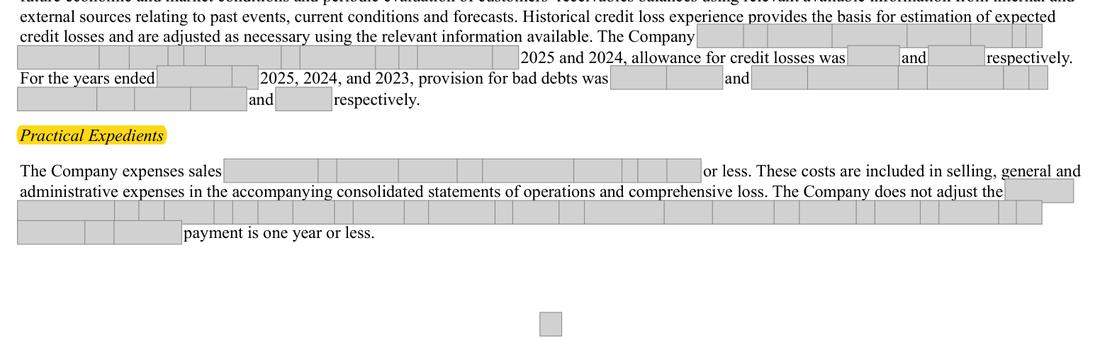
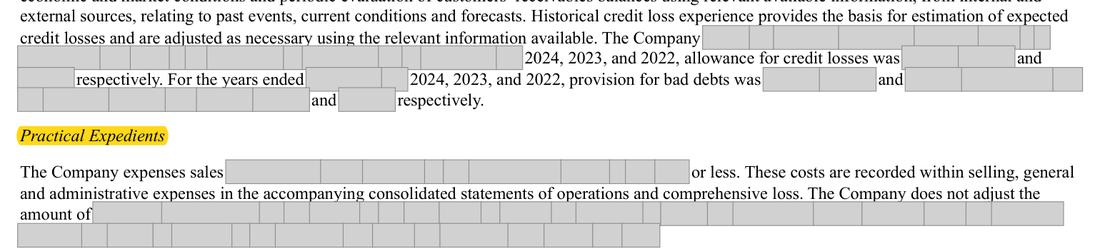
3 further page extracts: screenshot withheld to protect the company’s identity. The rows below say what each shows.
What the filing shows, and what the rule requires
| What the filing shows | What the rule requires |
|---|---|
Performance obligations for loyalty rewards and co-branded advertising are identified and deferred, but no remaining performance obligation amount, timing or expedient statement is given in either year | The aggregate transaction price allocated to unsatisfied (or partly unsatisfied) performance obligations at year-end with the expected timing of recognition, or a statement that the expedient for contracts with an original expected duration of one year or less is applied and the nature of the obligations excluded |
| What we checked. Revenue recognition policy, contract balances, practical expedients and segment note in both years; whole-report search | |
The rule
FASB ASC 606-10-50-13 to 50-15 (remaining performance obligations and the optional exemptions; paraphrase, Codification text not reproduced)
Summary; FASB/IFRS text is copyrighted Disclose transaction price allocated to unsatisfied performance obligations and expected timing of recognition, or state use of the permitted practical expedients and what is excluded.
Version: Text in force at the date of this review · Source: FASB Accounting Standards Codification, ASC 606-10-50-13 to 50-15 (ASU 2014-09 as amended)
Regulation S-X Rule 4-01(a)(1)
Financial statements filed with the Commission which are not prepared in accordance with generally accepted accounting principles will be presumed to be misleading or inaccurate, despite footnote or other disclosures
Version: Text in force at the date of this review · Source: Regulation S-X, 17 CFR 210.4-01 (eCFR as in force for fiscal 2025)
Why it applies here. paragraph 606-10-50-13 of the Accounting Standards Codification (ASC) requires the amount of transaction price allocated to remaining performance obligations and its timing; paragraph 606-10-50-14 lets an entity omit it for contracts of one year or less, but paragraph 606-10-50-15 then requires the entity to say so and describe what is omitted. Neither the amount nor the statement appears anywhere in the report. Whether the deferred revenue is small enough to be immaterial, and whether the rewards are redeemed within a year, are facts only management holds; the split of the [n] between rebates and deferred revenue is not given either.
Why it matters
Readers cannot see how much revenue already invoiced is still to be recognized for loyalty rewards and co-branded advertising, or whether management relies on the one-year exemption.
Exposure
A question for management; if the amount is material, the disclosure (or the expedient statement) is added in future filings. No fixed penalty.
Our workings
the revenue policy identifies two performance obligations besides the product sale: the loyalty reward, which is a material right, and co-branded advertising; the portion of the invoice price allocated to each is recorded as deferred revenue and recognized later. Contract liabilities, which include that deferred revenue together with rebates, were [n] at [date] and [n] at [date]. The practical-expedients paragraph lists only the expensing of sales commissions and the omission of a financing component.
| Requirement | Where looked | Status |
|---|---|---|
| Amount allocated to remaining performance obligations | Note 2 revenue, contract balances; Note 14 | Absent |
| Expected timing of recognition | Same | Absent |
| Statement that the one-year expedient is applied | Practical Expedients paragraph | Absent (only commissions and financing component listed) |
| Deferred revenue within contract liabilities | Contract Balances | Partial: combined with rebates in [n] |
Management’s best defense, and our reply
Management can say that loyalty rewards and co-branded advertising are normally redeemed or aired within a year, so the exemption applies, and that the deferred revenue is a small part of the contract liabilities, most of which are rebates, so the disclosure is immaterial. It can add that the auditor accepted the notes in both years. Those are reasonable positions, but the report does not state the exemption or the amount, which the standard requires even when the exemption is used; whether the amount is immaterial is a fact only management can show, so the point is put as a question.
The fix
- Add to the contract balances paragraph either the amount allocated to unsatisfied performance obligations with its expected timing, or: "The Company applies the optional exemption for performance obligations that are part of contracts with an original expected duration of one year or less; these comprise unredeemed loyalty rewards and co-branded advertising not yet aired."
Question for the company
How much of the contract liabilities at [date] and 2024 is deferred revenue for loyalty rewards and co-branded advertising, over what period is it expected to be recognized, and if the one-year exemption is relied on, why is that not stated?
Evidence relied on
| # | What it shows | Type | Where |
|---|---|---|---|
| 1 | Loyalty rewards are a separate performance obligation | Document | Form 10-K 2025, page 74 |
| 2 | Co-branded advertising is a separate performance obligation | Document | Form 10-K 2025, page 74 |
| 3 | Price allocated to the unsatisfied obligation is deferred | Document | Form 10-K 2025, page 74 |
| 4 | Contract liabilities at both year-ends, which include the deferred revenue | Document | Form 10-K 2025, page 75 |
Absence check
- Document
- Form 10-K 2025
- Where it would appear
- Practical Expedients
- What is missing
- the transaction price allocated to remaining performance obligations and its timing, or the statement that the one-year expedient is applied and what it excludes
- Pages looked at
- p.67-75, 94-95 (revenue policy, contract balances, practical expedients, segment note)
- Result
- Only 'one year or less' hits, twice on p.75, where it supports the commission and financing-component expedients, not remaining performance obligations; the other terms have no hits in the whole report.
Prepared by Pramanex from the company’s public SEC filings, without the company’s involvement, to show how a 10-K Pre-filing Check reads. The company is not named, and nothing on this page is a statement about any identifiable company. Observations are not an audit, review or other attestation or assurance engagement, and not legal advice. An SEC-style question is a question, not a conclusion.
Want this on your own 10-K, before you file?
Start with three free findings on your latest 10-K, or book a fixed-price 10-K Pre-filing Check.
Your next 10-K will be in draft before the audit is done.
Have it read before you file.
Start with three free findings on your latest 10-K, or book a fixed-price 10-K check. Drafts only under NDA, inside your insider trading policy.