1.13 The current portion of the operating lease liability equals the next year's undiscounted rent at both year-ends
Company C · a US-listed specialty healthcare products company · SEC-style question
In brief
The balance sheet shows a current operating lease liability of [amount] at [date], exactly the undiscounted rent due in 2026 in the maturity table; a year earlier the current portion ([amount]) was also exactly the undiscounted rent due in 2025. The lease liability is a present value (discount rate [n]%), so the part settled within twelve months is the payments less the interest that will accrue on them. The whole imputed interest therefore sits in the long-term portion.
The evidence, as filed
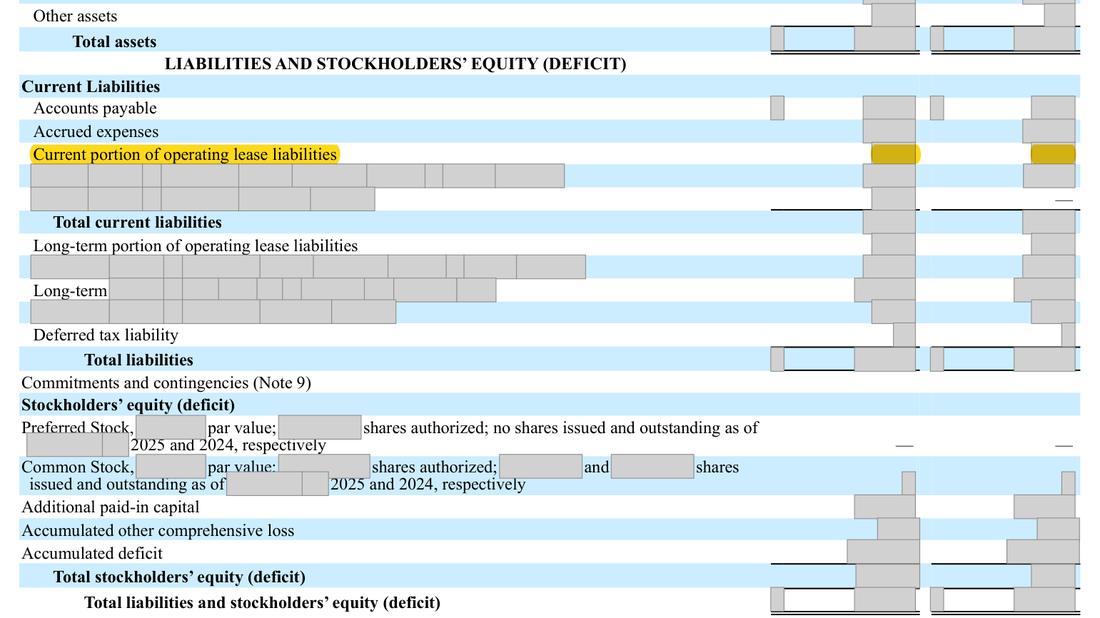
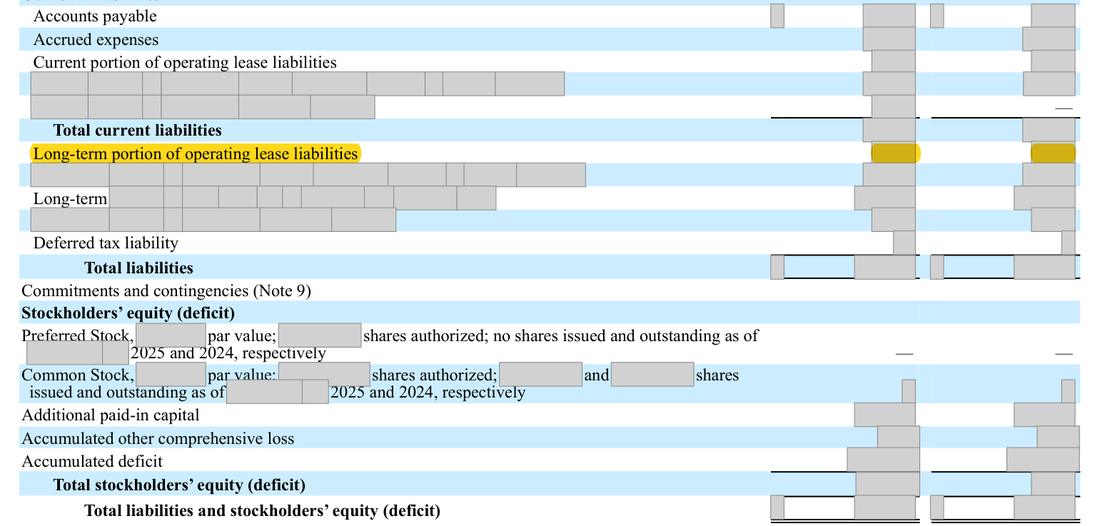
2 further page extracts: screenshot withheld to protect the company’s identity. The rows below say what each shows.
What the filing shows, and what the rule requires
| What the filing shows | What the rule requires |
|---|---|
Current portion of operating lease liabilities [n] (2025) and [n] (2024), each equal to the next year's undiscounted lease payment; long-term portion [n] absorbs all imputed interest of [n] | A current portion measured on the discounted liability: the reduction of the lease liability expected in the next twelve months (payments less interest accruing), or at least the present value of the payments due within twelve months |
| What we checked. Balance sheet; Note 8 maturity analysis and supplemental data, both years | |
The rule
FASB ASC 842-20-45-1; 842-20-50-1 to 50-10 (lessee presentation and disclosure; paraphrase, Codification text not reproduced)
Summary; FASB/IFRS text is copyrighted Lessees disclose lease nature and significant judgments, lease cost components, weighted-average term and discount rate, cash paid, and a maturity analysis reconciled to lease liabilities.
Version: Text in force at the date of this review · Source: FASB Accounting Standards Codification, ASC 842-20 (as amended by ASU 2018-11)
Regulation S-X Rule 4-01(a)(1)
Financial statements filed with the Commission which are not prepared in accordance with generally accepted accounting principles will be presumed to be misleading or inaccurate, despite footnote or other disclosures
Version: Text in force at the date of this review · Source: Regulation S-X, 17 CFR 210.4-01 (eCFR as in force for fiscal 2025)
Why it applies here. the current portion includes interest that has not accrued at the balance-sheet date, and the long-term portion is reduced by the same amount; total liabilities are unaffected. The amount is small, but the identical pattern at two year-ends points to a method rather than a coincidence, which only management can confirm.
Why it matters
Current liabilities include interest not yet accrued and long-term lease liabilities are reduced by the same amount; working capital is understated by up to [n]. No effect on total liabilities or results.
Exposure
A question for management; if the basis is confirmed, a future-filings correction of the current and long-term split. No fixed penalty.
Our workings
at [date] the balance sheet carries a current operating lease liability of [n] and a long-term portion of [n]; the maturity table shows 2026 payments of [n], total payments of [n], imputed interest of [n] and a present value of [n], with a weighted-average discount rate of [n]%. At [date] the current portion was [n] and the 2025 payment in that year's maturity table was [n].
[n] + [n] = [n], so the split is applied to the discounted liability, but the current part equals the undiscounted next-year payment in both years. Interest accruing in 2026 on an opening liability of [n] at [n]% is up to [n] ([n] x [n]%), so the principal settled in 2026 is nearer [n] ([n] - [n]); on the narrower present-value-of-next-year-payments basis the current portion would be about [n] ([n] / [n]^[n]).
| Item | Amount | Computation |
|---|---|---|
| Lease liability split (2025) | [n] | [n] + [n] = [n] |
| Current portion vs 2026 payment | 0 | [n] - [n] = 0 |
| Current portion vs 2025 payment (prior year) | 0 | [n] - [n] = 0 |
| Indicative 2026 interest (upper bound) | [n] | [n] x [n]% = [n] |
| Principal settled in 2026 on that basis | [n] | [n] - [n] = [n] |
| Present value of 2026 payments (mid-year) | [n] | [n] / [n]^[n] = [n] |
| Range of the difference | [n] to [n] | [n] - [n] = [n]; [n] - [n] = [n] |
Management’s best defense, and our reply
Management can argue that the amounts are small (at most about [n] against current liabilities of [n]), that total liabilities are correct, and that some preparers use the present value of next-year payments, which for a short lease is close to the undiscounted amount. It can add that the auditor did not raise the classification. However, the current portion equals the undiscounted payment to the dollar in two successive years, which neither the principal-reduction basis nor the present-value basis produces at a [n]% rate; the defense goes to size, not to method, so the point stays a question.
The fix
- Measure the current portion as the reduction of the discounted lease liability expected in the next twelve months (payments less interest accruing), and state the basis in Note 8.
Question for the company
How is the current portion of the operating lease liability determined, and why does it equal the next year's undiscounted lease payments at both [date] and [date]?
Evidence relied on
| # | What it shows | Type | Where |
|---|---|---|---|
| 1 | Balance sheet: current operating lease liability at both year-ends | Document | Form 10-K 2025, page 62 |
| 2 | Balance sheet: long-term operating lease liability | Document | Form 10-K 2025, page 62 |
| 3 | Maturity table: undiscounted 2026 payment equals the current portion | Document | Form 10-K 2025, page 84 |
| 4 | Maturity table: imputed interest and present value | Document | Form 10-K 2025, page 84 |
| 5 | Maturity table: total undiscounted payments | Document | Form 10-K 2025, page 84 |
| 6 | Discount rate used for the indicative interest | Document | Form 10-K 2025, page 84 |
| 7 | Prior year: the undiscounted 2025 payment equals that year's current portion of [n] | Document | Form 10-K 2024 (prior year), page 86 |
Prepared by Pramanex from the company’s public SEC filings, without the company’s involvement, to show how a 10-K Pre-filing Check reads. The company is not named, and nothing on this page is a statement about any identifiable company. Observations are not an audit, review or other attestation or assurance engagement, and not legal advice. An SEC-style question is a question, not a conclusion.
Want this on your own 10-K, before you file?
Start with three free findings on your latest 10-K, or book a fixed-price 10-K Pre-filing Check.
Your next 10-K will be in draft before the audit is done.
Have it read before you file.
Start with three free findings on your latest 10-K, or book a fixed-price 10-K check. Drafts only under NDA, inside your insider trading policy.