1.04 Goodwill sits in one reporting unit while the company has a stockholders' deficit, but the note does not say the unit's carrying amount is negative
Company C · a US-listed specialty healthcare products company · SEC-style question
In brief
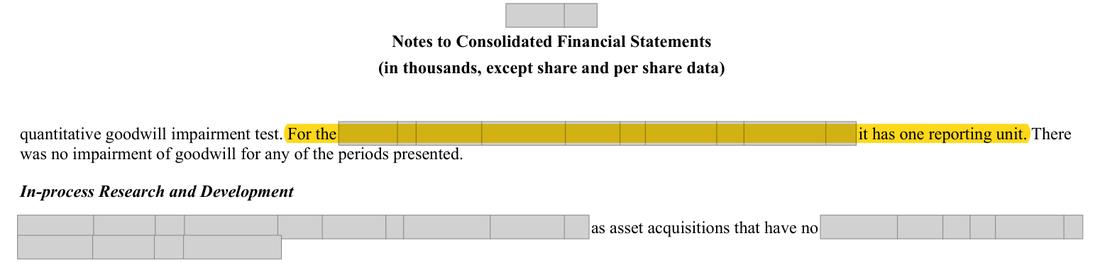
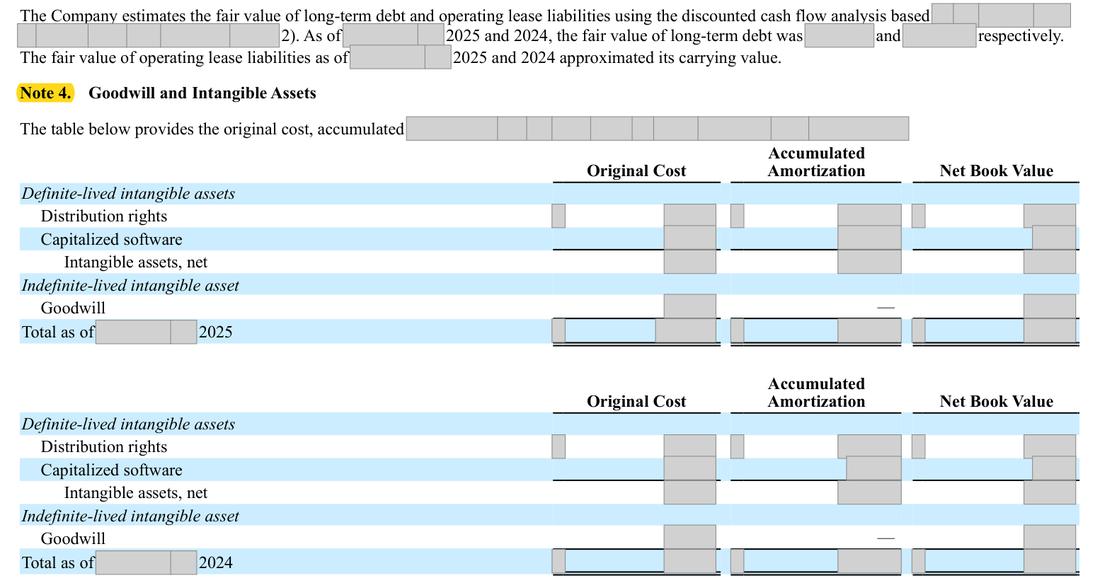
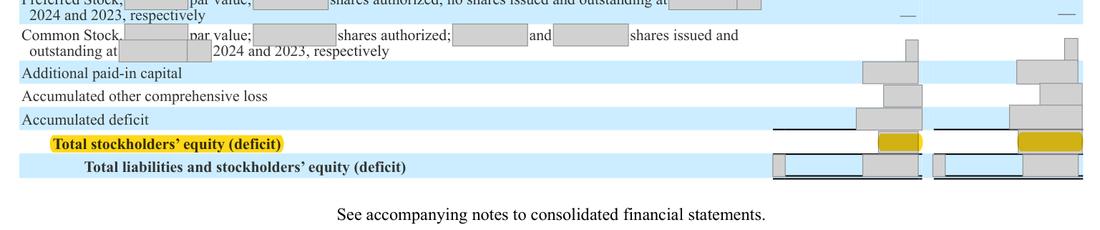
The company tests its goodwill of [amount] in one reporting unit, which is the whole business. At [date] the consolidated balance sheet shows a total stockholders' deficit of [amount], so on the usual equity basis the reporting unit's carrying amount is negative. US GAAP then asks for a specific disclosure: that a reporting unit has a zero or negative carrying amount and how much goodwill is allocated to it. Neither the goodwill note nor the impairment policy says this, or says which basis the company uses for the carrying amount. Stockholders' equity was also a deficit of [amount] at [date] (p.64), a deficit at two of the last three year-ends, and the policy describes an annual qualitative assessment without saying whether the 2025 test was qualitative or quantitative.
The evidence, as filed

What the filing shows, and what the rule requires
| What the filing shows | What the rule requires |
|---|---|
Note 4 shows goodwill of [amount]; the policy says there is one reporting unit and an annual qualitative assessment; the balance sheet shows total stockholders' equity (deficit) of [amount]. No statement that the reporting unit's carrying amount is zero or negative, and no statement of the basis used to measure it. | Either a sentence that the Company's single reporting unit had a negative carrying amount at [date] with [amount] of goodwill allocated to it, or a statement of the basis on which the carrying amount is measured (for example, excluding the term loans) showing why it is positive. |
| What we checked. Goodwill note, goodwill policy, balance sheet, prior-year balance sheet, the two later quarterly reports | |
The rule
Regulation S-X Rule 4-01(a)(1)
Financial statements filed with the Commission which are not prepared in accordance with generally accepted accounting principles will be presumed to be misleading or inaccurate, despite footnote or other disclosures
Version: Text in force at the date of this review · Source: Regulation S-X, 17 CFR 210.4-01(a)(1)
Regulation S-X Rule 4-01(a)
The information required with respect to any statement shall be furnished as a minimum requirement to which shall be added such further material information as is necessary to make the required statements, in the light of the circumstances under which they are made, not misleading.
Version: Text in force at the date of this review · Source: Regulation S-X, 17 CFR 210.4-01(a)
Why it applies here. since the 2017 simplification of the goodwill test (removal of the second step), a unit with a zero or negative carrying amount passes the impairment test automatically, which is why the Codification's goodwill disclosure rules (with its rules on assigning assets and liabilities to a reporting unit) require the existence of such units and their allocated goodwill to be disclosed. Unless the company measures the unit's carrying amount on an enterprise basis that leaves out the term loans, the disclosure is due and is absent. The note does not say which basis is used, so the point is put as a question.
Why it matters
If the carrying amount is measured on the equity basis, a required goodwill disclosure (ASC 350-20-50-1A, added by ASU 2017-04) is missing and readers are not told that the impairment test cannot fail while the deficit lasts. The realistic result is a staff comment asking for the basis and the disclosure in future filings.
Exposure
A question for management; if the equity basis is used, the realistic consequence is a staff comment and a future-filings undertaking, with no change to measured amounts.
Our workings
the policy states the company has one reporting unit for goodwill testing and performs an annual qualitative assessment in the fourth quarter. Note 4 shows goodwill of [amount] at both year ends. The balance sheet shows total stockholders' equity (deficit) of [amount] at [date] against [amount] a year earlier.
with one reporting unit covering every asset and liability of the group, its carrying amount on the equity basis equals consolidated equity, which is negative.
| Item | Amount (USD thousand) | Source |
|---|---|---|
| Total stockholders' equity (deficit), [date] | ([n]) | Balance sheet |
| Goodwill allocated to the one reporting unit | [n] | Note 4 |
| Equity excluding goodwill | -[n] - [n] = -[n] | computed |
| Total stockholders' equity (deficit), [date] | [n] | Balance sheet (positive: no disclosure due at that date) |
Management’s best defense, and our reply
The finance team may say the carrying amount of the single reporting unit is measured on an enterprise basis: the operating assets and liabilities are assigned to it, but the term loans are corporate financing that is not considered in measuring the unit's fair value, so the carrying amount is positive and no disclosure is due. They may add that market capitalization is far above book value, so impairment risk is remote and the disclosure would tell investors nothing. The answer: when the whole company is one reporting unit and its fair value is gauged against an equity value such as market capitalization, the debt must sit in the carrying amount for the comparison to be like for like, and the note does not say which basis is used. The disclosure exists precisely because a negative-carrying-amount unit passes the test automatically, so a reader cannot tell from this report whether the qualitative assessment had any real test to pass.
The fix
- Add to Note 4: 'The Company has one reporting unit. As of [date], the reporting unit had a negative carrying amount of net assets; goodwill allocated to it was [amount].' Or state the basis that makes the carrying amount positive.
Question for the company
On what basis does the Company measure the carrying amount of its single reporting unit for goodwill testing, and was that carrying amount zero or negative at [date]? If so, will the Company disclose that fact and the [amount] of goodwill allocated to the unit?
Evidence relied on
| # | What it shows | Type | Where |
|---|---|---|---|
| 1 | Goodwill is tested in a single reporting unit (the whole business) | Document | Form 10-K 2025, page 71 |
| 2 | The annual test is qualitative; the policy does not state the basis of the reporting unit's carrying amount | Document | Form 10-K 2025, page 70 |
| 3 | Goodwill of [amount] at [date], all in the one reporting unit | Document | Form 10-K 2025, page 80 |
| 4 | Consolidated equity is a deficit of [amount] at [date], against [amount] at [date] | Document | Form 10-K 2025, page 62 |
| 5 | the goodwill policy names a single reporting unit and says nothing on how its carrying amount is measured | Document | Form 10-K 2025, page 71 |
| 6 | equity is a deficit of ([n]) at [date], against [n] a year earlier | Document | Form 10-K 2025, page 62 |
| 7 | The policy describes a qualitative assessment and does not say whether the 2025 test was qualitative or quantitative | Document | Form 10-K 2025, page 70 |
| 8 | All goodwill sits in a single reporting unit | Document | Form 10-K 2025, page 71 |
| 9 | Stockholders' equity was also negative at [date] | Document | Form 10-K 2025, page 64 |
Absence check
- Document
- Form 10-K 2025
- Where it would appear
- Note 4.
- What is missing
- a statement that the single reporting unit has a zero or negative carrying amount and the goodwill allocated to it, or the basis on which its carrying amount is measured
- Pages looked at
- p.62, 70-71, 80-81
- Result
- Only 'reporting unit' hits, on p.70-71 (the goodwill impairment policy: qualitative assessment, option to go straight to the quantitative test, one reporting unit, no impairment). None of those sentences states the unit's carrying amount, its sign or the basis of measurement. The other four terms have no hits anywhere in the report.
Prepared by Pramanex from the company’s public SEC filings, without the company’s involvement, to show how a 10-K Pre-filing Check reads. The company is not named, and nothing on this page is a statement about any identifiable company. Observations are not an audit, review or other attestation or assurance engagement, and not legal advice. An SEC-style question is a question, not a conclusion.
Want this on your own 10-K, before you file?
Start with three free findings on your latest 10-K, or book a fixed-price 10-K Pre-filing Check.
Your next 10-K will be in draft before the audit is done.
Have it read before you file.
Start with three free findings on your latest 10-K, or book a fixed-price 10-K check. Drafts only under NDA, inside your insider trading policy.