7.06 Five wording slips in the risk factors, one of which calls an equity-method investee a subsidiary
Company B · a US-listed transportation and logistics company · Drafting slip
In brief
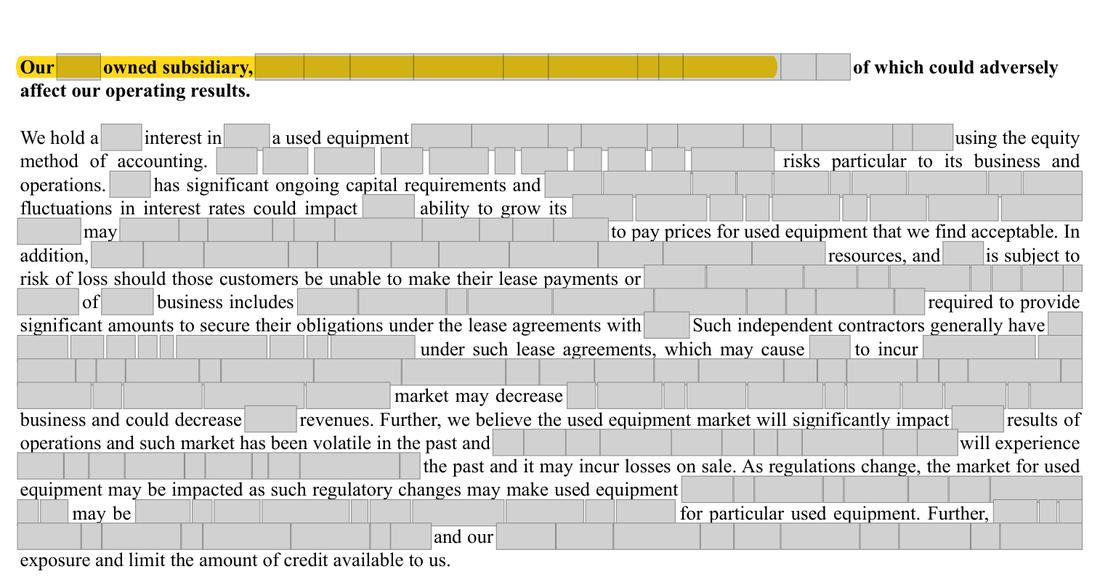
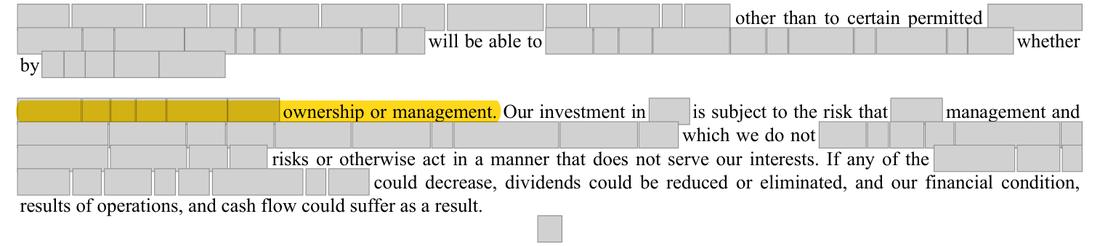
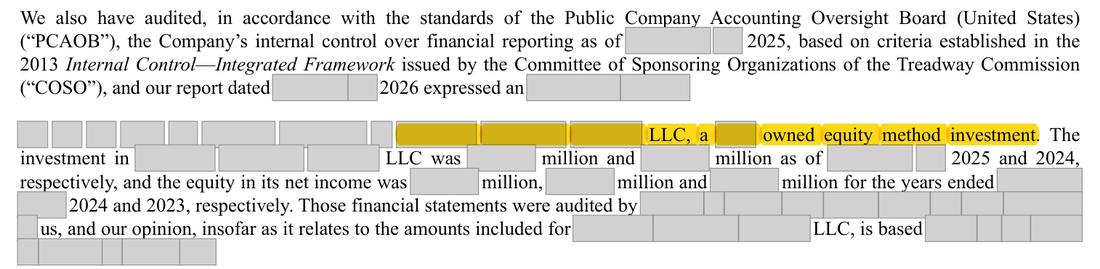
The risk-factor heading calls [equity investee], LLC ([equity investee]) a "[n]% owned subsidiary", while the same paragraph and the auditor's report treat it as an equity method investment, which by definition is not controlled. Four smaller slips sit in the same Item: "If these event occur", "can provide only reasonably assurance", "fuel efficiency decline" (for "declines") in the seasonality risk factor, and the opening list of industry factors, which names compliance with ongoing regulatory requirements twice, as factors (vii) and (x). The subsidiary label, the "reasonably assurance" slip, the repeated factor and "fuel efficiency decline" were also in the prior-year Form 10-K.
The evidence, as filed

What the filing shows, and what the rule requires
| What the filing shows | What the rule requires |
|---|---|
Heading: "Our [n]% owned subsidiary, [equity investee]"; "If these event occur"; "can provide only reasonably assurance"; "operating expenses increase and fuel efficiency decline because of engine idling"; factor list: "(vii) industry compliance with ongoing regulatory requirements" and "(x) compliance with ongoing regulatory requirements" | "Our [n]% owned equity method investee, [equity investee]"; "If these events occur"; "can provide only reasonable assurance"; "fuel efficiency declines"; one regulatory-compliance factor, or two worded so the difference is plain (industry-wide effects versus the Company's own compliance) |
The rule
Regulation S-X Rule 1-02(x) (definition of subsidiary)
A subsidiary of a specified person is an affiliate controlled by such person directly, or indirectly through one or more intermediaries.
Version: Text in force at the date of this review · Source: 17 CFR 210.1-02, Regulation S-X, as in force for fiscal 2025
Why it applies here. under Regulation S-X a subsidiary is an affiliate controlled by the registrant, so the heading label is wrong in terms, though the body text makes the accounting clear.
Why it matters
Cosmetic; a reader of the heading alone could take [equity investee] to be consolidated.
Exposure
No regulatory exposure; wording only.
Our workings
the heading on p.23 calls [equity investee] a subsidiary; the body of the same risk factor says the investment is accounted for by the equity method and that the Company does not control [equity investee]; the auditor's report calls it a [n]% owned equity method investment.
the first risk factor (unnumbered page) lists fourteen factors, of which (vii) is "industry compliance with ongoing regulatory requirements" and (x) "compliance with ongoing regulatory requirements"; the prior-year Form 10-K has the same pair. The two may be meant to separate industry-wide effects from the Company's own compliance, but the wording does not say so. The other three slips are grammar only; "fuel efficiency decline" is in the seasonality risk factor of both years (unnumbered page, Form 10-K 2024 (prior year) unnumbered page). None changes a figure.
Management’s best defense, and our reply
The body of the [equity investee] risk factor states the equity method and the lack of control, so no reader is misled about the accounting, and factors (vii) and (x) can be read as industry-wide versus Company-specific compliance. However, the heading is the part most readers scan, the defined term in Regulation S-X does not fit, and the factor list gives no words that draw the distinction; each fix is a one-line change.
The fix
- Read: "Our [n]% owned equity method investee, [equity investee], faces ..."; "If these events occur ..."; "... can provide only reasonable assurance ..."; "... [wording masked]"; delete factor (x) or reword (vii) and (x) so each names a distinct risk.
Evidence relied on
| # | What it shows | Type | Where |
|---|---|---|---|
| 1 | heading calls [equity investee] a subsidiary | Document | Form 10-K 2025, page 23 |
| 2 | same risk factor says the Company does not control [equity investee] | Document | Form 10-K 2025, page 23 |
| 3 | auditor's report describes [equity investee] as an equity method investment | Document | Form 10-K 2025, unnumbered page |
| 4 | grammar slip in the goodwill risk factor (prior year read 'these events') | Document | Form 10-K 2025, unnumbered page |
| 5 | grammar slip in the internal-control risk factor | Document | Form 10-K 2025, page 24 |
| 6 | prior-year Form 10-K carried the same subsidiary label | Document | Form 10-K 2024 (prior year), unnumbered page |
| 7 | prior-year Form 10-K carried the same grammar slip | Document | Form 10-K 2024 (prior year), page 24 |
| 8 | prior-year Form 10-K carried the same repeated factor alongside (vii) industry compliance | Document | Form 10-K 2024 (prior year), unnumbered page |
| 9 | Fiscal 2025 10-K: the same slip carried forward in the risk factor | Document | Form 10-K 2025, unnumbered page |
| 10 | Prior-year 10-K: factor (vii) of the opening risk factor | Document | Form 10-K 2024 (prior year), unnumbered page |
| 11 | Prior-year 10-K: the same factor repeated as (x) | Document | Form 10-K 2024 (prior year), unnumbered page |
| 12 | Prior-year 10-K, seasonality risk factor: 'fuel efficiency decline' (Item 1 reads 'declines') | Document | Form 10-K 2024 (prior year), unnumbered page |
Prepared by Pramanex from the company’s public SEC filings, without the company’s involvement, to show how a 10-K Pre-filing Check reads. The company is not named, and nothing on this page is a statement about any identifiable company. Observations are not an audit, review or other attestation or assurance engagement, and not legal advice. An SEC-style question is a question, not a conclusion.
Want this on your own 10-K, before you file?
Start with three free findings on your latest 10-K, or book a fixed-price 10-K Pre-filing Check.
Your next 10-K will be in draft before the audit is done.
Have it read before you file.
Start with three free findings on your latest 10-K, or book a fixed-price 10-K check. Drafts only under NDA, inside your insider trading policy.