4.12 Total assets in the year-end earnings release differ from the audited balance sheet by [amount]
Company B · a US-listed transportation and logistics company · SEC-style question
In brief
The fourth-quarter earnings release furnished on [date] gives total assets at [date] of [amount]. The audited balance sheet in the 10-K gives [amount], and the 10-K balance sheet balances at that figure. The release gives stockholders' equity of [amount] against [amount] in the 10-K. The release figure was not corrected or explained in the 10-K.
The evidence, as filed
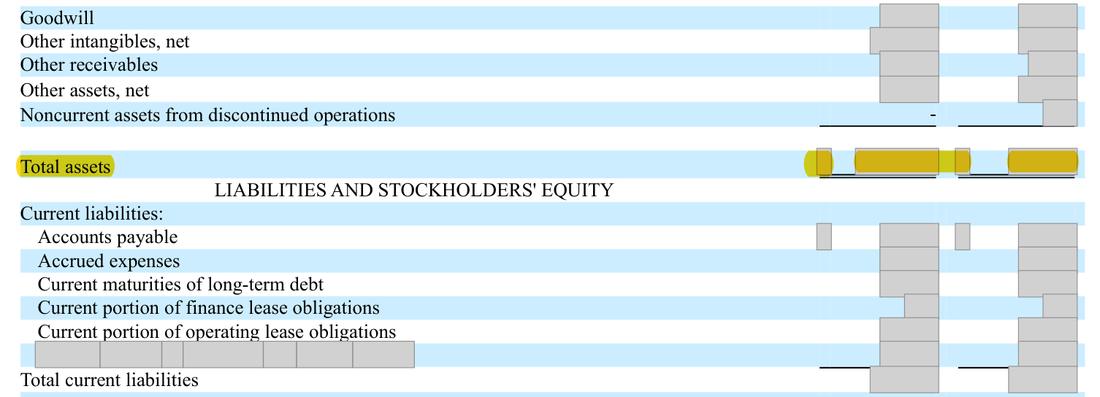
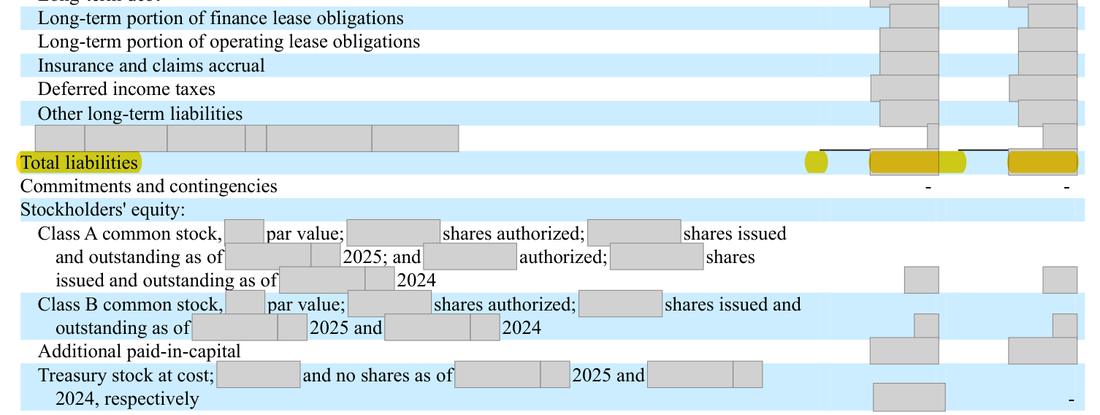

2 further page extracts: screenshot withheld to protect the company’s identity. The rows below say what each shows.
What the filing shows, and what the rule requires
| What the filing shows | What the rule requires |
|---|---|
Earnings release: total assets [amount], stockholders' equity [amount]. Form 10-K balance sheet: total assets [amount], total liabilities [amount], stockholders' equity [amount]. Difference in total assets: [amount]. | Release figures that agree with the balance sheet later filed in the 10-K, or, where a balance changed after the release, a short statement of the change. |
The rule
Consistency of the earnings release with the Form 10-K
Why it applies here. either the release carried a keying error in total assets, or an asset and a liability were both changed by [n] between the release and the 10-K (a post-release adjustment that left equity unchanged). Only management can say which; no figure in the 10-K is shown to be wrong.
Why it matters
Investors and data providers who took the balance sheet from the release hold a total-asset figure that does not match the audited accounts; if the difference reflects a post-release adjustment, the market was not told of it.
Exposure
No penalty: the release is furnished, the difference is small and the audited figure balances.
Our workings
the release's selected balance-sheet data and the 10-K balance sheet are quoted above.
total assets differ by [n]; the 10-K's total liabilities plus equity reproduce its total assets exactly; equity differs only by 1 thousand (rounding).
| Item | Amount (USD thousand) |
|---|---|
| Release total assets less 10-K total assets | [n] - [n] = [n] |
| 10-K total liabilities plus stockholders' equity | [n] + [n] = [n] |
| Release equity less 10-K equity | [n] - [n] = 1 |
Management’s best defense, and our reply
Management could say the release is furnished, not filed, that the release's balance-sheet data are preliminary and unaudited, and that a difference of [n]% of total assets is not material to any investor. It could add that the audited 10-K is the authoritative document and was filed four weeks later. That is fair as to materiality, but the release presents the figure as the year-end balance without a preliminary caveat on that table, and the cause is not known, so the point stays a question rather than a finding.
The fix
- Confirm the cause. If a keying error, no action beyond tightening the release tie-out; if a post-release reclassification, say so in the next release or the next Form 10-Q.
Question for the company
Total assets at [date] are [amount] in the earnings release and [amount] in the 10-K. Was the release figure a keying error, or was an asset and a matching liability adjusted after the release? If the latter, what was adjusted?
Evidence relied on
| # | What it shows | Type | Where |
|---|---|---|---|
| 1 | Total assets as given in the earnings release | Document | |
| 2 | Equity as given in the earnings release | Document | |
| 3 | Total assets in the audited balance sheet | Document | Form 10-K 2025, unnumbered page |
| 4 | Total liabilities in the audited balance sheet | Document | Form 10-K 2025, unnumbered page |
| 5 | Equity in the audited balance sheet | Document | Form 10-K 2025, page 54 |
Prepared by Pramanex from the company’s public SEC filings, without the company’s involvement, to show how a 10-K Pre-filing Check reads. The company is not named, and nothing on this page is a statement about any identifiable company. Observations are not an audit, review or other attestation or assurance engagement, and not legal advice. An SEC-style question is a question, not a conclusion.
Want this on your own 10-K, before you file?
Start with three free findings on your latest 10-K, or book a fixed-price 10-K Pre-filing Check.
Your next 10-K will be in draft before the audit is done.
Have it read before you file.
Start with three free findings on your latest 10-K, or book a fixed-price 10-K check. Drafts only under NDA, inside your insider trading policy.