4.09 Critical accounting estimates for goodwill and self-insurance give no quantitative sensitivity in the year of an impairment and a large claim
Company B · a US-listed transportation and logistics company · SEC-style question
In brief
The goodwill estimate reports a [amount] partial impairment of the legacy Segment 2 reporting unit after an interim test, but gives no remaining goodwill for that unit, no headroom for the other units and no sensitivity of the key assumptions. The self-insurance estimate, the subject of the auditor's critical audit matter, gives no amounts at all, although the insurance and claims accrual rose from [n] to [n] dollars. Item 303(b)(3) asks for quantitative information on how an estimate has changed and its sensitivity, to the extent material and reasonably available.
The evidence, as filed
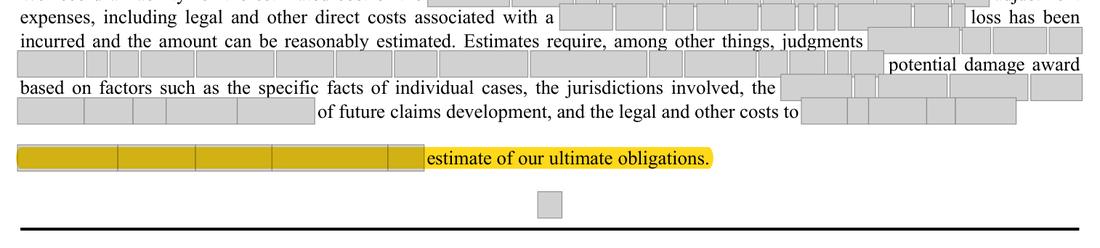
4 further page extracts: screenshot withheld to protect the company’s identity. The rows below say what each shows.
What the filing shows, and what the rule requires
| What the filing shows | What the rule requires |
|---|---|
Goodwill estimate: [amount] impairment described in words only; Segment 2 segment goodwill falls from [n] by [n] to [n] (note) with no headroom or assumption values in MD&A. Self-insurance estimate: a list of judgments and one sentence; accrual [n] against [n] a year earlier, up [n], not mentioned. | For goodwill: the goodwill remaining in the impaired unit and in any unit whose fair value is not substantially above carrying value, the headroom, the key assumptions (discount rate, growth, margins) and their sensitivity. For self-insurance: the accrual, how much it changed from prior-year estimates (development) and the effect of a reasonably possible change in severity assumptions. |
The rule
Regulation S-K Item 303(b)(3) (17 CFR 229.303(b)(3))
Provide qualitative and quantitative information necessary to understand the estimation uncertainty and the impact the critical accounting estimate has had or is reasonably likely to have on financial condition or results of operations to the extent the information is material and reasonably available.
Version: In force from [date] · Source: Regulation S-K Item 303, as amended by Release 33-10890, eCFR
Why it applies here. a unit just written down to fair value has no headroom, so any further fall in its forecasts gives a further charge; the quantitative information the rule describes was evidently available from the interim test and the actuarial work, and both estimates moved by amounts large against the year's pre-tax income. Whether the company judged the information not material or not reasonably available is a matter only management can answer.
Why it matters
Readers cannot judge how close the remaining goodwill is to a further charge, or how sensitive the largest judgmental liability is, in a year when pre-tax income was [n].
How often the SEC staff raises this. In 1,100 SEC staff comment letters on fiscal 2023 and 2024 Forms 10-K, released January 2025 to October 2026, critical accounting estimates drew 23 of the 1,774 numbered comments (1.3%): topic 16 of 25 by frequency.
Exposure
A question for management; critical accounting estimates are a frequent SEC comment theme and the staff may ask for quantified sensitivity in future filings.
Our workings
the goodwill estimate (unnumbered page) says the [date] quantitative test found no impairment, and that a later interim test gave a partial impairment of [amount] for the legacy Segment 2 reporting unit; it names the assumption types but gives no values, headroom or sensitivity. The goodwill note (unnumbered page) shows Segment 2 segment goodwill of [n] at the start of the year. The self-insurance estimate lists the judgments involved and states that the liability is management's best estimate. The auditor's only critical audit matter (unnumbered page) is [wording masked]. The balance sheet (unnumbered page) shows the insurance and claims accrual at [n] current plus [n] long-term.
[n] - [n] = [n] of Segment 2 segment goodwill left; [n] + [n] = [n] against [n] + [n] = [n], an increase of [n].
| Item (USD thousand) | Computation |
|---|---|
| Segment 2 segment goodwill after impairment | [n] - [n] = [n] |
| Insurance and claims accrual, [date] | [n] + [n] = [n] |
| Insurance and claims accrual, [date] | [n] + [n] = [n] |
| Increase in the year | [n] - [n] = [n] |
Management’s best defense, and our reply
Management could say that once a unit is written down its fair value equals carrying value, so headroom is self-evident, and that the other units passed a quantitative test with ample room. It could add that self-insurance development is volatile and that quantified sensitivity could mislead or prejudice pending claims, so the information is not reasonably available in a useful form. The answer: the rule asks for the information to the extent material and reasonably available, and both estimates moved by amounts far larger than pre-tax income; the question remains why none of it is given.
The fix
- Add to each estimate the quantitative elements: for goodwill, the remaining goodwill and headroom of at-risk units, key assumptions and a sensitivity (for example a 1% change in discount rate); for self-insurance, the accrual, prior-year development and the effect of a reasonably possible change in severity.
Question for the company
Was quantitative information on the goodwill headroom and assumptions of the legacy Segment 2 unit and other units, and on the development and sensitivity of the self-insurance accrual, considered for the critical accounting estimates, and if so why was it judged not material or not reasonably available?
Evidence relied on
| # | What it shows | Type | Where |
|---|---|---|---|
| 1 | Goodwill estimate: impairment described in words, no headroom or sensitivity | Document | Form 10-K 2025, unnumbered page |
| 2 | Goodwill note: Segment 2 segment goodwill [n] before the impairment | Document | Form 10-K 2025, unnumbered page |
| 3 | Self-insurance estimate ends with no amounts | Document | Form 10-K 2025, page 41 |
| 4 | The auditor's critical audit matter is the same estimate | Document | Form 10-K 2025, unnumbered page |
| 5 | Balance sheet: current accrual | Document | Form 10-K 2025, unnumbered page |
| 6 | Balance sheet: long-term accrual | Document | Form 10-K 2025, unnumbered page |
Absence check
- Document
- Form 10-K 2025
- Where it would appear
- Goodwill and Other Intangible Assets
- What is missing
- headroom, remaining goodwill of the impaired unit, assumption values and sensitivity
- Pages looked at
- p.40-41 (critical accounting estimates), p.105 and [n] (goodwill policy and note) - images
- Result
- 'sensitivity' hits only unnumbered page, the diesel price sensitivity in market risk; 'headroom', 'exceeded its carrying' and 'substantially in excess' have no hit.
Prepared by Pramanex from the company’s public SEC filings, without the company’s involvement, to show how a 10-K Pre-filing Check reads. The company is not named, and nothing on this page is a statement about any identifiable company. Observations are not an audit, review or other attestation or assurance engagement, and not legal advice. An SEC-style question is a question, not a conclusion.
Want this on your own 10-K, before you file?
Start with three free findings on your latest 10-K, or book a fixed-price 10-K Pre-filing Check.
Your next 10-K will be in draft before the audit is done.
Have it read before you file.
Start with three free findings on your latest 10-K, or book a fixed-price 10-K check. Drafts only under NDA, inside your insider trading policy.