4.08 The leverage ratio is defined on average net indebtedness but every printed figure uses year-end net indebtedness
Company B · a US-listed transportation and logistics company · Presentation point
In brief
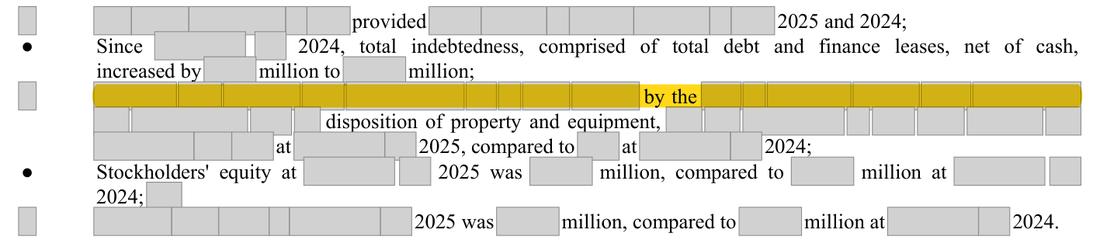
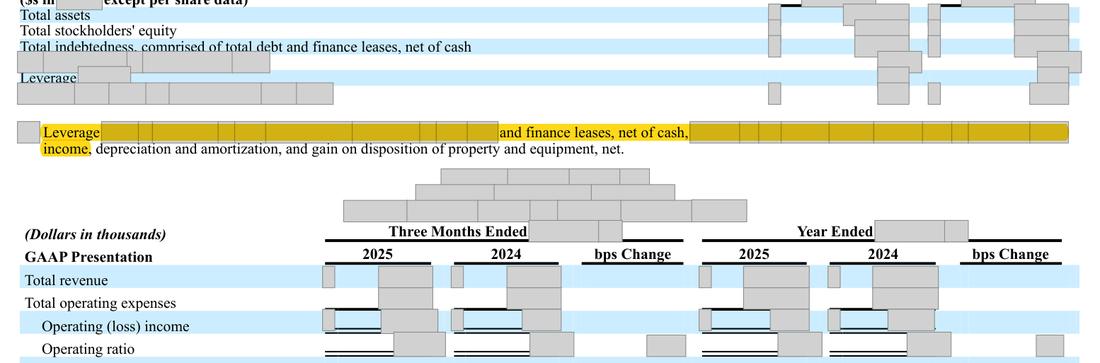
The MD&A defines the leverage ratio as average total indebtedness, net of cash, divided by operating income plus depreciation and amortization and similar items. The printed ratios of [n] for 2025 and [n] for 2024 are reproduced exactly only with year-end net indebtedness; on the average the definition describes, 2025 would be [n]. The year-end earnings release defines the same ratio on period-end indebtedness, and the prior-year Form 10-K carried the same wording with ratios that also tie to year-end balances.
The evidence, as filed
What the filing shows, and what the rule requires
| What the filing shows | What the rule requires |
|---|---|
Definition: "average total indebtedness, net of cash"; printed ratios [n] (2025) and [n] (2024) equal year-end net indebtedness divided by the operating-income-based sum | A definition that matches the calculation, e.g. "total indebtedness, net of cash, at period end, divided by ...", with the closing parenthesis after "operating income (loss)" |
The rule
Exchange Act Rule 12b-20
there shall be added such further material information, if any, as may be necessary to make the required statements, in the light of the circumstances under which they are made not misleading.
Version: Text in force at the date of this review · Source: 17 CFR 240.12b-20, as in force for fiscal 2025
Why it applies here. Year-end net indebtedness reproduces [n] and [n]; average net indebtedness gives [n] and [n]. The definition does not match the calculation.
Why it matters
- Readers comparing the ratio with peers or covenants would assume a smoothed average basis that was not used.
- The printed ratio is the more conservative figure; there is no penalty exposure.
Exposure
Definition inconsistency in a voluntary leverage measure; no fixed penalty; its non-GAAP presentation is dealt with separately.
Our workings
p.29 defines the ratio on average net indebtedness and prints [n] and [n]. The balance sheet gives the debt, finance lease and cash balances; the statement of operations gives operating income, depreciation and amortization, the held-for-sale write-down and the loss on disposition. The [date] earnings release defines the ratio as total indebtedness, [wording masked].
year-end net indebtedness divided by the sum reproduces [n] and [n] exactly, and the prior-year [n] for 2023; average net indebtedness gives [n] and [n] (workings).
the word 'average' misdescribes the calculation; the printed ratio is the higher, more conservative figure, so the slip does not flatter leverage. The definition also leaves a parenthesis open ('operating income (loss, depreciation ...').
| Basis | 2025 | 2024 |
|---|---|---|
| Year-end net indebtedness / sum (as printed) | [n] / [n] = [n] | [n] / [n] = [n] |
| Average net indebtedness / sum (as defined) | ([n] + [n]) / 2 = [n]; [n] / [n] = [n] | ([n] + [n]) / 2 = [n]; [n] / [n] = [n] |
| Item | 2025 | 2024 | 2023 |
|---|---|---|---|
| Net indebtedness: current debt + long-term debt + finance leases - cash | [n] + [n] + [n] + [n] - [n] = [n] | [n] + [n] + [n] + [n] - [n] = [n] | [n] + [n] = [n] (prior-year Form 10-K) |
| Sum: operating income + depreciation and amortization + held-for-sale write-down + loss (gain) on disposition | [n] + [n] + [n] + [n] = [n] | [n] + [n] + 0 + [n] = [n] | [n] + [n] + 0 - [n] = [n] |
| Prior-year check: year-end basis | [n] / [n] = [n] (printed [n]) |
Management’s best defense, and our reply
Management could say the ratio has been calculated the same way for years and matches the earnings release, so investors following the Company are not misled. It could add that the printed ratio is higher than the average-basis ratio, so leverage is not understated. However, the Form 10-K is the filed document and its own definition describes a different calculation; three years of printed ratios tie only to year-end balances, so the definition, not the figure, needs correcting.
The fix
- Read: "Leverage ratio (total indebtedness, net of cash, at period end, divided by the sum of operating income (loss), depreciation and amortization, (gain) loss on disposition of property and equipment, net, and impairment of long-lived property and equipment) was [n] ...".
Evidence relied on
| # | What it shows | Type | Where |
|---|---|---|---|
| 1 | definition says average net indebtedness; parenthesis left open | Document | Form 10-K 2025, page 29 |
| 2 | printed ratios | Document | Form 10-K 2025, page 29 |
| 3 | year-end net indebtedness as stated in MD&A | Document | Form 10-K 2025, page 29 |
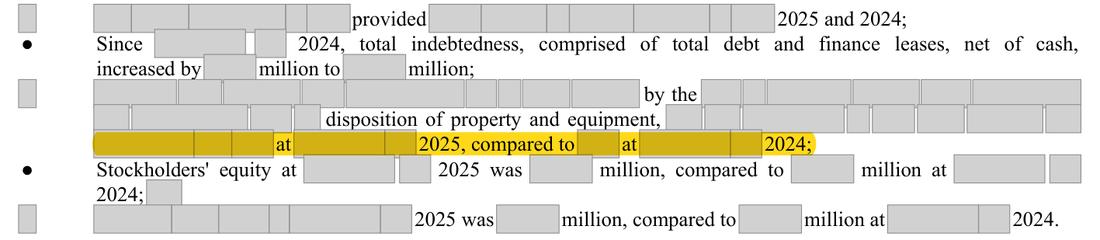
| 4 | cash at year end | Document | Form 10-K 2025, unnumbered page |
| 5 | current debt | Document | Form 10-K 2025, unnumbered page |
| 6 | current finance leases | Document | Form 10-K 2025, unnumbered page |
| 7 | long-term debt | Document | Form 10-K 2025, unnumbered page |
| 8 | long-term finance leases | Document | Form 10-K 2025, unnumbered page |
| 9 | depreciation and amortization, three years | Document | Form 10-K 2025, page 55 |
| 10 | held-for-sale write-down 2025 | Document | Form 10-K 2025, page 55 |
| 11 | loss (gain) on disposition, three years | Document | Form 10-K 2025, page 55 |
| 12 | operating income, three years | Document | Form 10-K 2025, page 55 |
| 13 | earnings release defines the ratio on period-end net indebtedness | Document | |
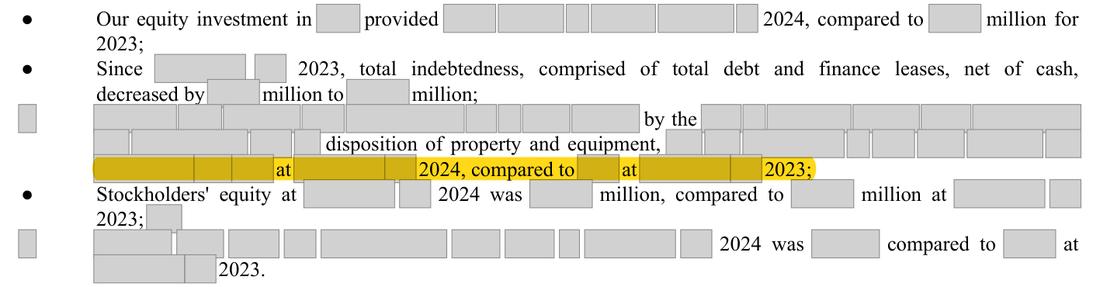
| 14 | prior-year Form 10-K: same definition, ratios also on year-end basis | Document | Form 10-K 2024 (prior year), page 29 |
| 15 | prior-year net indebtedness movement, giving the 2023 year-end balance | Document | Form 10-K 2024 (prior year), page 29 |
| 16 | The earnings release defines the leverage ratio on year-end net indebtedness | Document | |
| 17 | Leverage ratio as published in the release, same figures as the 10-K | Document |
Prepared by Pramanex from the company’s public SEC filings, without the company’s involvement, to show how a 10-K Pre-filing Check reads. The company is not named, and nothing on this page is a statement about any identifiable company. Observations are not an audit, review or other attestation or assurance engagement, and not legal advice. An SEC-style question is a question, not a conclusion.
Want this on your own 10-K, before you file?
Start with three free findings on your latest 10-K, or book a fixed-price 10-K Pre-filing Check.
Your next 10-K will be in draft before the audit is done.
Have it read before you file.
Start with three free findings on your latest 10-K, or book a fixed-price 10-K check. Drafts only under NDA, inside your insider trading policy.