6.02 Exhibit 4.[n] Description of Securities still names the superseded articles, the old authorized share counts and the former stock exchange
Company B · a US-listed transportation and logistics company · Presentation point
In brief
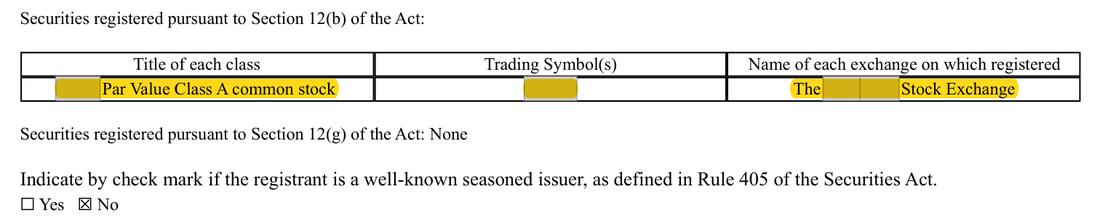
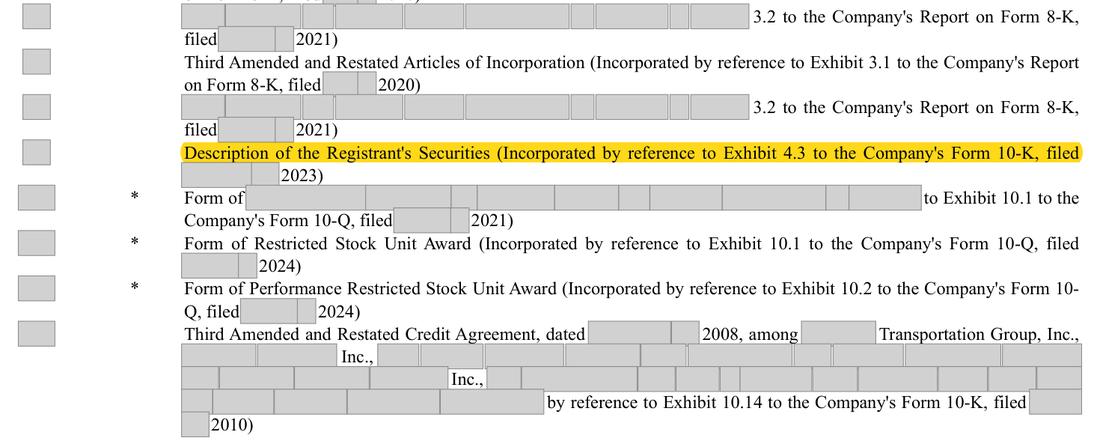
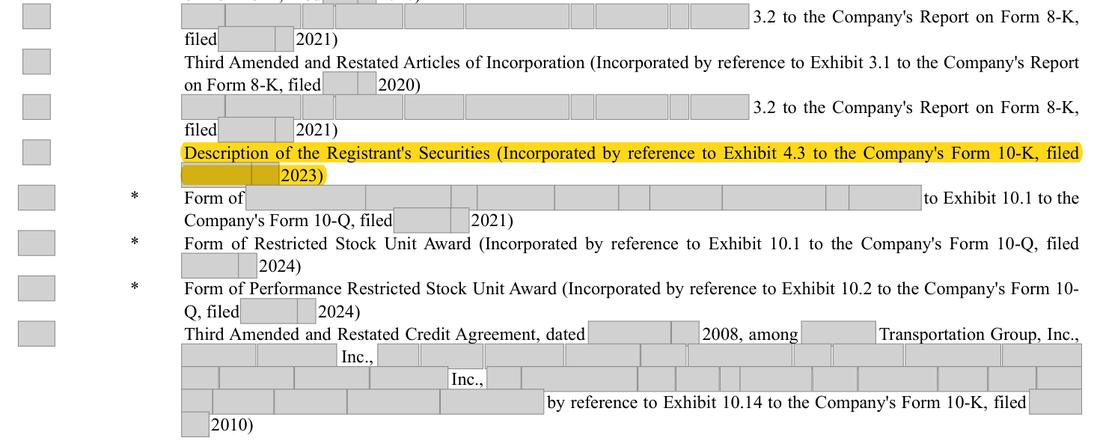
The 10-K incorporates as Exhibit 4.[n] the Description of Securities filed with the [date] Form 10-K. That description says the Class A common stock is listed on the NASDAQ Global Select Market, that it is qualified by the Third Amended and Restated Articles of Incorporation, and that the authorized capital is [n] Class A, [n] Class B and [n] preferred shares. The same 10-K's cover page registers the Class A stock on The New York Stock Exchange, its Exhibit 3.1 is the Fourth Amended and Restated Articles, and those Articles authorize [n] Class A and [n] Class B shares.
The evidence, as filed
1 further page extract: screenshot withheld to protect the company’s identity. The rows below say what each shows.
What the filing shows, and what the rule requires
| What the filing shows | What the rule requires |
|---|---|
Exhibit 4.[n] (incorporated from the Form 10-K filed [date]): Class A listed on NASDAQ; Third Amended and Restated Articles; authorized [n] Class A, [n] Class B, [n] preferred. Form 10-K for 2025: cover page exchange The New York Stock Exchange; Exhibit 3.1 Fourth Amended and Restated Articles (Form 10-Q filed [date]), Article IV authorizing [n] shares: [n] Class A, [n] Class B, [n] preferred. | A Description of Securities, filed with the 10-K or incorporated from a filing that is still accurate, that describes the Class A common stock as registered at [date]: listed on the New York Stock Exchange, governed by the Fourth Amended and Restated Articles, with the authorized capital those Articles set. |
The rule
Regulation S-K Item 601(b)(4)(vi)
For each class of securities that is registered under Section 12 of the Exchange Act, provide the information required by Item 202(a) through (d) and (f) of Regulation S-K
Version: Text in force at the date of this review · Source: 17 CFR 229.601(b)(4)(vi) (eCFR, as amended by Release 33-10618, 2019)
Regulation S-K Item 601(b)(4)(vi), Instruction 2
all references in Item 202 to securities to be or being registered, offered, or sold will mean securities that are registered as of the end of the period covered by the report with which the exhibit is filed
Version: Text in force at the date of this review · Source: 17 CFR 229.601(b)(4)(vi), Instruction 2 (eCFR, as amended by Release 33-10618, 2019)
Regulation S-K Item 202(a)
If capital stock is to be registered, state the title of the class and describe such of the matters listed in paragraphs (a) (1) through (5) as are relevant
Version: Text in force at the date of this review · Source: 17 CFR 229.202(a) (eCFR, last amended by Release 33-10618, 2019)
Exchange Act Rule 12b-20
there shall be added such further material information, if any, as may be necessary to make the required statements, in the light of the circumstances under which they are made not misleading
Version: Text in force at the date of this review · Source: 17 CFR 240.12b-20 (eCFR, current)
Why it applies here. The rights outlined (votes, conversion, dividends) still read correctly, but the governing articles, the authorized capital ([n] against [n] shares in total) and the exchange are out of date.
Why it matters
- A reader relying on the exhibit sees about half the true authorized capital, understating shares the Board can issue without a further vote.
- The exhibit is incorporated into registration statements; a staff request for an updated exhibit is the realistic outcome.
How often the SEC staff raises this. In 1,100 SEC staff comment letters on fiscal 2023 and 2024 Forms 10-K, released January 2025 to October 2026, exhibits and certifications drew 41 of the 1,774 numbered comments (2.3%): topic 13 of 25 by frequency.
Exposure
No fixed penalty. The realistic consequence is a staff comment asking the company to file an updated Exhibit 4 description, normally accepted in the next periodic report.
Our workings
the exhibit index of this 10-K incorporates Exhibit 4.[n] from the Form 10-K filed on [date] and, as Exhibit 3.1 and again among the Exhibit 4 instruments, the Fourth Amended and Restated Articles filed with the Form 10-Q of [date]. The 2023 description states the NASDAQ listing, the Third Amended and Restated Articles and authorized capital of [n] Class A, [n] Class B and [n] preferred shares. The company announced the transfer of its listing to the New York Stock Exchange in the Form 8-K filed on [date], and the shareholders approved the increase in authorized Class A and Class B shares at the [date] annual meeting; the Fourth Amended Articles record [n] Class A and [n] Class B shares.
authorized Class A rose by [n] and Class B by [n], so total authorized capital rose from [n] to [n] shares.
Item 601(b)(4)(vi) asks for the Item 202 information for each class registered under Section 12, and Instruction 2 reads Item 202 by reference to the securities registered at the end of the period. The rights the description outlines (one vote for Class A, two for Class B, one-for-one conversion, equal dividends and liquidation) read the same in the Fourth Amended Articles, so the Item 202(a)(1) outline itself is not shown to be wrong. What is wrong is the surrounding description: it is qualified by articles that no longer exist, it gives an authorized capital that is now about half the true figure, and it names an exchange the stock left in 2024. An exhibit incorporated by reference speaks as part of this 10-K, so it now contradicts the cover page, the risk factor on charter provisions and Exhibit 3.1 in the same filing. The exchange statement was already out of date when the fiscal 2024 10-K incorporated the same exhibit.
| Item | Exhibit 4.[n] (2023) | Fourth Amended Articles (2025) | Change |
|---|---|---|---|
| Class A common shares authorized | [n] | [n] | [n] - [n] = [n] |
| Class B common shares authorized | [n] | [n] | [n] - [n] = [n] |
| Preferred shares authorized | [n] | [n] | [n] - [n] = 0 |
| Total authorized shares | [n] + [n] + [n] = [n] | [n] + [n] + [n] = [n] | [n] - [n] = [n] |
Management’s best defense, and our reply
Management could say that Item 202(a) asks only for an outline of dividend, conversion, voting, liquidation and similar rights, and that none of those rights changed: the Fourth Amended Articles increased the authorized shares, and Item 202 does not itself require the exchange or the authorized share count. It could add that the current Articles are filed as Exhibits 3.1 and [n] of the same 10-K, so a reader has the authoritative text, and that a description may be incorporated from an earlier year. The answer: incorporating an earlier description works only while it is still accurate; this one makes three affirmative statements that are now untrue, it is qualified by articles that have been superseded, and it is contradicted by the cover page and Exhibit 3.1 of the same filing. That is an inconsistency within the 10-K, kept as a minor point because the outlined rights themselves are correct.
The fix
- File an updated Description of Securities as Exhibit 4.[n] to the next Form 10-K (or earlier with a Form 10-Q or 8-K), stating the New York Stock Exchange listing, the Fourth Amended and Restated Articles and the authorized capital those Articles set; update the reference in any registration statement that incorporates the description.
Evidence relied on
| # | What it shows | Type | Where |
|---|---|---|---|
| 1 | The description is qualified by the Third Amended and Restated Articles | Document | |
| 2 | Authorized capital as stated in the incorporated description | Document | |
| 3 | Exchange as stated in the incorporated description | Document | |
| 4 | Authorized capital under Article IV of the Fourth Amended and Restated Articles | Document | |
| 5 | Cover page: the Class A stock is registered on The New York Stock Exchange | Document | Form 10-K 2025, unnumbered page |
| 6 | Exhibit index: the Fourth Amended Articles are Exhibits 3.1 and [n] | Document | Form 10-K 2025, unnumbered page |
| 7 | Exhibit index: Exhibit 4.[n] is incorporated from the [date] 10-K | Document | Form 10-K 2025, unnumbered page |
| 8 | Risk factors refer to the Fourth Amended Articles | Document | Form 10-K 2025, unnumbered page |
| 9 | The listing moved from NASDAQ to the New York Stock Exchange in 2024 | Document | |
| 10 | The prior-year 10-K incorporates the same [date] description of securities | Document | Form 10-K 2024 (prior year), unnumbered page |
| 11 | The prior-year cover page already registers the Class A stock on The New York Stock Exchange | Document | Form 10-K 2024 (prior year), unnumbered page |
| 12 | The incorporated description still names the former exchange | Document |
Prepared by Pramanex from the company’s public SEC filings, without the company’s involvement, to show how a 10-K Pre-filing Check reads. The company is not named, and nothing on this page is a statement about any identifiable company. Observations are not an audit, review or other attestation or assurance engagement, and not legal advice. An SEC-style question is a question, not a conclusion.
Want this on your own 10-K, before you file?
Start with three free findings on your latest 10-K, or book a fixed-price 10-K Pre-filing Check.
Your next 10-K will be in draft before the audit is done.
Have it read before you file.
Start with three free findings on your latest 10-K, or book a fixed-price 10-K check. Drafts only under NDA, inside your insider trading policy.