4.02 Adjusted operating ratio removes 'one-time' insurance expenses although a similar large claim arose in 2024 and was not adjusted
Company B · a US-listed transportation and logistics company · Compliance or disclosure gap
In brief
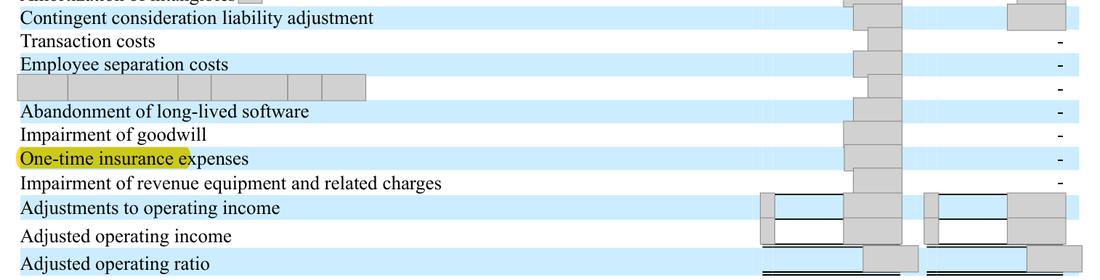
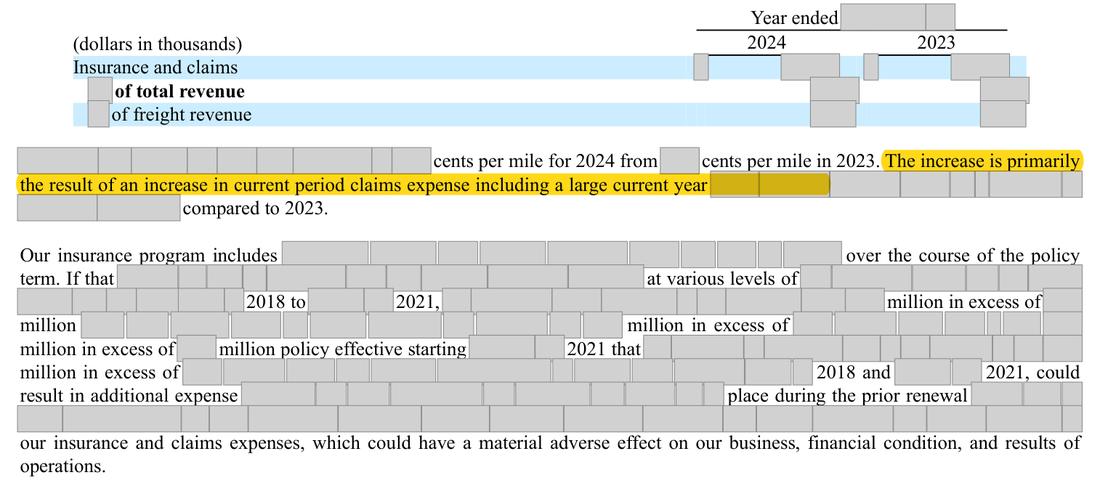
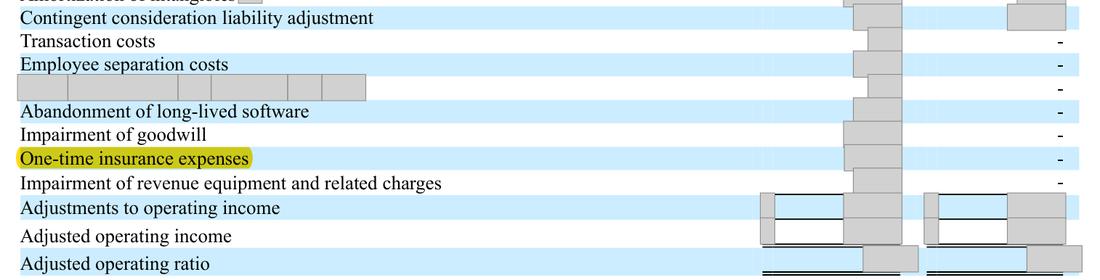
The adjusted operating ratio reconciliation excludes [n] dollars labelled 'One-time insurance expenses' in 2025, with no description of what it is in the 10-K; the [date] earnings release showed the same amount as a 'Large claims settlement'. Insurance and claims cost is a normal operating cost of a trucking company: the same MD&A says the company expects it to continue to be volatile, and last year's Form 10-K attributed the 2024 increase partly to a large current-year claim that was not adjusted. The SEC's non-GAAP rules forbid describing a charge as non-recurring when a similar charge arose within the prior two years.
The evidence, as filed

What the filing shows, and what the rule requires
| What the filing shows | What the rule requires |
|---|---|
2025 reconciliation adds back 'One-time insurance expenses' of [n] and 'Impairment of revenue equipment and related charges' of [n]; the 2024 column adds back neither, although 2024 had a large claim and [amount] of extra depreciation. Without the insurance add-back the 2025 adjusted operating ratio is [n]%, not [n]%. | No 'one-time' label for insurance and claims costs; any insurance adjustment described (what it is, why excluded) and applied consistently to both years shown, or the change between periods disclosed and explained; otherwise no adjustment. |
The rule
Regulation S-K Item 10(e)(1)(ii)(B) (17 CFR 229.10(e)(1)(ii)(B))
Adjust a non-GAAP performance measure to eliminate or smooth items identified as non-recurring, infrequent or unusual, when the nature of the charge or gain is such that it is reasonably likely to recur within two years or there was a similar charge or gain within the prior two years
Version: Text in force at the date of this review · Source: Regulation S-K Item 10(e), as amended, eCFR
SEC Corporation Finance Non-GAAP Interpretation, Question [n]
Presenting a non-GAAP performance measure that excludes normal, recurring, cash operating expenses necessary to operate a registrant’s business is one example of a measure that could be misleading. ... The staff would view an operating expense that occurs repeatedly or occasionally, including at irregular intervals, as recurring.
Version: Text in force at the date of this review · Source: SEC Division of Corporation Finance, Compliance and Disclosure Interpretations: Non-GAAP Financial Measures, Question [n]
SEC Corporation Finance Non-GAAP Interpretation, Question [n]
a non-GAAP measure that adjusts a particular charge or gain in the current period and for which other, similar charges or gains were not also adjusted in prior periods could violate Rule 100(b) of Regulation G unless the change between periods is disclosed and the reasons for it explained
Version: Text in force at the date of this review · Source: SEC Division of Corporation Finance, Compliance and Disclosure Interpretations: Non-GAAP Financial Measures, Question [n]
Why it applies here. Without the insurance add-back the ratio is [n]%. A similar 2024 claim, and [amount] of 2024 accelerated depreciation, stay unadjusted in the comparative, and the change in approach is not explained.
Why it matters
- The headline ratio improves by about one point by removing a cost the company expects to recur, and 2025 and 2024 are adjusted differently.
- Non-GAAP adjustments are the most frequent SEC comment theme; a request to remove the label or the adjustment is the likely outcome.
How often the SEC staff raises this. In 1,100 SEC staff comment letters on fiscal 2023 and 2024 Forms 10-K, released January 2025 to October 2026, non-GAAP measures drew 317 of the 1,774 numbered comments (17.9%): the most frequent topic.
The SEC staff has raised this with other companies
The SEC staff asked LifeMD to support its basis for treating adjustments as one-time, non-recurring charges across three years.
| Company written to | Staff letter | Public record |
|---|---|---|
| LifeMD, Inc. | 2024-11-22 | EDGAR |
Exposure
Non-GAAP adjustments are the most frequent SEC comment theme; likely consequence is a comment letter asking the company to remove the label or the adjustment and to revise future filings and earnings releases.
Our workings
the reconciliation adds back 'One-time insurance expenses' of [n] in 2025 and nothing in 2024. The earnings release furnished on [date] carried the same [n] under the caption 'Large claims settlement' ([amount] in its summary of fourth-quarter items), so the item is a claims settlement and the 'one-time' label was introduced in the 10-K. The insurance discussion (unnumbered page) attributes the 2025 increase to higher claims and premium [wording masked], and says the company expects insurance and claims expense to continue to be volatile over the long term. The prior-year Form 10-K (Form 10-K 2024 (prior year) unnumbered page) attributed the 2024 increase to a large current-year claim; neither that filing nor the 2024 column here adjusts for it. Separately, and as a narrower point resting on an inferred split, 2025 adds back 'Impairment of revenue equipment and related charges' of [n], while the critical accounting estimates record a [amount] held-for-sale write-down and [amount] of accelerated depreciation in 2025 and [amount] of accelerated depreciation in 2024, which the 2024 column does not adjust.
[n] - [n] = [n], which matches the [amount] of 2025 accelerated depreciation; removing the insurance add-back gives adjusted operating income of [n] - [n] = [n] and an adjusted operating ratio of [n]% against the [n]% shown.
an item labelled 'one-time' that is of the same kind as a charge in the prior year meets the condition in Item 10(e)(1)(ii)(B), and adjusting a charge in 2025 while a similar 2024 charge stays in the comparative is the inconsistency between periods that the staff's non-GAAP interpretations describe; the 10-K neither describes the item nor explains the change in approach.
| Adjustment (USD thousand) | 2025 | 2024 | Note |
|---|---|---|---|
| One-time insurance expenses | [n] | nil | 2024 had a large current-year claim (prior-year 10-K) that was not adjusted |
| Impairment of revenue equipment and related charges | [n] - [n] = [n] beyond the write-down | nil | [n] matches the [amount] 2025 accelerated depreciation; 2024 accelerated depreciation of [amount] not adjusted |
| Adjusted operating income without the insurance add-back | [n] - [n] = [n] | ||
| Adjusted operating ratio without it | 1 - [n] / [n] = [n]% | [n]% as presented |
Management’s best defense, and our reply
Management could say the [n] relates to a single claim settlement and related premium effects far outside the company's normal claims experience, so removing it shows the underlying cost of running the fleet. It could add that the staff's interpretations allow such an adjustment so long as it is not called non-recurring, and that the 2024 claim was smaller and absorbed in normal results. The answer: the label used is 'One-time', which is exactly the description the rule forbids where a similar charge arose within two years, and the prior-year 10-K itself attributed the 2024 rise to a large claim; the company also says the cost will stay volatile. Even renamed, the adjustment would need a description and a consistent treatment of 2024, neither of which the 10-K gives.
The fix
- Remove the 'One-time' label; either stop adjusting insurance and claims costs or describe the item (for example 'settlement of [claim] in excess of retention') and apply the same treatment to the 2024 comparative, and explain any change in the adjustments made between periods.
Non-GAAP reconciliation, page 39: line caption
Also: or stop adjusting insurance and claims costs (see the fix)
Evidence relied on
| # | What it shows | Type | Where |
|---|---|---|---|
| 1 | 2025 add-back labelled one-time; the 2024 column shows none | Document | Form 10-K 2025, page 39 |
| 2 | 2025 add-back for equipment write-down and related charges | Document | Form 10-K 2025, page 39 |
| 3 | Adjusted operating income and ratio as presented | Document | Form 10-K 2025, page 39 |
| 4 | Denominator of the adjusted operating ratio | Document | Form 10-K 2025, page 39 |
| 5 | 2025 insurance cost driven by a large claim settlement | Document | Form 10-K 2025, unnumbered page |
| 6 | The company expects the cost to recur and to stay volatile | Document | Form 10-K 2025, unnumbered page |
| 7 | Prior-year 10-K: a large claim in 2024, within the prior two years, not adjusted | Document | Form 10-K 2024 (prior year), unnumbered page |
| 8 | 2025 held-for-sale write-down | Document | Form 10-K 2025, page 40 |
| 9 | Write-down line in thousands, used to split the [n] add-back | Document | Form 10-K 2025, page 34 |
| 10 | 2025 accelerated depreciation | Document | Form 10-K 2025, page 40 |
| 11 | 2024 accelerated depreciation, not adjusted in the 2024 column | Document | Form 10-K 2025, page 40 |
| 12 | The earnings release described the same adjustment as a large claims settlement, not as one-time | Document | |
| 13 | Release reconciliation: the same [n] under the claims-settlement caption | Document |
Absence check
- Document
- Form 10-K 2025
- Where it would appear
- One-time insurance expenses
- What is missing
- a description of what the [n] insurance adjustment consists of and why it is excluded
- Pages looked at
- p.32-58 (insurance and claims discussion), p.39-40 (non-GAAP tables and usefulness statement), p.70-41 (self-insurance estimate) - images
- Result
- 'one-time', '[n]' and 'insurance expenses' hit only p.39, the reconciliation line itself; '[n]' has no hit anywhere in the report.
Prepared by Pramanex from the company’s public SEC filings, without the company’s involvement, to show how a 10-K Pre-filing Check reads. The company is not named, and nothing on this page is a statement about any identifiable company. Observations are not an audit, review or other attestation or assurance engagement, and not legal advice. An SEC-style question is a question, not a conclusion.
Want this on your own 10-K, before you file?
Start with three free findings on your latest 10-K, or book a fixed-price 10-K Pre-filing Check.
Your next 10-K will be in draft before the audit is done.
Have it read before you file.
Start with three free findings on your latest 10-K, or book a fixed-price 10-K check. Drafts only under NDA, inside your insider trading policy.