3.01 Balances with the [n]%-owned related party [equity investee] are not identified on the face of the balance sheet
Company B · a US-listed transportation and logistics company · Compliance or disclosure gap
In brief
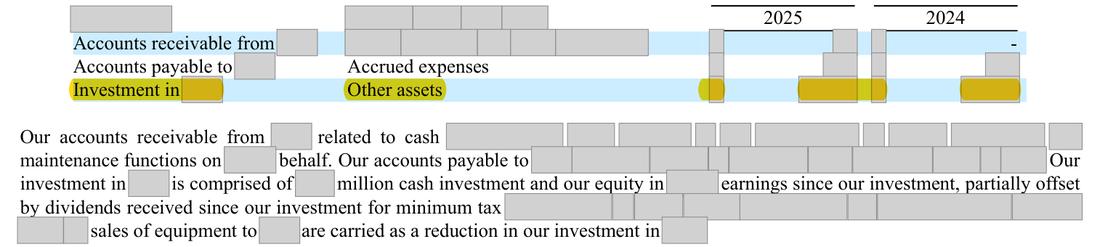
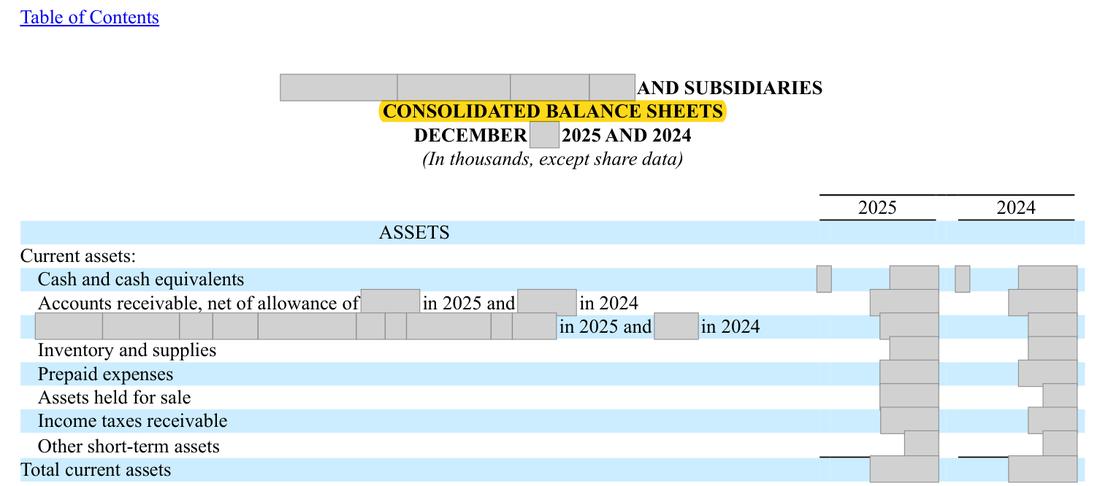
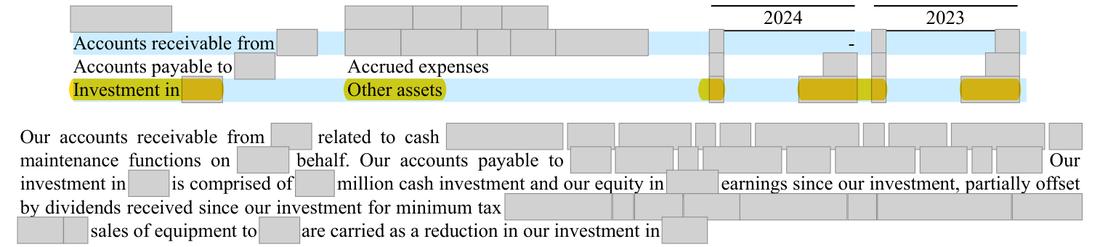
Regulation S-X requires related-party amounts to be stated on the face of the balance sheet, income statement or cash-flow statement. The company's only material related party is [equity investee], its [n]%-owned equipment lessor. The statements of operations and cash flows identify the equity income and distributions, but the balance sheet does not: the [amount] investment sits inside 'Other assets, net' (87.8% of that caption and [n]% of total assets), the [amount] of lease liabilities to [equity investee] sits inside the operating lease lines (20.8% of them), and the [amount] payable sits in accrued expenses. Only Note 13 maps them to the lines. The prior-year 10-K presented them the same way.
The evidence, as filed

What the filing shows, and what the rule requires
| What the filing shows | What the rule requires |
|---|---|
[equity investee] balances (investment [n]; operating lease liabilities [n]; payable [n]) are combined with third-party amounts in balance-sheet captions and identified only in the notes, in both years. | The balance sheet identifies related-party amounts on its face, for example 'Investment in equity method investee (related party)' as a separate caption and parenthetical related-party amounts within the lease obligation and accrued expense captions. |
The rule
Regulation S-X Rule 4-08(k)(1)
(k) Related party transactions that affect the financial statements. (1) Amounts of related party transactions should be stated on the face of the balance sheet, statement of comprehensive income, or statement of cash flows.
Version: Text in force at the date of this review · Source: 17 CFR 210.4-08(k), as in force for fiscal 2024 and 2025
Regulation S-X Rule 5-02, caption [n](a)
[n]. Accounts and notes payable. (a) State separately amounts payable to (1) banks for borrowings; (2) factors or other financial institutions for borrowings; (3) holders of commercial paper; (4) trade creditors; (5) related parties (see § [n]-08(k))
Version: Text in force at the date of this review · Source: 17 CFR 210.5-02, as in force for fiscal 2024 and 2025
Why it applies here. The face requirement is met for income and cash flows but not for the balance sheet, in this or the prior-year Form 10-K.
Why it matters
- A reader of the balance sheet cannot see that [n]% of total assets and a fifth of operating lease obligations are related-party balances.
- A staff comment and an undertaking to revise captions are the realistic outcome; no amounts change.
Exposure
A staff comment and a future-filings undertaking to revise the balance-sheet captions are the realistic consequences; no change to amounts.
Our workings
Note 15 says that, other than [equity investee], there are no material related party transactions. Note 13 lists [equity investee] balances by balance-sheet line: accounts payable to [equity investee] of [n] within accrued expenses and the investment of [n] within other assets, and states operating lease liabilities with [equity investee] of [amounts] at the two year ends. The balance sheet shows 'Other assets, net' of [n] and operating lease obligations of [n] current and [n] long-term with no related-party identification; the cash-flow statement does identify equity income and the return on investment from the affiliate. A search of the whole filing finds no related-party designation on the balance sheet.
[n] / [n] = 87.8% of the caption; [n] / [n] = [n]% of total assets; lease liabilities to [equity investee] [n] / [n] = 20.8% of operating lease obligations.
the income and cash-flow statements meet the face requirement for [equity investee]; the balance sheet does not, and the amounts are not small.
| Step | Computation | Result |
|---|---|---|
| Operating lease obligations, total | [n] + [n] = [n] | [n] |
| [equity investee] lease liabilities | [n] x [n] = [n] | [n] |
| [equity investee] share of operating lease obligations | [n] / [n] = 20.8% | 20.8% |
| [equity investee] investment share of 'Other assets, net' | [n] / [n] = 87.8% | 87.8% |
| [equity investee] investment share of total assets | [n] / [n] = [n]% | [n]% |
Management’s best defense, and our reply
Management could say Note 13 gives every [equity investee] balance with its balance-sheet line, so nothing is hidden, and that the income statement and cash-flow statement already identify the affiliate amounts. They could add that the payable of [n] is immaterial and that combining the investment with other assets keeps the balance sheet uncluttered. However, the rule places related-party amounts on the face of the statements, and the investment (87.8% of its caption and [n]% of total assets) and the [n] of lease liabilities (20.8% of the lease lines) are not immaterial; the company already applies the rule on the cash-flow statement, which shows it can be done.
The fix
- Present 'Investment in equity method investee' ([equity investee], a related party) as a separate balance-sheet caption, and show the related-party portions of operating lease obligations and accrued expenses parenthetically on the face (for example 'including [amount] due to a related party').
Evidence relied on
| # | What it shows | Type | Where |
|---|---|---|---|
| 1 | [equity investee] is the company's material related party | Document | Form 10-K 2025, unnumbered page |
| 2 | Note maps the [n] [equity investee] investment into 'Other assets' | Document | Form 10-K 2025, unnumbered page |
| 3 | Note maps the [n] payable to [equity investee] into 'Accrued expenses' | Document | Form 10-K 2025, unnumbered page |
| 4 | Lease liabilities to [equity investee] [n] inside the operating lease lines | Document | Form 10-K 2025, page 75 |
| 5 | Balance-sheet caption holding the [equity investee] investment, with no related-party identification | Document | Form 10-K 2025, unnumbered page |
| 6 | Current operating lease obligations [n] | Document | Form 10-K 2025, unnumbered page |
| 7 | Long-term operating lease obligations [n] | Document | Form 10-K 2025, unnumbered page |
| 8 | Total assets for the share of the [equity investee] investment | Document | Form 10-K 2025, unnumbered page |
| 9 | The cash-flow statement does identify affiliate amounts | Document | Form 10-K 2025, unnumbered page |
Absence check
- Document
- Form 10-K 2025
- Where it would appear
- CONSOLIDATED BALANCE SHEETS
- What is missing
- identification of the related-party ([equity investee]) amounts on the face of the balance sheet: the equity-method investment, the lease liabilities and the payable
- Pages looked at
- p.93-98, 75-134
- Result
- 'related party' hits only unnumbered page (Note 15); 'related parties' does not hit. 'Investment in [equity investee]' hits Item 1 and risk factors (p.10, [n]), the management's discussion (p.29, [n]), Note 1, Note 9 (unnumbered page) and Note 13, none on the balance sheet. 'lease liabilities with [equity investee]' hits only Note 13. 'affiliate' hits the cover page (unnumbered page, non-affiliates), risk factors (p.41, [n]), the cash-flow statement (unnumbered page, equity income and return on investment, which does meet the rule for that statement) and Note 10 (p.72, covenants); none is on the balance sheet.
Prepared by Pramanex from the company’s public SEC filings, without the company’s involvement, to show how a 10-K Pre-filing Check reads. The company is not named, and nothing on this page is a statement about any identifiable company. Observations are not an audit, review or other attestation or assurance engagement, and not legal advice. An SEC-style question is a question, not a conclusion.
Want this on your own 10-K, before you file?
Start with three free findings on your latest 10-K, or book a fixed-price 10-K Pre-filing Check.
Your next 10-K will be in draft before the audit is done.
Have it read before you file.
Start with three free findings on your latest 10-K, or book a fixed-price 10-K check. Drafts only under NDA, inside your insider trading policy.