1.25 Gross reporting of brokerage revenue rests on the pre-2018 'primary obligor' test rather than the control analysis now required
Company B · a US-listed transportation and logistics company · SEC-style question
In brief
Segment 3 revenue of [n] ([n]% of total revenue) is reported gross because, in the policy's words, the company acts '[wording masked]'. Those are indicators from the revenue rules replaced in 2018; the current rules ask whether the company controls the transportation service before it is transferred to the customer. The same note applies the control test to the asset-based segments but not to brokerage, where the carriage is outsourced to third parties and purchased transportation is [n] of the segment's costs.
The evidence, as filed
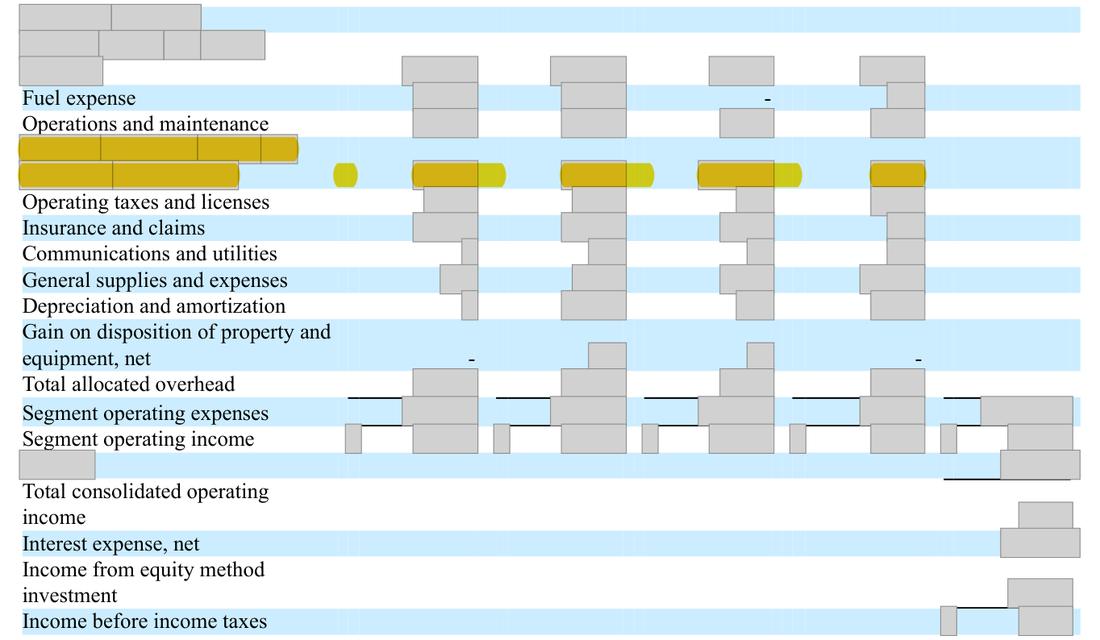
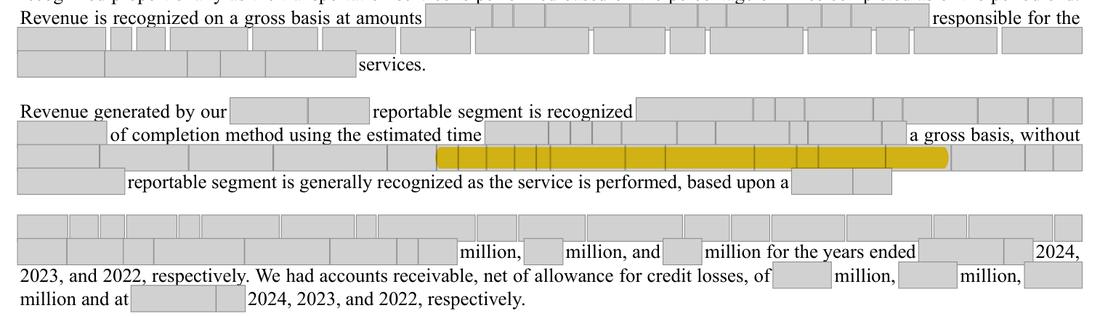
5 further page extracts: screenshot withheld to protect the company’s identity. The rows below say what each shows.
What the filing shows, and what the rule requires
| What the filing shows | What the rule requires |
|---|---|
Segment 3: 'Revenue is recorded on a gross basis, without deducting third-party purchased transportation costs, as we [wording masked].' Segment 1 and Segment 2: gross 'because we control and are primarily responsible for the fulfillment of the promised service'. | A company-specific control analysis for brokerage and transport-management services: why the company controls the specified service before transfer (for example primary responsibility for fulfilment and discretion in setting the price), and the judgment involved. |
The rule
ASC 606-10-50-12, 50-17 and 606-10-55-36 to 55-40 (performance obligations, significant judgments, principal versus agent; paraphrase, the Codification text is copyrighted)
Summary; FASB/IFRS text is copyrighted Describe performance obligations, when satisfied, payment terms, principal-versus-agent nature, and significant judgments on timing, transaction price, variable consideration and allocation.
Version: Text in force at the date of this review · Source: FASB Accounting Standards Codification, ASC 606-10-50-12 and 606-10-55-36 to 55-40 (ASU 2014-09 as amended by ASU 2016-08)
Why it applies here. the conclusion may well be right (logistics brokers commonly report gross on a control analysis), but the stated basis is the superseded one; this is a frequent SEC staff comment for logistics brokers.
Why it matters
Readers and the SEC staff cannot see the control judgment behind gross reporting of about a quarter of revenue; the stated basis is the superseded one.
How often the SEC staff raises this. In 1,100 SEC staff comment letters on fiscal 2023 and 2024 Forms 10-K, released January 2025 to October 2026, revenue recognition and disclosure drew 68 of the 1,774 numbered comments (3.8%): topic 7 of 25 by frequency.
Exposure
No penalty attaches to a question. The realistic outcome is a staff comment asking for the control analysis and a future-filings revision of the policy.
Our workings
Note 1 supports gross reporting in Segment 1 and Segment 2 by control ('because we control and are primarily responsible for the fulfillment'), but supports gross reporting in Segment 3 by being '[wording masked]'. Brokerage, by the note's own description (unnumbered page), outsources [wording masked]. The segment table (unnumbered page) shows Segment 3 'revenue equipment rentals and purchased transportation' of [n] against segment revenue of [n]. The prior-year 10-K and the [date] Form 10-Q use the same sentence. Law: under the revenue standard in force since 2018 an entity is a principal if it controls the specified good or service before it is transferred to the customer; primary responsibility for fulfilment, inventory risk and pricing discretion are indicators of control, and the policy must describe the significant judgments. 'Primary obligor' and 'substantial risks' were the tests of the superseded guidance.
[n] / [n] = [n]% of revenue; [n] / [n] = [n]% of segment revenue is paid to third-party carriers, so the gross or net conclusion moves reported revenue by up to [n] (21.2% of total revenue) without changing profit.
| Item | Computation | Result |
|---|---|---|
| Segment 3 share of total revenue | [n] / [n] = [n]% | [n]% |
| Purchased transportation as share of segment revenue | [n] / [n] = [n]% | [n]% |
| Purchased transportation as share of total revenue | [n] / [n] = 21.2% | 21.2% |
Management’s best defense, and our reply
Management would say that being the primary obligor is the same as being primarily responsible for fulfilment, which remains the leading indicator of control under the current standard, and that the company also sets the customer price and bears the risk of carrier non-performance. They would add that the conclusion has been audited each year since adoption and that the wording has not drawn a staff comment.
The fix
- Replace the sentence with a control-based policy, for example: 'We are the principal in our brokerage arrangements because we control the transportation service before it is transferred to the customer: we are primarily responsible for fulfilling the service, including selecting and directing the carrier and remedying service failures, and we have discretion in setting the price charged to the customer.' (adjusted to the facts).
Question for the company
What is the company's control analysis under the current revenue standard for Segment 3 brokerage and transport-management services, and will the policy be revised to describe it in place of the 'primary obligor' and 'substantial risks' wording?
Evidence relied on
| # | What it shows | Type | Where |
|---|---|---|---|
| 1 | Segment 3 gross reporting rests on 'primary obligor' and 'substantial risks'. | Document | Form 10-K 2025, page 60 |
| 2 | The asset-based segments use the control test. | Document | Form 10-K 2025, page 60 |
| 3 | Brokerage outsources the carriage. | Document | Form 10-K 2025, unnumbered page |
| 4 | Segment 3 revenue. | Document | Form 10-K 2025, unnumbered page |
| 5 | Total revenue. | Document | Form 10-K 2025, unnumbered page |
| 6 | Segment 3 purchased transportation of [n] in 2025. | Document | Form 10-K 2025, unnumbered page |
| 7 | Same basis in the prior-year 10-K. | Document | Form 10-K 2024 (prior year), page 60 |
Prepared by Pramanex from the company’s public SEC filings, without the company’s involvement, to show how a 10-K Pre-filing Check reads. The company is not named, and nothing on this page is a statement about any identifiable company. Observations are not an audit, review or other attestation or assurance engagement, and not legal advice. An SEC-style question is a question, not a conclusion.
Want this on your own 10-K, before you file?
Start with three free findings on your latest 10-K, or book a fixed-price 10-K Pre-filing Check.
Your next 10-K will be in draft before the audit is done.
Have it read before you file.
Start with three free findings on your latest 10-K, or book a fixed-price 10-K check. Drafts only under NDA, inside your insider trading policy.