1.20 Finance lease right-of-use assets fell by [amount] in 2025, about twice the [amount] of amortization, with no new leases and no change in the lease liability beyond payments
Company B · a US-listed transportation and logistics company · SEC-style question
In brief
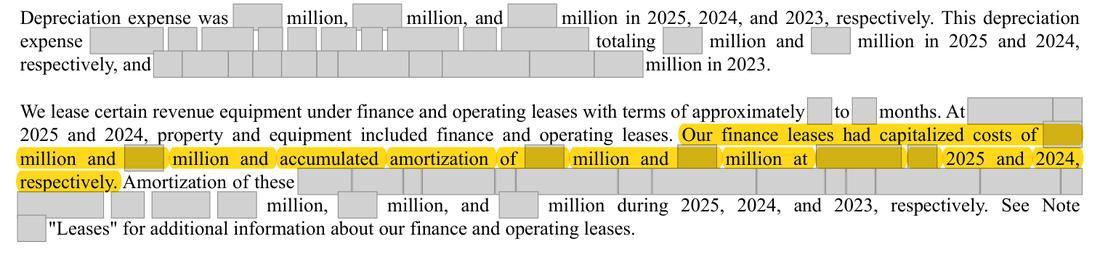
Note 5 says finance-leased equipment cost [amount] at both year-ends, with accumulated amortization rising from [amount] to [amount], and Note 11 puts the finance lease right-of-use (ROU) assets at [amounts]. The amortization charged in 2025 was [amount] and no new finance leases began. The lease liability moved only by the [n] of principal paid, so no lease ended early. About [n] of the fall in the asset ([n]% of pre-tax income) is not explained by any figure in the notes.
The evidence, as filed
What the filing shows, and what the rule requires
| What the filing shows | What the rule requires |
|---|---|
Finance lease ROU assets fell from [amount] to [amount] (accumulated amortization up [amount]) against 2025 amortization of [n], with no additions, no change in gross cost and no lease termination visible in the liability. | The movement in finance lease ROU assets is explained by the amortization charged, any impairment or transfer, and lease modifications, each consistent with the lease cost table, the liability roll-forward and the long-lived asset impairment statement. |
The rule
FASB ASC 842-20-50-1 to 50-10; 842-20-45-1
Summary; FASB/IFRS text is copyrighted Lessees disclose lease nature and significant judgments, lease cost components, weighted-average term and discount rate, cash paid, and a maturity analysis reconciled to lease liabilities.
Version: Text in force at the date of this review · Source: FASB Accounting Standards Codification, ASC 842-20-50-1 to 50-10 (as amended by ASU 2016-02 and later updates)
Why it applies here. an amount of about [n] left the finance lease asset in 2025 through a route the notes do not show (a write-down, a transfer to assets held for sale, or a misstated balance). With gross cost unchanged, a buy-out or transfer to owned equipment would also have reduced the gross cost, so that explanation does not fit the printed figures. Only management can say which applies.
Why it matters
Either the finance lease asset and accumulated amortization are misstated by about [n], or a charge or transfer of that size is recorded without the disclosure the notes would need (and the no-impairment statement would be inaccurate).
Exposure
A question for management; a staff comment asking for the reconciliation is possible.
Our workings
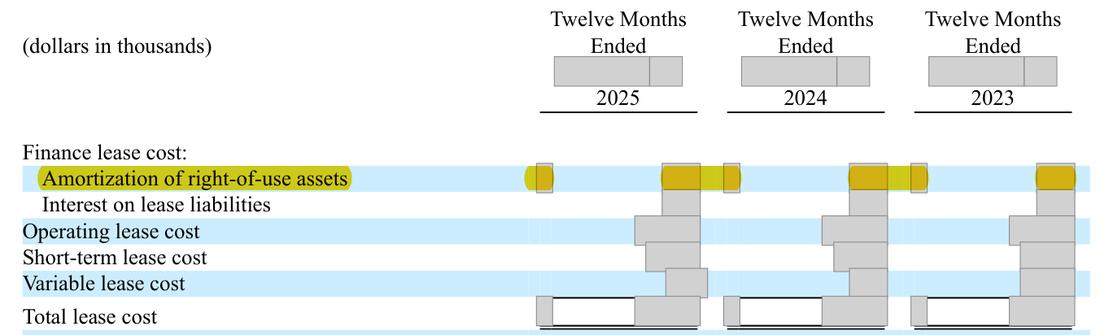
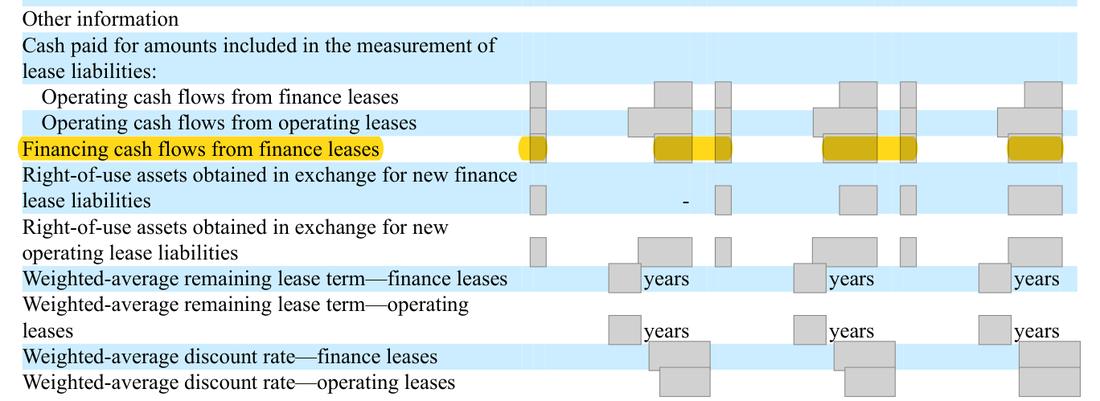
Note 5 states finance lease capitalized costs of [amount] at [date] and 2024 and accumulated amortization of [amounts]. Note 11 states finance lease ROU assets of [amounts], amortization of ROU assets of [n] for 2025, no ROU assets obtained for new finance lease liabilities in 2025, and principal payments on finance leases of [n]. The balance sheet shows finance lease obligations of [n] plus [n] at the start of the year and [n] plus [n] at the end. Note 1 says there were no events that led to an impairment of long-lived assets in 2025.
the liability moves [n] - [n] = [n], exactly the closing balance, so no lease was terminated or remeasured. The asset should move [n] - [n] = [n], but closes at [n]: a gap of [n]. Accumulated amortization rose [n] - [n] = [n] against [n] charged.
| Step | Computation | Result (USD thousand) |
|---|---|---|
| Finance lease liability, opening | [n] + [n] = [n] | [n] |
| Liability after 2025 principal payments | [n] - [n] = [n] | [n] |
| Finance lease liability, closing (balance sheet) | [n] + [n] = [n] | agrees: no termination or remeasurement |
| Finance lease ROU asset, opening | [n] x [n] = [n] | [n] |
| Expected closing ROU asset (no new leases) | [n] - [n] = [n] | [n] |
| Reported closing ROU asset | [n] x [n] = [n] | [n] |
| Unexplained reduction | [n] - [n] = [n] | [n] |
| Accumulated amortization increase vs charge | [n] - [n] = [n]; [n] - [n] = [n] | [n] |
| Rounding tolerance on the [amount] figures | [n] - [n] = [n] | at least [n] unexplained |
| Share of 2025 pre-tax income | [n] / [n] = [n]% | [n]% |
Management’s best defense, and our reply
Management could say the note figures are rounded to [amount] and that leased units were moved to assets held for sale in the fourth quarter as part of the fleet reduction, with the write-down charged against accumulated amortization, so the balances are right and the charge sits inside the [amount] held-for-sale write-down. They could add that a sub-[amount] movement inside [amount] of net property and equipment is not material. However, rounding covers at most [n] of the [n] gap, a transfer to held for sale would also have reduced the gross cost (which stayed at [amount]), and the notes say no long-lived asset was impaired; the amount is [n]% of pre-tax income, so the explanation should be in the filing.
The fix
- Reconcile the finance lease ROU asset for 2025 (opening [n], amortization [n], any impairment, transfer or modification, closing [n]) and correct whichever figure is wrong; if a write-down was booked, disclose it and revisit the no-impairment statement in Note 1.
Question for the company
What accounts for the reduction of about [amount] in finance lease right-of-use assets in 2025 beyond the [n] of amortization (for example an impairment, a transfer to assets held for sale or a lease modification), where is it recorded in the statement of operations, and is the 'no impairment of long-lived assets' statement in Note 1 consistent with it?
Evidence relied on
| # | What it shows | Type | Where |
|---|---|---|---|
| 1 | Gross cost unchanged at [amount]; accumulated amortization up from [amount] to [amount] | Document | Form 10-K 2025, unnumbered page |
| 2 | 2025 finance lease ROU amortization [n] | Document | Form 10-K 2025, unnumbered page |
| 3 | 2025 finance lease principal paid [n] | Document | Form 10-K 2025, unnumbered page |
| 4 | No new finance leases in 2025 | Document | Form 10-K 2025, unnumbered page |
| 5 | Finance lease ROU assets [amount] (2025) and [amount] (2024) | Document | Form 10-K 2025, unnumbered page |
| 6 | Current finance lease liability, closing and opening | Document | Form 10-K 2025, unnumbered page |
| 7 | Long-term finance lease liability, closing and opening | Document | Form 10-K 2025, unnumbered page |
| 8 | Policy note states no long-lived asset impairment in 2025 | Document | Form 10-K 2025, unnumbered page |
| 9 | 2025 pre-tax income [n], the materiality benchmark | Document | Form 10-K 2025, unnumbered page |
Prepared by Pramanex from the company’s public SEC filings, without the company’s involvement, to show how a 10-K Pre-filing Check reads. The company is not named, and nothing on this page is a statement about any identifiable company. Observations are not an audit, review or other attestation or assurance engagement, and not legal advice. An SEC-style question is a question, not a conclusion.
Want this on your own 10-K, before you file?
Start with three free findings on your latest 10-K, or book a fixed-price 10-K Pre-filing Check.
Your next 10-K will be in draft before the audit is done.
Have it read before you file.
Start with three free findings on your latest 10-K, or book a fixed-price 10-K check. Drafts only under NDA, inside your insider trading policy.