1.19 First ASU 2023-09 rate reconciliation: an undescribed 'Other' line of [n] and no line for a [n] rise in the valuation allowance
Company B · a US-listed transportation and logistics company · SEC-style question
In brief
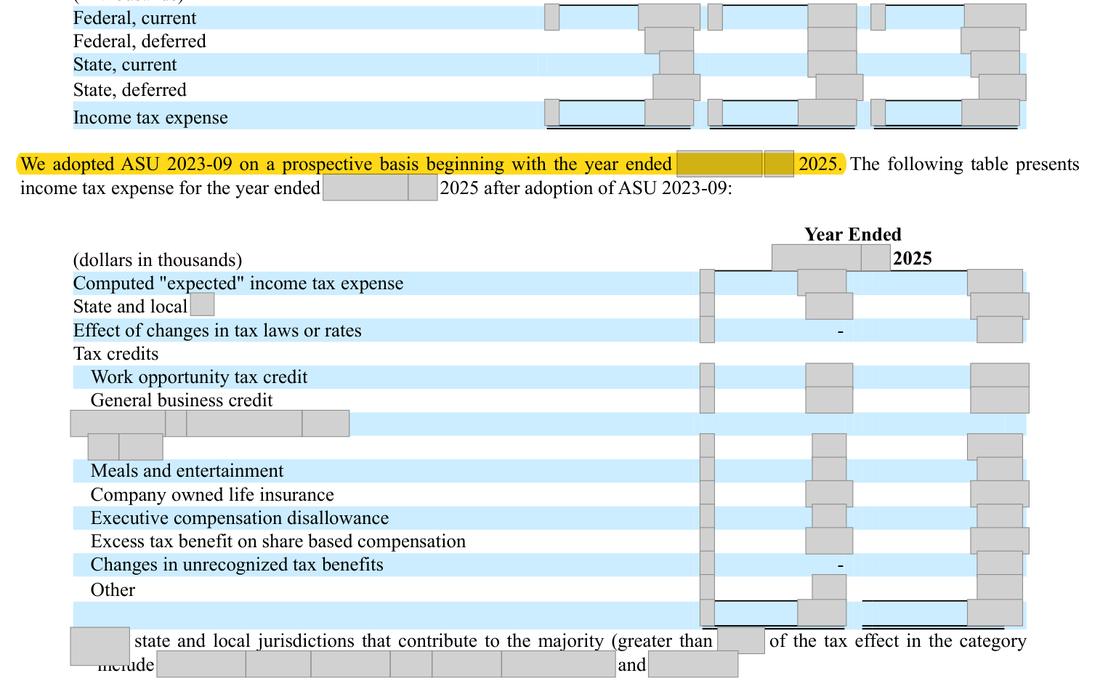
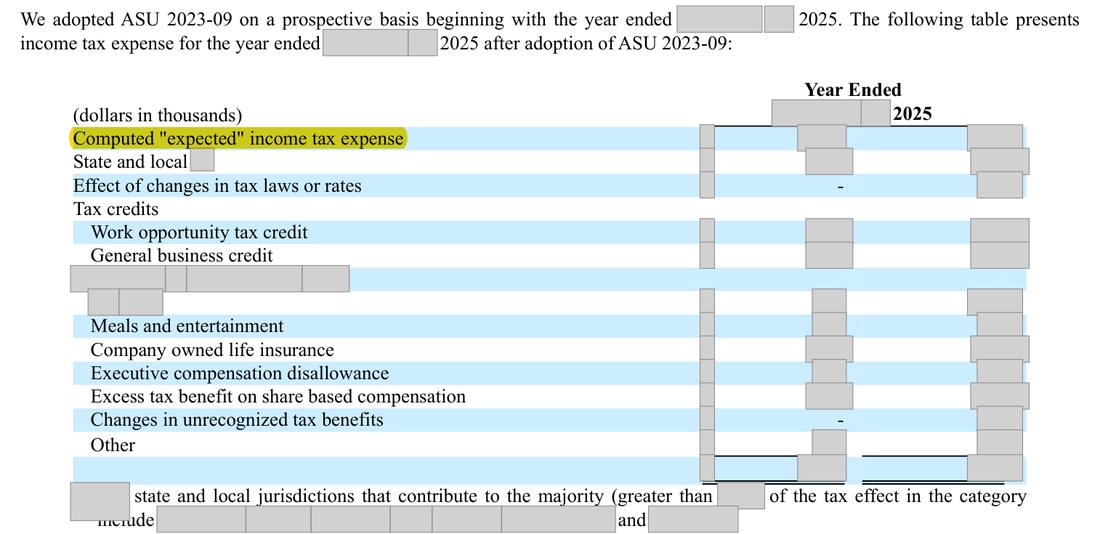
The first income tax rate reconciliation under Accounting Standards Update (ASU) 2023-09 shows 'Other' of [n] (USD thousand), 32.2% of the computed tax of [n] and well above the 5% threshold of [n], with no description of what it contains. The deferred tax table shows the valuation allowance rising from [n] to [n], an increase of [n] (88.0% of the computed tax), but the reconciliation has no line for changes in valuation allowances and the note does not say in which category the increase sits.
The evidence, as filed
What the filing shows, and what the rule requires
| What the filing shows | What the rule requires |
|---|---|
2025 reconciliation: computed tax [n] (21.0%); state and local ([n]); tax credits; nontaxable or nondeductible items; changes in unrecognized tax benefits nil; 'Other' [n] ([n]%); total [n] ([n]%). Valuation allowance ([n]) against ([n]) a year earlier, with no reconciliation line for the change. | Each reconciling item of [n] or more shown separately by its nature, and the valuation-allowance increase shown in its own category, or the note stating that it is included in 'State and local' and for how much. |
The rule
Regulation S-X Rule 4-08(h)(2) (income tax rate reconciliation: aggregation only of items below 5% of the computed amount)
Reconciling items that are individually less than five percent of the computed amount may be aggregated in the reconciliation.
Version: Text in force at the date of this review · Source: Regulation S-X, 17 CFR 210.4-08(h)(2), eCFR text as amended to 2025
FASB ASC paragraphs 740-10-50-12A to 50-12C, as amended by ASU 2023-09 (rate reconciliation categories and 5% threshold)
Summary; FASB/IFRS text is copyrighted PBEs disclose annually a tabular rate reconciliation in percentages and amounts with specified categories, separately itemising qualifying reconciling items, and explaining state and local effects.
Version: Text in force at the date of this review · Source: FASB Accounting Standards Codification, ASC 740-10-50-12A to 50-12C (as amended by ASU 2023-09) (paraphrase)
Why it applies here. either reading may be right, but the note says neither, so a reader cannot tell whether [n] is one item or several, or where a movement nearly equal to the whole computed tax has gone. Because pre-tax income is low, the threshold is low; that is the standard working as designed, not a reason to aggregate.
Why it matters
Income taxes under ASU 2023-09 are a current staff comment theme in the first year of adoption. An unexplained 'Other' line far above the threshold, and an allowance movement with no category, are likely to draw a comment asking for the breakdown and a future-filings undertaking.
Exposure
A question for management; no penalty attaches. If an item of [n] or more is inside 'Other', the realistic outcome is a staff comment and a revised table in the next Form 10-K.
Our workings
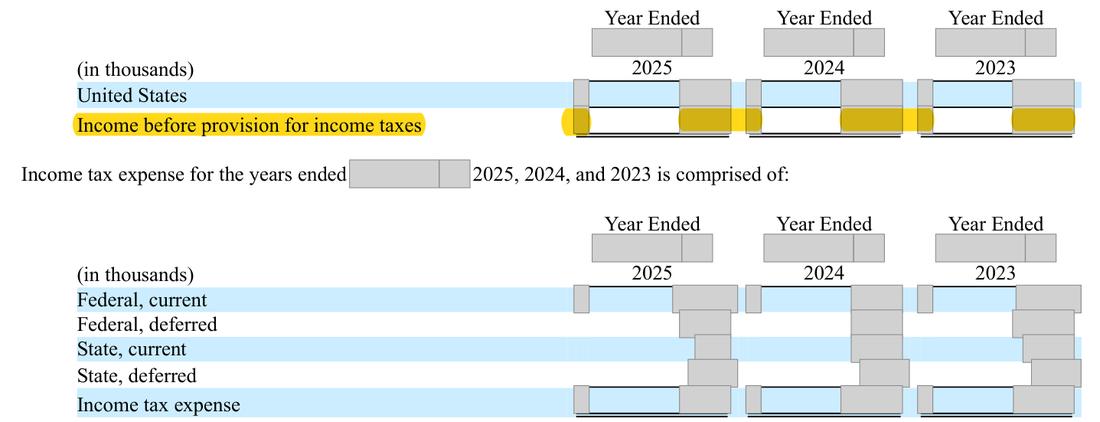
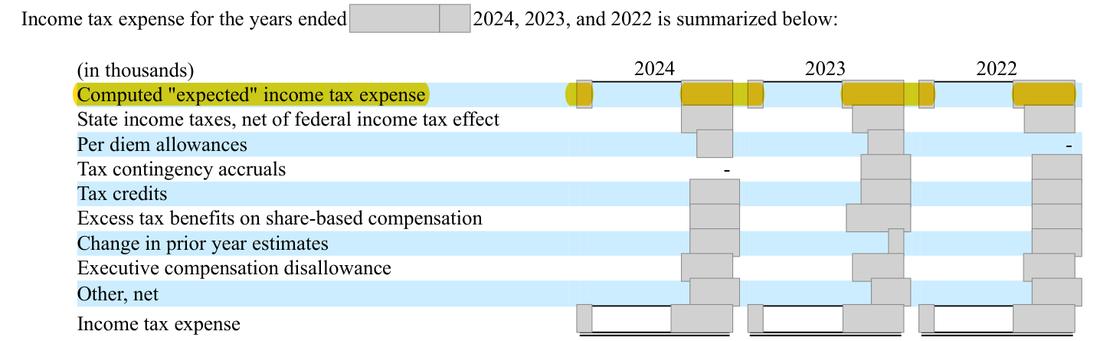
The Company adopted ASU 2023-09 prospectively for 2025. Its reconciliation starts from a computed tax of [n] on pre-tax income of [n] and ends at [n]; the last line, 'Other', is [n] ([n]% of pre-tax income) with no description. The deferred tax table shows a valuation allowance of ([n]) at the end of 2025 against ([n]) at the end of 2024, and the text says only that an immaterial amount of state attributes is deemed unrealizable.
the 5% threshold is [n] x 5% = [n]; 'Other' is 32.2% of the computed tax; the allowance rose by [n], which is 88.0% of the computed tax and 18.4% of pre-tax income. Architecture: ASC paragraph 740-10-50-12A, as amended by ASU 2023-09, requires a public business entity to present the reconciliation in amounts and percentages within eight specified categories, one of which is changes in valuation allowances, and to disaggregate by nature any item within certain categories (including other adjustments) that equals or exceeds 5% of the computed tax. Regulation S-X Rule 4-08(h)(2) makes the same cut: only items individually below 5% of the computed amount may be aggregated. Grey area: practice under the new standard allows the federal-effected change in a state valuation allowance to be presented within the state and local category, and 'Other' may be a collection of items each below [n].
| Item | Computation |
|---|---|
| Computed tax at the federal rate | [n] x 21.0% = [n] (printed [n]; a difference of [n], immaterial and not explained in the note) |
| 5% threshold for separate items | [n] x 5% = [n] |
| 'Other' against the computed tax | [n] / [n] = 32.2% |
| 'Other' against pre-tax income | [n] / [n] = [n]% |
| Valuation allowance increase | [n] - [n] = [n] |
| Increase against the computed tax | [n] / [n] = 88.0% |
| Increase against pre-tax income | [n] / [n] = 18.4% |
Management’s best defense, and our reply
The finance team would say 'Other' is an aggregation of many small items each below [n], which both Regulation S-X Rule 4-08(h)(2) and the standard allow, and that with pre-tax income of only [n] the threshold is so low that itemising every difference would clutter the table. They would also say the valuation-allowance increase relates to state attributes and is properly included, net of federal effect, in the 'State and local' category, as practice under the new standard permits. However, neither position is stated in the note: a reader cannot tell whether [n] is one item or several, and a movement of [n], equal to 88.0% of the computed tax, appears nowhere in the reconciliation.
The fix
- Break 'Other' into its components by nature (any item of [n] or more on its own line), and either add a 'Changes in valuation allowances' line for the [n] increase or footnote the state and local line to say it includes that increase, net of federal effect.
Question for the company
What does the [n] 'Other' line consist of, and is any single item [n] or more? In which category of the 2025 reconciliation is the [n] increase in the valuation allowance included, and will the note say so?
Evidence relied on
| # | What it shows | Type | Where |
|---|---|---|---|
| 1 | the new categories apply to the 2025 reconciliation | Document | Form 10-K 2025, unnumbered page |
| 2 | 2025 pre-tax income, the base of the computed tax | Document | Form 10-K 2025, unnumbered page |
| 3 | the computed tax that sets the 5% threshold | Document | Form 10-K 2025, unnumbered page |
| 4 | the only state line; no amount is said to include a valuation allowance | Document | Form 10-K 2025, unnumbered page |
| 5 | the undescribed 'Other' line and the total | Document | Form 10-K 2025, unnumbered page |
| 6 | valuation allowance at the end of 2025 and 2024 | Document | Form 10-K 2025, page 74 |
| 7 | the only explanation of the allowance | Document | Form 10-K 2025, unnumbered page |
Absence check
- Document
- Form 10-K 2025
- Where it would appear
- Computed "expected" income tax expense
- What is missing
- a line for changes in valuation allowances, and any breakdown or description of the [n] shown as 'Other'
- Pages looked at
- p.129-131 (Note 12, page images); unnumbered page (income tax policy)
- Result
- 'valuation allowance' appears on unnumbered page (policy sentence referring to Note 12) and p.74 (deferred tax table, ([n]) and ([n])); neither is a reconciliation line or a breakdown. 'other adjustments' appears only on unnumbered page, in the allowance for credit losses roll-forward ('Write-offs and other adjustments'), which is unrelated to income taxes. The other terms do not appear.
Prepared by Pramanex from the company’s public SEC filings, without the company’s involvement, to show how a 10-K Pre-filing Check reads. The company is not named, and nothing on this page is a statement about any identifiable company. Observations are not an audit, review or other attestation or assurance engagement, and not legal advice. An SEC-style question is a question, not a conclusion.
Want this on your own 10-K, before you file?
Start with three free findings on your latest 10-K, or book a fixed-price 10-K Pre-filing Check.
Your next 10-K will be in draft before the audit is done.
Have it read before you file.
Start with three free findings on your latest 10-K, or book a fixed-price 10-K check. Drafts only under NDA, inside your insider trading policy.