1.17 The [n] discontinued-operations liability carried at the end of 2024 disappears in 2025 without explanation in Note 2
Company B · a US-listed transportation and logistics company · SEC-style question
In brief
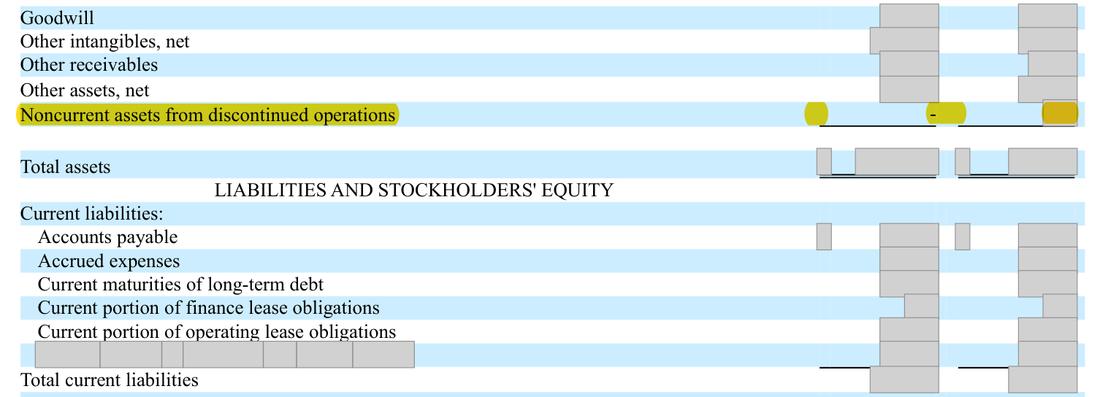
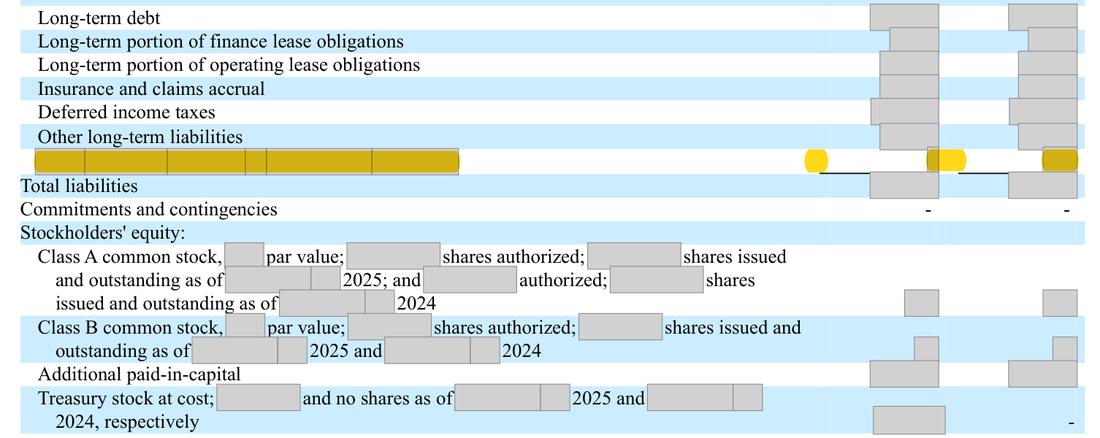
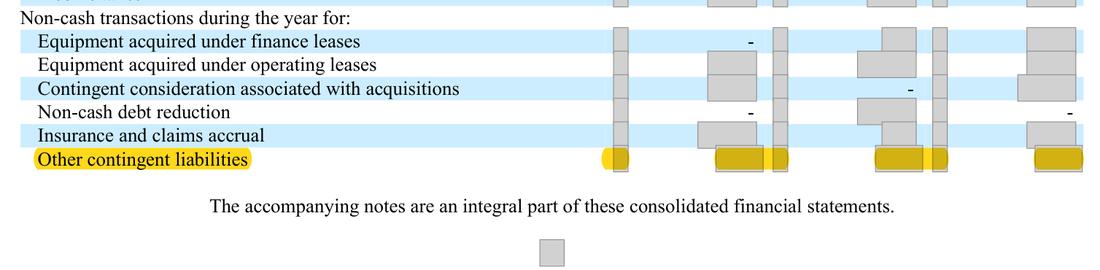
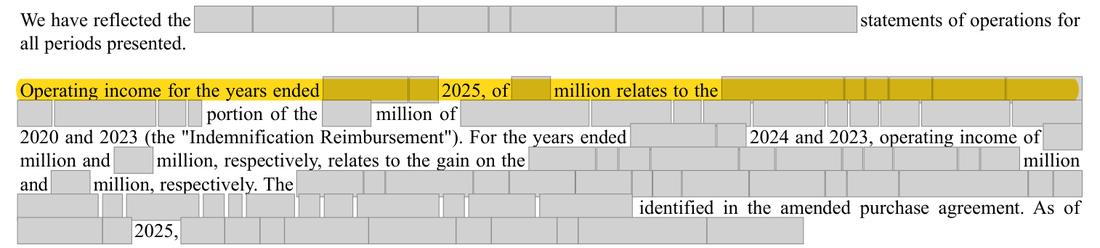
At [date] the balance sheet carried discontinued-operations liabilities of [n] and assets of [n]. Both are nil at [date]. Note 2 says all of 2025's discontinued income ([amount] before tax) came from a cash reimbursement of the same amount from the buyer of the former factoring business, while the cash-flow statement records a non-cash reduction of [n] in contingent liabilities. The note does not say where the [n] release went, and it no longer gives the table of discontinued assets and liabilities that the prior-year note gave.
The evidence, as filed
3 further page extracts: screenshot withheld to protect the company’s identity. The rows below say what each shows.
What the filing shows, and what the rule requires
| What the filing shows | What the rule requires |
|---|---|
2024 balance sheet: discontinued assets [n], liabilities [n]; 2025: nil. Non-cash 'Other contingent liabilities ([n])' in 2025. Note 2: 2025 income of [amount] 'relates to the reimbursement', cash inflow [amount]; tax allocated [amount]; income from discontinued operations net of tax [n]. | A reconciliation of the 2025 discontinued result (reimbursement, release of the remaining [n] liability, the [n] deferred tax asset, tax) and the table of the major classes of discontinued assets and liabilities for the balance-sheet dates presented. |
The rule
ASC 205-20-45 and 205-20-50 (discontinued operations presentation and disclosure; paraphrase)
Summary; FASB/IFRS text is copyrighted A component disposal is discontinued operations only if it is a strategic shift with a major effect on operations and results; disclose major line items.
Version: Text in force at the date of this review · Source: FASB Accounting Standards Codification, ASC 205-20 (as amended by ASU 2014-08)
Exchange Act Rule 12b-20 (further material information so that required statements are not misleading)
there shall be added such further material information, if any, as may be necessary to make the required statements, in the light of the circumstances under which they are made not misleading.
Version: Text in force at the date of this review · Source: Exchange Act Rule 12b-20, 17 CFR 240.12b-20, eCFR text as amended
Why it applies here. either part of the [amount] is the release rather than cash, which would contradict the cash statement on p.65, or the [n] was released outside discontinued income (for example against the [n] asset or the reimbursement), which the note does not describe. The prior-year note gave the table of discontinued assets and liabilities ([n] of noncurrent contingent liabilities at [date]); the 2025 note drops it although the 2024 balances are still presented. The amount is [n]% of pre-tax income from continuing operations ([n] / [n]).
Why it matters
A reader cannot reconcile the 2025 discontinued result with the release of the [n] liability and the [n] asset, so it is unclear whether the 2025 result is complete and correctly classified.
Exposure
No penalty attaches to a question. The realistic outcome is a staff comment asking for the reconciliation.
Our workings
the balance sheet (unnumbered page) shows 'Noncurrent assets from discontinued operations' of [n] and 'Other long-term liabilities of discontinued operations' of [n] at [date], both nil at [date]. The cash-flow supplemental lists 'Other contingent liabilities' of ([n]) as a non-cash item in 2025, after ([n]) in each of 2024 and 2023, the years in which Note 2 says the liability was partly reversed into income. Note 2 says 2025 operating income of [amount] 'relates to the reimbursement' and that operating cash inflows of [amount] came from it; the tax note allocates [amount] of tax to discontinued operations; net income from discontinued operations is [n].
[n] + [n] = [n], which is the reimbursement alone; had the [n] release also been taken to income, pre-tax discontinued income would be about [n] + [n] = [n].
| Item | Computation | Result (USD thousand) |
|---|---|---|
| Pre-tax discontinued income implied by the statements | [n] + [n] = [n] | [n] (the [amount] reimbursement) |
| Pre-tax income if the [n] release were also included | [n] + [n] = [n] | [n] |
| Release as % of pre-tax income | [n] / [n] = [n]% | [n]% |
Management’s best defense, and our reply
Management would say the remaining liability was settled as part of the final agreement with the buyer under which the reimbursement was paid, so the release and the reimbursement are one transaction whose net effect is the [amount] reported. They would add that the amounts are small and that the balances are fully visible on the face of the 2024 balance sheet.
The fix
- Add to Note 2: 'In 2025 the remaining contingent loss liability of [amount] was [released to income / settled against the reimbursement], and the related deferred tax asset of [amount] was [reversed]', with the table of discontinued assets and liabilities for [date].
Question for the company
How was the [n] discontinued-operations liability at [date] (shown as a non-cash reduction in 2025) released, and where is it reflected in the 2025 discontinued result of [n] net of tax? What happened to the [n] discontinued deferred tax asset?
Evidence relied on
| # | What it shows | Type | Where |
|---|---|---|---|
| 1 | Discontinued assets of [n] at the end of 2024, nil at the end of 2025. | Document | Form 10-K 2025, unnumbered page |
| 2 | Discontinued liabilities of [n] at the end of 2024, nil at the end of 2025. | Document | Form 10-K 2025, unnumbered page |
| 3 | The [n] was reduced without cash in 2025. | Document | Form 10-K 2025, page 58 |
| 4 | Note 2 attributes all 2025 discontinued income to the reimbursement. | Document | Form 10-K 2025, unnumbered page |
| 5 | The liability is gone at year end. | Document | Form 10-K 2025, unnumbered page |
| 6 | The reimbursement was received in cash in full. | Document | Form 10-K 2025, page 65 |
| 7 | Tax on 2025 discontinued income. | Document | Form 10-K 2025, page 74 |
| 8 | Net discontinued income: [n] in 2025. | Document | Form 10-K 2025, page 55 |
| 9 | The prior-year note gave the table of discontinued liabilities. | Document | Form 10-K 2024 (prior year), page 65 |
Absence check
- Document
- Form 10-K 2025
- Where it would appear
- There were [amount] of operating cash inflows
- What is missing
- the table of major classes of discontinued assets and liabilities at [date] and an account of how the [n] liability and [n] asset were released in 2025
- Pages looked at
- unnumbered page (balance sheet), p.98-58 (cash flows), p.111-65 (Note 2), p.129-74 (income taxes)
- Result
- 'assets from discontinued operations' hits only unnumbered page, the balance-sheet caption itself; the other terms do not hit.
Prepared by Pramanex from the company’s public SEC filings, without the company’s involvement, to show how a 10-K Pre-filing Check reads. The company is not named, and nothing on this page is a statement about any identifiable company. Observations are not an audit, review or other attestation or assurance engagement, and not legal advice. An SEC-style question is a question, not a conclusion.
Want this on your own 10-K, before you file?
Start with three free findings on your latest 10-K, or book a fixed-price 10-K Pre-filing Check.
Your next 10-K will be in draft before the audit is done.
Have it read before you file.
Start with three free findings on your latest 10-K, or book a fixed-price 10-K check. Drafts only under NDA, inside your insider trading policy.