1.12 Fatal accident on a brokered load: loss called probable but no amount or range estimated, and no court, date or parties given
Company B · a US-listed transportation and logistics company · SEC-style question
In brief
Note 16 says a loss is probable from a 2025 accident on [wording masked] a subsidiary, using a subsidiary's trailer, in which people died, but that no range of loss can be estimated; only [amount] of legal costs is accrued. The note does not name the court, the filing date, the parties or the relief sought, and Item 3 relies on the note by cross-reference. Whether a probable loss with no accrued amount, and no separately recognized insurance recovery, is the right position at the filing date is a judgment only management and the auditor can explain.
The evidence, as filed
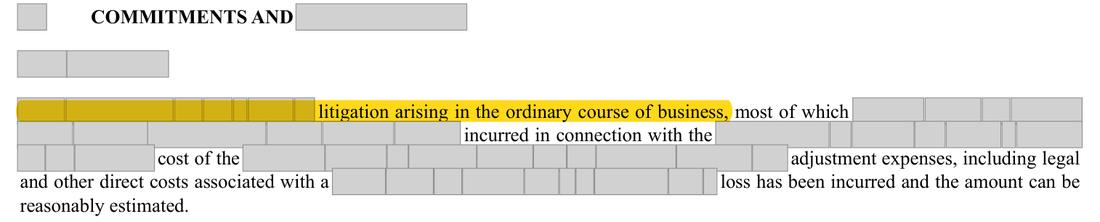
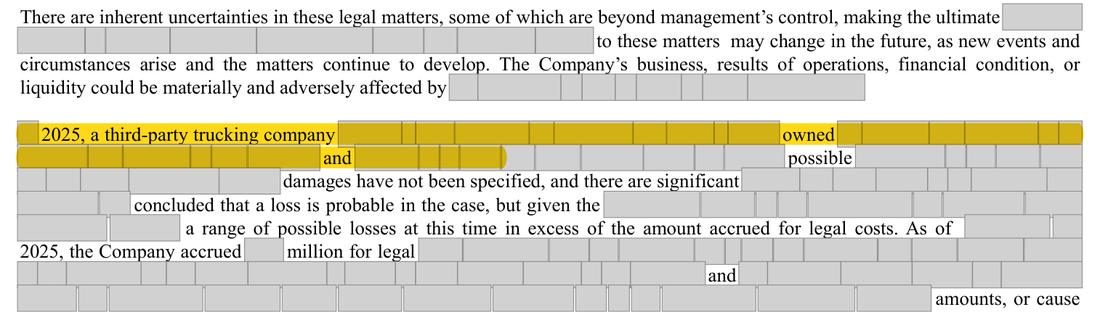
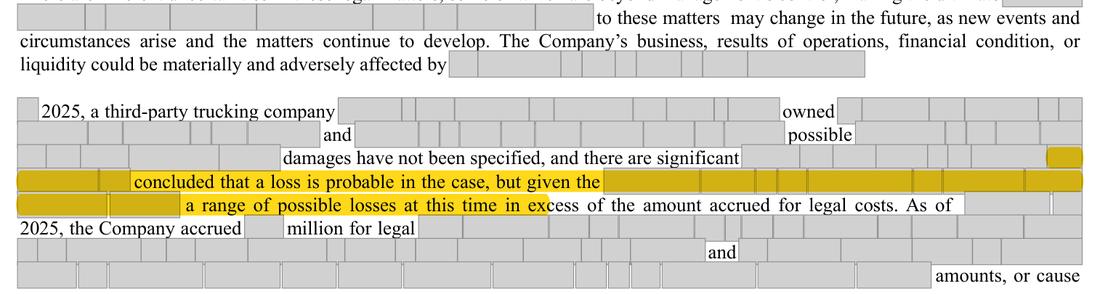
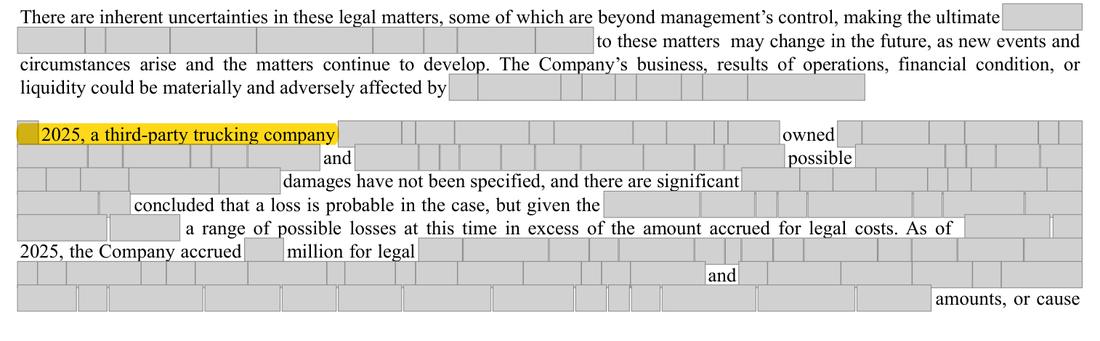
2 further page extracts: screenshot withheld to protect the company’s identity. The rows below say what each shows.
What the filing shows, and what the rule requires
| What the filing shows | What the rule requires |
|---|---|
Loss described as probable; no amount or range estimated; [amount] accrued for legal costs only; no court, filing date, parties or relief; no statement of the retention or insurance cover that applies to this claim. | Either an accrual of the best estimate, or of the minimum of a range, with any insurance recovery shown separately; or a fuller explanation of why no amount within a range can be estimated. If the matter is material, the court, the date instituted, the principal parties, the factual basis and the relief sought. |
The rule
Regulation S-K Item 103(a) (legal proceedings: particulars of material pending proceedings; cross-reference permitted)
Include the name of the court or agency in which the proceedings are pending, the date instituted, the principal parties thereto, a description of the factual basis alleged to underlie the proceedings and the relief sought.
Version: In force from [date] · Source: Regulation S-K, 17 CFR 229.103(a), as amended by Release 33-10825
FASB ASC paragraphs 450-20-25-2 and 450-20-50-1 to 50-5 (loss contingencies: accrual and disclosure)
Summary; FASB/IFRS text is copyrighted Accrue probable, estimable losses; for reasonably possible losses disclose nature and an estimate of possible loss or range, or state that none can be made.
Version: Text in force at the date of this review · Source: FASB Accounting Standards Codification, ASC 450-20 (paraphrase; originally FASB Statement No. 5)
Why it applies here. a probable loss with nothing accrued for the claim itself is an unusual combination; it is defensible only if not even a minimum is estimable, and the note does not say what retention or insurance applies, so a reader cannot judge the Company's own exposure.
Why it matters
Contingencies are a frequent staff comment theme, and the staff commonly questions a 'probable but not estimable' conclusion, asks whether a minimum should be accrued, and asks for the Item 103 particulars when a matter is singled out.
Exposure
A question for management; no penalty attaches. If an amount was estimable at the filing date, the outcome would be an accrual and fuller disclosure, in a later period or by amendment if material.
Our workings
Note 16 describes one specific matter: an accident in 2025 involving a third-party carrier [wording masked] [subsidiary] [wording masked] [related company], with fatalities. The Company has concluded that a loss is probable, says it cannot reasonably estimate a range in excess of legal costs, and has accrued [amount] for legal costs only. Item 3 incorporates Note 16 by reference. The 2025 note no longer calls the Company's litigation 'ordinary, routine', as the 2024 note did. Architecture: under ASC paragraph 450-20-25-2 a loss is accrued when it is probable and reasonably estimable; under ASC paragraph 450-20-30-1, where a range can be estimated and no amount in it is better than another, the minimum is accrued; under ASC paragraphs 450-20-50-3 and 50-4, where no accrual is made because the loss cannot be estimated, the nature of the contingency is disclosed with a statement that no estimate can be made, which the note does. A liability to claimants and a recovery from insurers are recognized separately, not netted. Item 103(a) of Regulation S-K asks, for a material pending proceeding that is not ordinary routine litigation incidental to the business, for the court, the date instituted, the principal parties, the factual basis and the relief sought; a cross-reference to a note is allowed only if the note carries those particulars. Grey area: the case is at an early stage with several possible defendants and unspecified damages, and the risk factors explain that federal courts are divided on whether federal law pre-empts personal-injury claims against freight brokers.
Management’s best defense, and our reply
Management would say the case is at a very early stage: several defendants, damages not specified, and a live question whether federal law pre-empts negligent-selection claims against a freight broker, which the risk factors explain courts have decided differently. On that footing no amount within a range is reasonably estimable, the note already says so in the form the standard requires, and personal-injury claims from freight transportation are the ordinary routine litigation that Item 103 excludes. However, the Company has itself concluded that the loss is probable and singled the matter out, which takes it out of the routine category, and the later quarterly reports show that the retention for this claim and the insurance recoveries could be quantified, so the reader is entitled to know the Company's own exposure.
The fix
- State the court, the filing date, the principal parties and the relief sought (or say why the matter is routine), the retention and cover that apply, and either accrue the minimum of the range with any insurance recovery shown separately or explain in more detail why no amount can be estimated.
Question for the company
At the filing date, what was the basis for concluding that a loss is probable but that no amount within a range, including a minimum, could be estimated? What retention and coverage limits apply to this claim, and was any insurance recovery recognized separately? Does management regard the matter as material for Item 103, so that the court, filing date, parties and relief sought should be given?
Evidence relied on
| # | What it shows | Type | Where |
|---|---|---|---|
| 1 | Item 3 relies on Note 16 for the legal proceedings disclosure | Document | Form 10-K 2025, page 25 |
| 2 | the 2025 note no longer calls the litigation 'ordinary, routine' | Document | Form 10-K 2025, unnumbered page |
| 3 | the matter singled out, with no court, date, parties or relief | Document | Form 10-K 2025, unnumbered page |
| 4 | loss probable, no range estimated | Document | Form 10-K 2025, unnumbered page |
| 5 | only legal costs accrued | Document | Form 10-K 2025, unnumbered page |
| 6 | the legal uncertainty management would rely on | Document | Form 10-K 2025, unnumbered page |
Absence check
- Document
- Form 10-K 2025
- Where it would appear
- In 2025, a third-party trucking company
- What is missing
- the court, the date instituted, the principal parties and the relief sought, and the retention or insurance cover that applies to this claim
- Pages looked at
- p.25 (Item 3), 134-135 (Note 16, page images), [n] (insurance program), [n] and [n] (risk factors)
- Result
- None of the terms appears anywhere in the report.
Prepared by Pramanex from the company’s public SEC filings, without the company’s involvement, to show how a 10-K Pre-filing Check reads. The company is not named, and nothing on this page is a statement about any identifiable company. Observations are not an audit, review or other attestation or assurance engagement, and not legal advice. An SEC-style question is a question, not a conclusion.
Want this on your own 10-K, before you file?
Start with three free findings on your latest 10-K, or book a fixed-price 10-K Pre-filing Check.
Your next 10-K will be in draft before the audit is done.
Have it read before you file.
Start with three free findings on your latest 10-K, or book a fixed-price 10-K check. Drafts only under NDA, inside your insider trading policy.