1.02 The [acquisition 4] earn-out is described without its range of outcomes, its maximum, or a statement that no range can be given
Company B · a US-listed transportation and logistics company · Compliance or disclosure gap
In brief
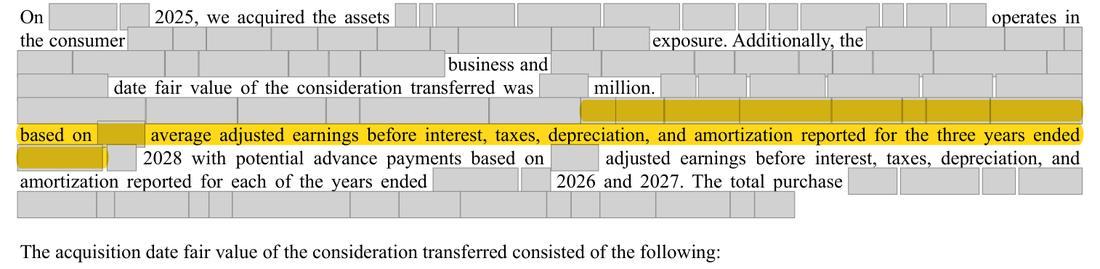
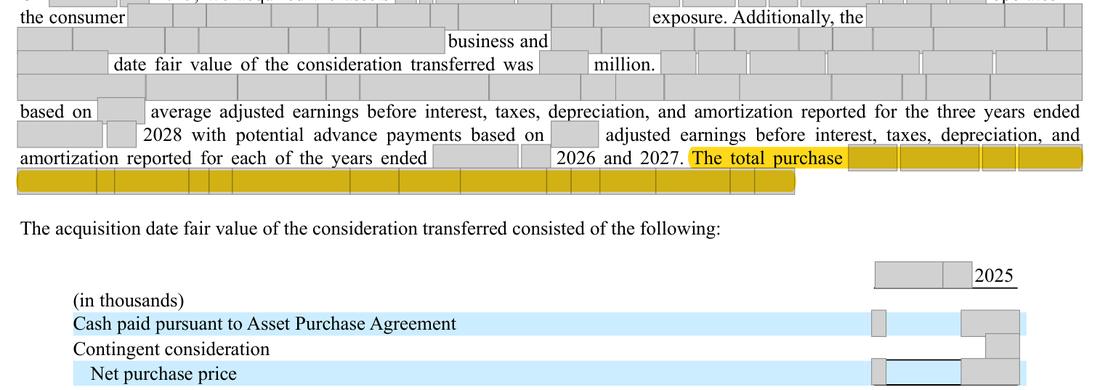
The [date] [acquisition 4] acquisition includes an earn-out based on [acquisition 4]'s average adjusted earnings before interest, taxes, depreciation and amortization (EBITDA) for the three years to 2028, recognized at [n] (thousand dollars). The note says only that the total price, including any earn-out, is expected to be about [amount]. Unlike the other three earn-outs in the same report, it gives no maximum, no undiscounted range of outcomes and no statement that a range cannot be estimated.
The evidence, as filed
1 further page extract: screenshot withheld to protect the company’s identity. The rows below say what each shows.
What the filing shows, and what the rule requires
| What the filing shows | What the rule requires |
|---|---|
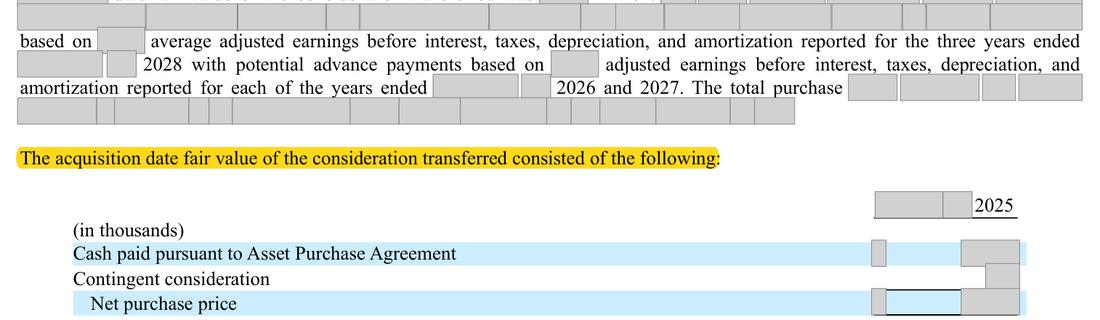
Note 6: earn-out based on average adjusted EBITDA for the three years ended [date], with possible advance payments; contingent consideration [n]; total purchase price 'expected to be approximately [amount]'. No cap, range or 'cannot be estimated' statement; Note 3 refers back to Note 6. | The undiscounted range of possible earn-out payments (for example 'nil to $x million'), or that the payment is uncapped, or that a range cannot be estimated and why. |
The rule
FASB ASC 805-30-50-1(c) (contingent consideration: amount recognized, description and basis, undiscounted range of outcomes)
Summary; FASB/IFRS text is copyrighted Purchase-price allocation table, contingent consideration (fair value and range), acquired intangibles by class and lives, qualitative goodwill factors and tax-deductible goodwill.
Version: Text in force at the date of this review · Source: FASB Accounting Standards Codification, ASC 805-10-50-2 and 805-30-50-1; paraphrased summary
Why it applies here. The amount recognized and the basis of payment are given; the range element is not. An expected total is in substance the recognized fair value, not a range.
Why it matters
- Readers cannot tell how much more the company may pay for [acquisition 4] through 2028, or how sensitive future earnings are to remeasuring the earn-out.
- The SEC staff could ask for the range and an undertaking for future filings.
How often the SEC staff raises this. In 1,100 SEC staff comment letters on fiscal 2023 and 2024 Forms 10-K, released January 2025 to October 2026, business combinations and consolidation drew 62 of the 1,774 numbered comments (3.5%): topic 9 of 25 by frequency.
Exposure
No fixed penalty; a staff comment asking for the range and a future-filings undertaking is the realistic consequence.
Our workings
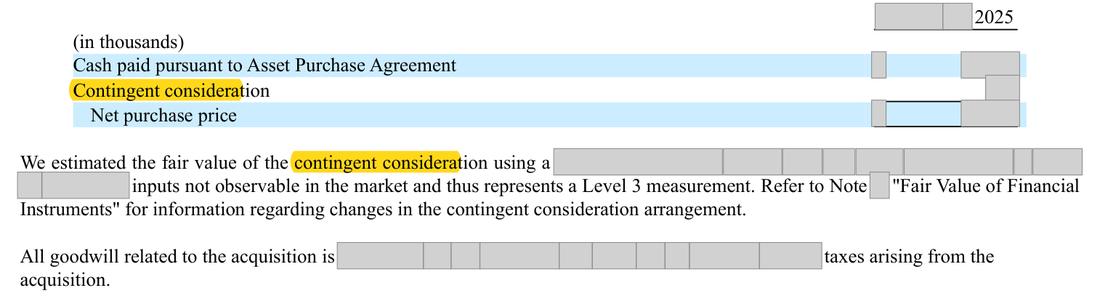
Note 6 describes the [acquisition 4] earn-out formula and recognizes contingent consideration of [n] within a net purchase price of [n] (unnumbered page). The only quantity given for the future payment is the expected total purchase price of approximately [amount]. Note 3 lists the caps of the other arrangements - up to [amount] ([acquisition 2]), [amount] ([acquisition 3]) and [amount] (the [date] asset purchase) - but for [acquisition 4] says only that it 'requires us to pay additional consideration to the sellers as described in Note 6' (unnumbered page).
the business combinations disclosure paragraph 805-30-50-1(c) asks, for each contingent consideration arrangement, for the amount recognized at the acquisition date, a description of the arrangement and the basis for the payment, and an estimate of the range of outcomes (undiscounted) - or, if no range can be estimated, that fact and the reasons, and if the maximum is unlimited, that fact. The first two elements are given; the third is not. An expected value is not a range: it equals, in substance, the recognized fair value and says nothing about the exposure if [acquisition 4] performs well. The company's own practice for [acquisition 3] and [acquisition 2] (a cap plus a 'total purchase price is expected to range from ... to ...' sentence) shows the form the disclosure should take.
| Element | Arithmetic (USD thousand) |
|---|---|
| [acquisition 4] consideration at acquisition | [n] + [n] = [n] |
| Earn-out caps given for the other arrangements (USD million) | [n] ([acquisition 2]), [n] ([acquisition 3]), [n] (asset purchase); [acquisition 4]: none |
Management’s best defense, and our reply
The amount recognized for the [acquisition 4] earn-out is small, and the sentence that the total price is expected to be about [amount] tells readers that management expects to pay very little beyond what has been paid; the formula is an average over three years, so a single maximum may be hard to state. On that reading a full range would add little information. However, the paragraph requires the range of outcomes - or the statement that it cannot be estimated, or that the maximum is unlimited - precisely because the expected value can be small while the exposure is not; the company states caps for all its other earn-outs, so the contract terms are known, and the omission cannot be cured by an expectation.
The fix
- Add to Note 6: 'The earn-out payable under the Asset Purchase Agreement ranges from nil to $x million (undiscounted), including any advance payments for 2026 and 2027', or, if uncapped, 'There is no maximum on the earn-out payment', and repeat the cap in Note 3.
Evidence relied on
| # | What it shows | Type | Where |
|---|---|---|---|
| 1 | The [acquisition 4] earn-out exists and its basis is described | Document | Form 10-K 2025, unnumbered page |
| 2 | Only an expected total is given - no cap or range | Document | Form 10-K 2025, unnumbered page |
| 3 | Amount recognized for the earn-out at the acquisition date | Document | Form 10-K 2025, unnumbered page |
| 4 | Note 3 gives caps for the other earn-outs but defers [acquisition 4] to Note 6 | Document | Form 10-K 2025, unnumbered page |
| 5 | Cap stated for the [acquisition 3] earn-out | Document | Form 10-K 2025, unnumbered page |
| 6 | Cap stated for the [date] asset purchase earn-out | Document | Form 10-K 2025, unnumbered page |
| 7 | The company's own form for another earn-out: a range is given | Document | Form 10-K 2025, unnumbered page |
Absence check
- Document
- Form 10-K 2025
- Where it would appear
- The acquisition date fair value of the consideration transferred consisted of the following
- What is missing
- The undiscounted range of outcomes (or maximum) for the [acquisition 4] earn-out, or a statement that a range cannot be estimated and why
- Pages looked at
- p.113-66 (Note 3), p.117-119 (Note 6), unnumbered page (Note 9), p.34-38 and [n] (MD&A)
- Result
- 'earnout' hits p.118-120: [acquisition 4] without an amount, [acquisition 3] and [acquisition 2] with caps; 'up to $' hits unnumbered page for the [acquisition 1], [acquisition 2], [acquisition 3] and asset-purchase caps (none for [acquisition 4]), p.71 for the credit facility accordion, p.78 for the repurchase authorization and p.24 and [n] in MD&A on financing and repurchases; 'range from' hits p.119-120 ([acquisition 3] and [acquisition 2] ranges) and p.21, [n] and [n] on truck weights and salvage values; 'maximum' hits p.24, [n] and [n] on truck speed, the incentive plan award cap and the [n](k) plan; 'cannot be estimated' and 'unlimited' have no hits.
Prepared by Pramanex from the company’s public SEC filings, without the company’s involvement, to show how a 10-K Pre-filing Check reads. The company is not named, and nothing on this page is a statement about any identifiable company. Observations are not an audit, review or other attestation or assurance engagement, and not legal advice. An SEC-style question is a question, not a conclusion.
Want this on your own 10-K, before you file?
Start with three free findings on your latest 10-K, or book a fixed-price 10-K Pre-filing Check.
Your next 10-K will be in draft before the audit is done.
Have it read before you file.
Start with three free findings on your latest 10-K, or book a fixed-price 10-K check. Drafts only under NDA, inside your insider trading policy.