7.08 Item 9A paraphrases the disclosure controls definition only in part and cites the wrong paragraph of Rule 13a-15 for the quarterly change evaluation
Company A · a US-listed consumer leisure company · Drafting slip
In brief
The disclosure controls conclusion restates the definition in Rule 13a-15(e) but stops short: it says information is accumulated and communicated to management, without the rule's closing words 'including its principal executive and principal financial officers ... as appropriate to allow timely decisions regarding required disclosure'. Paragraph (d) says the evaluation of changes in internal control over financial reporting (ICFR) is 'required by Rule 13a-15(b)'; the quarterly change evaluation is required by Rule 13a-15(d), the paragraph Item 308(c) names. The prior-year 10-K used the same words.
The evidence, as filed
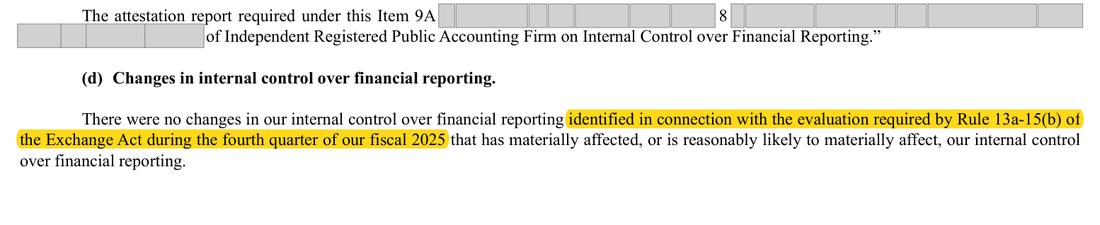
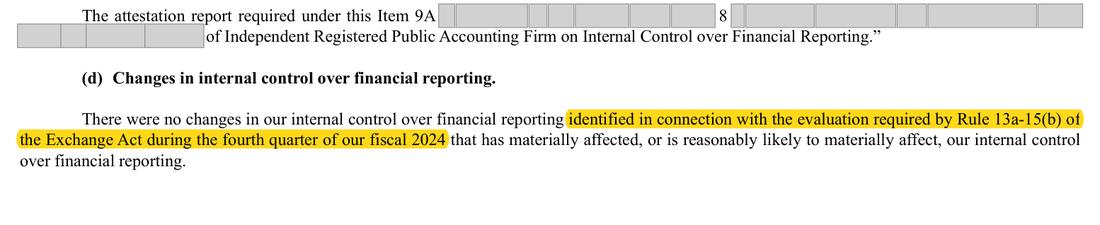
1 further page extract: screenshot withheld to protect the company’s identity. The rows below say what each shows.
What the filing shows, and what the rule requires
| What the filing shows | What the rule requires |
|---|---|
Item 9A(a): 'effective to ensure that information required to be disclosed ... is accumulated and communicated to our management and recorded, processed, summarized and reported within the time periods specified'; Item 9A(d): 'the evaluation required by Rule 13a-15(b)'. | Either a plain conclusion that disclosure controls and procedures are effective, or the full definition including '... including our principal executive and principal financial officers, as appropriate to allow timely decisions regarding required disclosure'; and in (d) 'the evaluation required by Rule 13a-15(d)'. |
The rule
Exchange Act Rule 13a-15(e)
Disclosure controls and procedures include, without limitation, controls and procedures designed to ensure that information required to be disclosed by an issuer in the reports that it files or submits under the Act is accumulated and communicated to the issuer's management, including its principal executive and principal financial officers, or persons performing similar functions, as appropriate to allow timely decisions regarding required disclosure.
Version: Text in force at the date of this review · Source: 17 CFR 240.13a-15(e), as amended
Regulation S-K Item 308(c)
Disclose any change in the registrant's internal control over financial reporting identified in connection with the evaluation required by paragraph (d) of § 240.13a-15 or 240.15d-15 of this chapter
Version: Text in force at the date of this review · Source: 17 CFR 229.308(c), as amended
Why it applies here. when a filer restates the definition, the conclusion should track it in full, or simply state that the controls are effective; the SEC staff has long asked filers to do one or the other. Both slips are wording, not a defect in the controls.
Why it matters
A conclusion tied to a partial definition can be read as narrower than the rule; the staff routinely asks filers to revise such wording in future filings.
Exposure
Wording only; the conclusion on effectiveness is given.
Our workings
Item 9A(a) concludes that disclosure controls are effective and then paraphrases what they ensure, ending at 'within the time periods specified in Securities and Exchange Commission rules and forms'. Rule 13a-15(e) defines disclosure controls to include controls designed so that information is communicated to management, including the principal executive and principal financial officers, as appropriate to allow timely decisions regarding required disclosure.
Item 9A(d) refers to the evaluation required by Rule 13a-15(b). Rule 13a-15(b) is the evaluation of disclosure controls; Rule 13a-15(d) is the evaluation of changes in ICFR during each quarter, and Item 308(c) asks for changes identified in that paragraph (d) evaluation.
Management’s best defense, and our reply
The conclusion is unqualified and the paraphrase covers both limbs of the definition, recording and reporting on time and communication to management; the principal officers are part of management. The citation in paragraph (d) is a long-standing form of words that no reader would misunderstand, and the staff completed a review of this 10-K in [date] without raising Item 9A. However, the rule's words on timely decisions are what give the conclusion its meaning, and the paragraph cited is simply the wrong one; both are one-line corrections.
The fix
- Item 9A(a): end the sentence at '... are effective.' or add '... and is accumulated and communicated to our management, including our principal executive and principal financial officers, as appropriate to allow timely decisions regarding required disclosure.'; Item 9A(d): change 'Rule 13a-15(b)' to 'Rule 13a-15(d)'.
Evidence relied on
| # | What it shows | Type | Where |
|---|---|---|---|
| 1 | The definition is restated without its closing words on the principal officers and timely decisions | Document | Form 10-K 2025, page 85 |
| 2 | Item 9A(d) cites Rule 13a-15(b) instead of 13a-15(d) | Document | Form 10-K 2025, page 85 |
| 3 | The prior-year 10-K used the same citation (and the same partial definition) | Document | Form 10-K 2024 (prior year), page 84 |
Prepared by Pramanex from the company’s public SEC filings, without the company’s involvement, to show how a 10-K Pre-filing Check reads. The company is not named, and nothing on this page is a statement about any identifiable company. Observations are not an audit, review or other attestation or assurance engagement, and not legal advice. An SEC-style question is a question, not a conclusion.
Want this on your own 10-K, before you file?
Start with three free findings on your latest 10-K, or book a fixed-price 10-K Pre-filing Check.
Your next 10-K will be in draft before the audit is done.
Have it read before you file.
Start with three free findings on your latest 10-K, or book a fixed-price 10-K check. Drafts only under NDA, inside your insider trading policy.