7.07 Taxes-paid jurisdiction table shows three amounts that its own 5 percent threshold would exclude
Company A · a US-listed consumer leisure company · Drafting slip
In brief
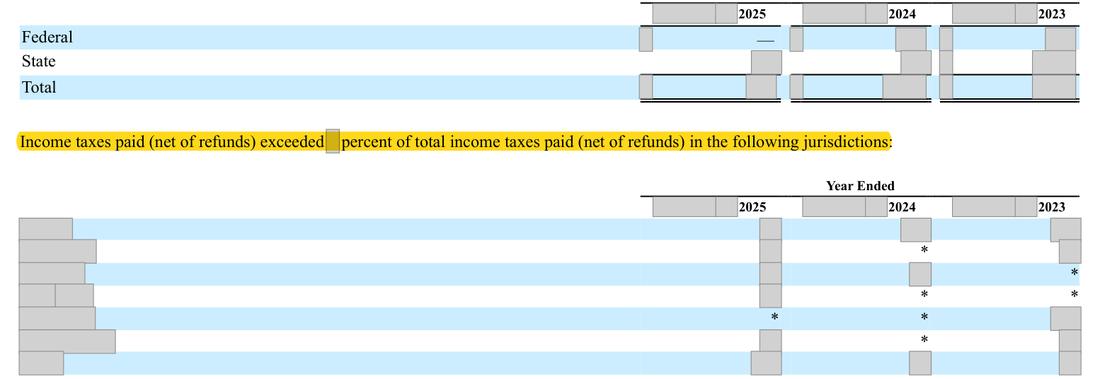
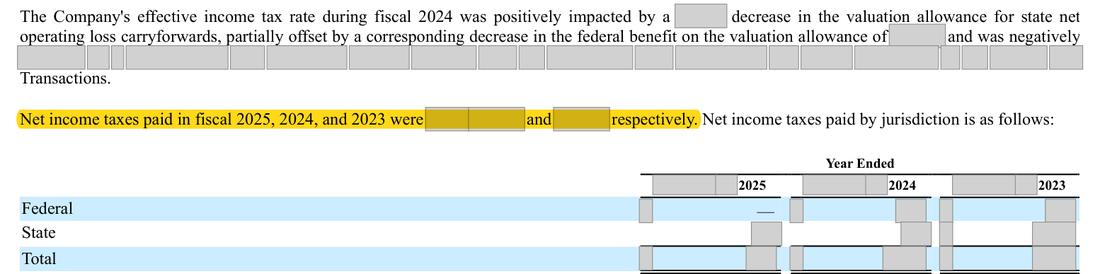
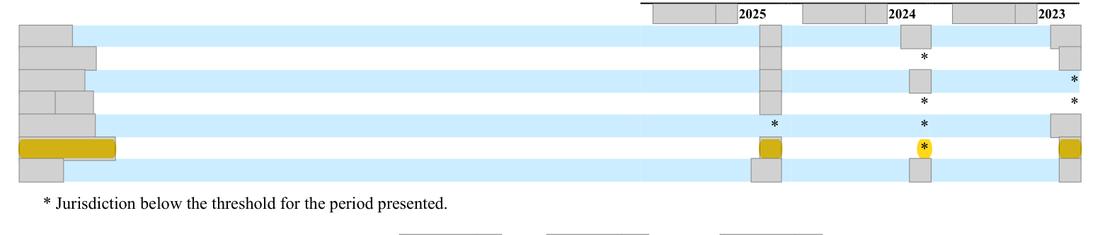
The income tax note lists the jurisdictions where income taxes paid exceeded 5 percent of total income taxes paid, and marks the others with an asterisk. Three cells show amounts although they are below that threshold: [state] [n] against total taxes paid of [n] in fiscal 2024, and [state] [n] and [state] [n] against [n] in fiscal 2023. The cells appear to have been tested against state taxes paid ([n] and [n]), not against total taxes paid as the heading says.
The evidence, as filed

1 further page extract: screenshot withheld to protect the company’s identity. The rows below say what each shows.
What the filing shows, and what the rule requires
| What the filing shows | What the rule requires |
|---|---|
Heading: jurisdictions whose taxes paid exceeded 5 percent of total income taxes paid; [state] [n] (fiscal 2024, total [n]) and [state] [n] and [state] [n] (fiscal 2023, total [n]) are shown with amounts instead of the asterisk. | Either the asterisk for those three cells, or a heading that names the basis actually applied (for example 5 percent of state income taxes paid). |
Why it matters
A reader applying the stated threshold cannot see why these three states are shown while others are not; no amount is misstated.
Exposure
Presentation only; over-disclosure of jurisdictions is not a breach of the income tax disclosure requirements.
Our workings
the heading on the taxes-paid table says the jurisdictions shown are those where taxes paid exceeded 5 percent of total income taxes paid, and the legend says an asterisk marks a jurisdiction below the threshold.
total taxes paid were [n] in fiscal 2024 and [n] in fiscal 2023; [state] [n], [state] [n] and [state] [n] are shown with amounts.
each of those amounts is below 5 percent of the total for its year, while [state] in fiscal 2024 carries the asterisk, so the table applies two different bases; the amounts shown are consistent with a test against state taxes paid of [n] and [n]. Showing more jurisdictions than the standard requires is not a breach; the slip is that the heading and legend describe a basis the table does not follow.
Management’s best defense, and our reply
Showing more jurisdictions than the standard requires is permitted and gives readers more information, not less. The company may have chosen a stricter threshold on purpose. However, the heading and asterisk legend tell the reader that every amount shown passed the stated 5 percent-of-total test, which three cells do not; the fix is only to align the words with the basis used.
The fix
- Replace the three amounts with the asterisk, or reword the heading to the basis applied, e.g. 'Income taxes paid (net of refunds) exceeded 5 percent of state income taxes paid'.
Evidence relied on
| # | What it shows | Type | Where |
|---|---|---|---|
| 1 | The heading states the basis: 5 percent of total income taxes paid | Document | Form 10-K 2025, page 80 |
| 2 | State taxes paid [n] (fiscal 2024) and [n] (fiscal 2023) | Document | Form 10-K 2025, page 80 |
| 3 | Total taxes paid [n] (fiscal 2024) and [n] (fiscal 2023), the base the heading names | Document | Form 10-K 2025, page 80 |
| 4 | [state] shown at [n] for fiscal 2024 | Document | Form 10-K 2025, page 80 |
| 5 | [state] shown at [n] for fiscal 2023 | Document | Form 10-K 2025, page 80 |
| 6 | [state] shown at [n] for fiscal 2023 | Document | Form 10-K 2025, page 80 |
| 7 | Legend: an asterisk marks a jurisdiction below the threshold | Document | Form 10-K 2025, page 80 |
Prepared by Pramanex from the company’s public SEC filings, without the company’s involvement, to show how a 10-K Pre-filing Check reads. The company is not named, and nothing on this page is a statement about any identifiable company. Observations are not an audit, review or other attestation or assurance engagement, and not legal advice. An SEC-style question is a question, not a conclusion.
Want this on your own 10-K, before you file?
Start with three free findings on your latest 10-K, or book a fixed-price 10-K Pre-filing Check.
Your next 10-K will be in draft before the audit is done.
Have it read before you file.
Start with three free findings on your latest 10-K, or book a fixed-price 10-K check. Drafts only under NDA, inside your insider trading policy.