4.05 The critical accounting estimate for venue asset impairment names its key assumption but gives no quantitative sensitivity
Company A · a US-listed consumer leisure company · SEC-style question
In brief
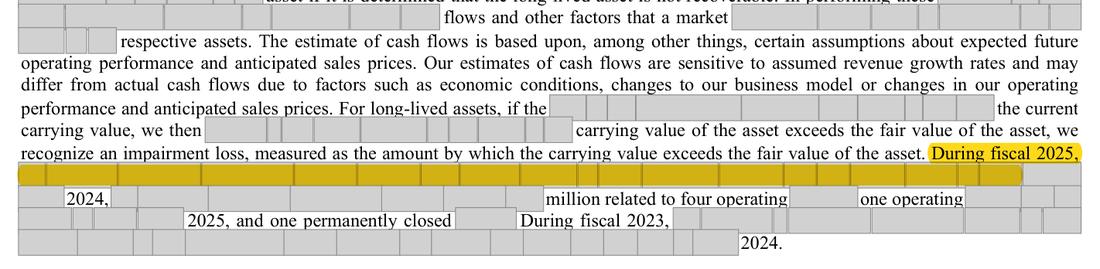
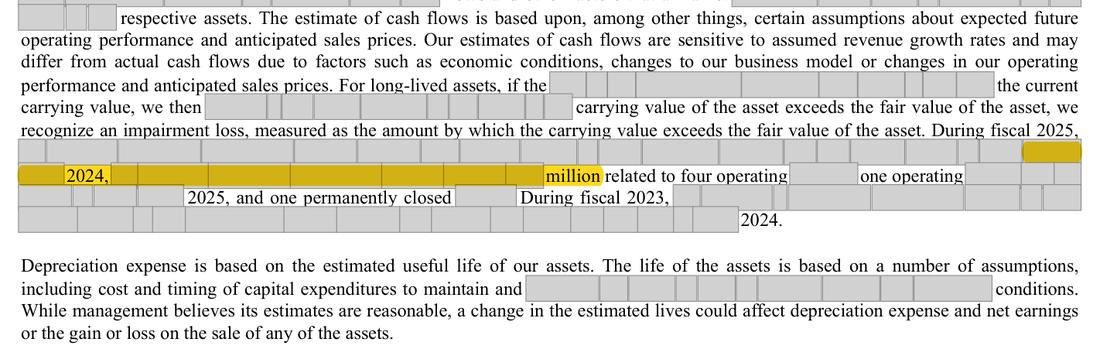
The critical accounting estimate for long-lived assets says the cash-flow estimates 'are sensitive to assumed revenue growth rates' and lists the charges ([amount] in fiscal 2025 for eight operating venues and one land parcel; [amount] in fiscal 2024). It gives no figure for how sensitive the estimate is, and the auditor reports venue impairment as its critical audit matter. Item 303(b)(3) of Regulation S-K asks for quantitative information on estimation uncertainty to the extent it is material and reasonably available, so the question is whether such information exists.
The evidence, as filed
4 further page extracts: screenshot withheld to protect the company’s identity. The rows below say what each shows.
What the filing shows, and what the rule requires
| What the filing shows | What the rule requires |
|---|---|
Qualitative description of the impairment method and of the revenue-growth assumption, plus the [amounts] charges; no sensitivity, headroom or range. | Where material and reasonably available: the sensitivity of the venue impairment estimate to its key assumption (for example the effect of a lower revenue growth rate), or the carrying amount of venue asset groups whose cash flows exceed carrying value by only a small margin. |
The rule
Regulation S-K Item 303(b)(3) (critical accounting estimates)
Provide qualitative and quantitative information necessary to understand the estimation uncertainty and the impact the critical accounting estimate has had or is reasonably likely to have on financial condition or results of operations to the extent the information is material and reasonably available.
Version: Text in force at the date of this review · Source: 17 CFR 229.303(b)(3), Regulation S-K Item 303 (eCFR, as amended to 2026)
Why it applies here. an estimate that produced charges in each of the last three years, that is large against pre-tax income and that the auditor treats as its most judgemental area is the kind of estimate for which Item 303(b)(3) expects quantitative sensitivity. The rule limits the requirement to information that is material and reasonably available, and only the company knows whether its venue-by-venue models can produce it; that is why this is a question rather than a finding.
Why it matters
The venue impairment estimate is a frequent subject of staff comments on critical accounting estimates; a comment would ask for sensitivity disclosure in future filings.
Exposure
A question for management; a staff comment, if any, would ask for added disclosure in future filings.
Our workings
the estimate on p.48 explains the two-step test (undiscounted cash flows, then fair value), names revenue growth as the assumption the cash flows are sensitive to, and lists charges of [amount] (fiscal 2025) and [amount] (fiscal 2024). The auditor's report (p.52) identifies impairment of the venues segment property and equipment and right-of-use assets as the critical audit matter (CAM), because of the subjectivity of the forecast cash flows. The prior-year 10-K used the same text.
the fiscal 2025 charge is 59.7% of pre-tax income (workings).
| Item | Figure | Where |
|---|---|---|
| Impairment charge fiscal 2025 ($ million) | [n] | critical accounting estimate, p.48 |
| Impairment charge fiscal 2024 ($ million) | [n] | critical accounting estimate, p.48 |
| Fiscal 2025 charge in thousands | [n] x [n] = [n] | |
| Charge against pre-tax income | [n] / [n] = 59.7% | pre-tax income [amount] |
Management’s best defense, and our reply
Item 303(b)(3) asks for quantitative information only to the extent it is material and reasonably available, and impairment is tested asset group by asset group across [n] venues, so a single sensitivity figure may mislead more than it informs. The estimate already explains why it is uncertain and shows three years of charges, which conveys how the estimate has moved; the staff reviewed this 10-K in [date] and made no comment on the critical accounting estimates.
The fix
- Add, for example: 'A 1 percentage point reduction in the assumed revenue growth rate would have increased the fiscal 2025 impairment charge by approximately $X million; Venue asset groups with a carrying value of $Y million had estimated undiscounted cash flows within 10% of their carrying value.'
Question for the company
Is quantitative information on the venue impairment estimate reasonably available from the venue-level models (for example the effect on the fiscal 2025 charge of a lower assumed revenue growth rate, or the carrying amount of venue asset groups whose estimated cash flows exceed carrying value by only a small margin), and if so will it be added to the critical accounting estimate?
Evidence relied on
| # | What it shows | Type | Where |
|---|---|---|---|
| 1 | The estimate names its key assumption but quantifies nothing | Document | Form 10-K 2025, page 48 |
| 2 | The fiscal 2025 charge the estimate produced | Document | Form 10-K 2025, page 48 |
| 3 | The fiscal 2024 charge: the estimate produced charges in consecutive years | Document | Form 10-K 2025, page 48 |
| 4 | The auditor treats venue asset impairment as its critical audit matter | Document | Form 10-K 2025, page 52 |
Absence check
- Document
- Form 10-K 2025
- Where it would appear
- Long-lived & Other Intangible Assets:
- What is missing
- any quantitative sensitivity, headroom or range for the venue impairment estimate
- Pages looked at
- p.47-49 (critical accounting estimates), p.51-52 (auditor's report), p.32 and [n] (impairment discussion in results)
- Result
- None of the terms hits anywhere in the 10-K; the nearest wording is 'sensitive to assumed revenue growth rates' on p.48, which names the assumption without quantifying it.
Prepared by Pramanex from the company’s public SEC filings, without the company’s involvement, to show how a 10-K Pre-filing Check reads. The company is not named, and nothing on this page is a statement about any identifiable company. Observations are not an audit, review or other attestation or assurance engagement, and not legal advice. An SEC-style question is a question, not a conclusion.
Want this on your own 10-K, before you file?
Start with three free findings on your latest 10-K, or book a fixed-price 10-K Pre-filing Check.
Your next 10-K will be in draft before the audit is done.
Have it read before you file.
Start with three free findings on your latest 10-K, or book a fixed-price 10-K check. Drafts only under NDA, inside your insider trading policy.